10 Best Time Management Tips Eat That Frog Productivity Guide by Brian Tracy
We have all been there: staring at a to-do list that feels more like a mountain than a plan. You have your coffee ready, your laptop is open, but instead of diving into that big project, you find yourself organizing your desktop icons or checking emails for the tenth time. This is the classic struggle of procrastination, and it is exactly what Brian Tracy tackles in his legendary productivity framework. Based on the iconic concept of Eating That Frog, this approach is not about working harder or putting in more hours. Instead, it is about developing the mental discipline to identify your most impactful task and attacking it before anything else can distract you. By the end of this guide, you will understand how to transform your daily routine from a chaotic scramble into a streamlined engine of success.
What Does It Actually Mean to Eat That Frog?
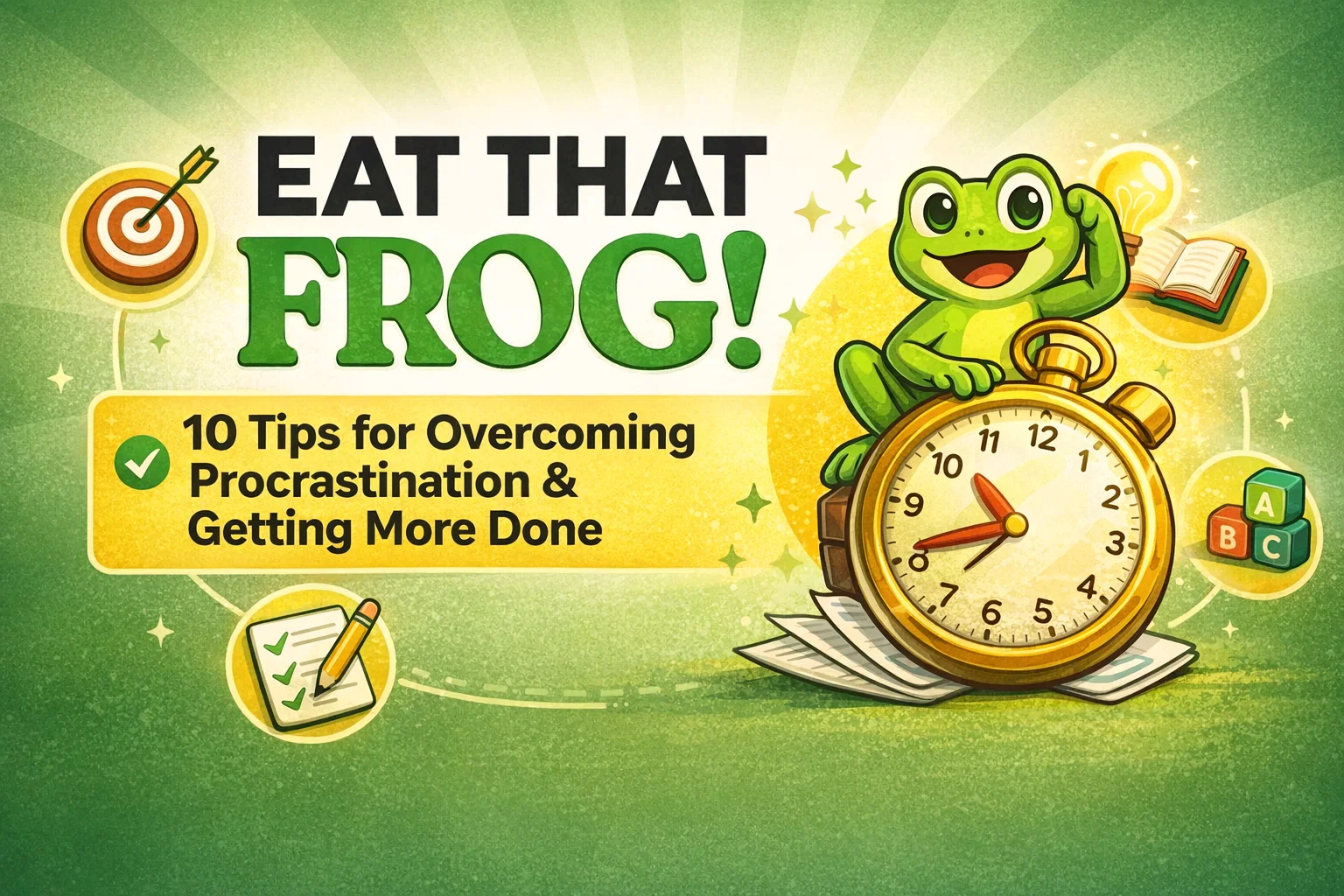
The phrase originates from a famous quote often attributed to Mark Twain: If it is your job to eat a frog, it is best to do it first thing in the morning. And If it is your job to eat two frogs, it is best to eat the big one first. In the world of productivity, the frog represents your biggest, most important task. This is the task you are most likely to procrastinate on because it requires the most effort, focus, and perhaps a bit of discomfort. However, it is also the task that has the greatest positive impact on your life or career.
Eating the frog means you stop making excuses and stop “cleaning the lily pad” around the frog. You simply take a bite. When you complete your most daunting task at the start of the day, you experience a massive surge of dopamine and a sense of accomplishment that carries you through the remaining hours. You are no longer haunted by the “big thing” hanging over your head, allowing you to handle smaller, administrative tasks with ease and clarity.
1. The Foundation: Setting Clear Goals
You cannot hit a target that you cannot see. The first step in the Tracy method is absolute clarity. Productivity is not just about being busy; it is about being effective. Many people spend their entire lives running in circles because they have never sat down to decide exactly what they want to achieve. Clarity is the foundation of success.
How to Define Your Moves
-
Write them down: There is a unique neurological connection between the hand and the brain when you write. Thoughts are fuzzy; ink is permanent.
Be specific: Instead of saying “I want to be successful,” say “I want to increase my monthly revenue by 20 percent by December.”
Review daily: Look at your goals every single morning. This aligns your subconscious mind with your daily actions.
2. Planning Every Day in Advance
Every minute spent in planning saves as many as ten minutes in execution. If you start your morning by wondering what you should do first, you have already lost the productivity battle. Your willpower is a finite resource, and using it to make basic decisions at 9:00 AM drains the energy you should be using to eat the frog.
The best time to plan your day is the night before. When you create a list before going to sleep, your subconscious mind works on those problems while you rest. You wake up with a sense of purpose and a pre-determined roadmap. Whether you use a digital calendar or a classic paper planner, the act of prioritizing your actions prevents distractions and wasted effort from creeping into your schedule.
3. Mastering the 80/20 Rule
The Pareto Principle, or the 80/20 Rule, is one of the most powerful concepts in time management. It states that 20 percent of your activities will account for 80 percent of your results. In a list of ten items, two of those items will be worth more than the other eight put together.
The trap most people fall into is the “tendency to clear up small things first.” They think that by knocking off five small, easy tasks, they are being productive. In reality, they are just avoiding the one high-value task that actually moves the needle. To be truly successful, you must resist the urge to clear up the small things and instead concentrate your energy on the vital few activities that produce the most significant results.
4. Considering the Long-Term Consequences
Highly productive people are future-oriented. They evaluate tasks not just by how urgent they feel in the moment, but by their long-term impact. A task is important if it has potential long-term consequences. For example, exercising for thirty minutes has positive long-term consequences for your health, even if it feels “less urgent” than answering a minor email.
When you are looking at your to-do list, ask yourself: If I do not do this task, what will happen in six months? If the answer is “nothing,” then it is not a priority. Tasks with the greatest positive consequences deserve your immediate and undivided attention. This shift in perspective helps you separate the “busy work” from the “life-changing work.”
5. Practicing the ABCDE Method
Ranking your tasks is essential for maintaining focus. The ABCDE Method is a simple prioritization technique that ensures you are always working on the right thing at the right time. Here is how it works:
-
A Tasks: Must do. These are tasks with serious consequences if not completed. These are your frogs.
B Tasks: Should do. These have mild consequences but are not as vital as A tasks. Never do a B task when an A task is left undone.
C Tasks: Nice to do. Getting coffee with a friend or checking social media falls here. There are no real consequences for missing these.
D Tasks: Delegate. These are things someone else can do so you can focus on your A tasks.
E Tasks: Eliminate. These are habits or tasks that add no value and should be cut from your life entirely.
6. Identifying Key Result Areas (KRAs)
Every job or project has a few key result areas that determine success. These are the core responsibilities that you were hired to perform or the essential functions of your business. If you fail in a key result area, you fail at the job, no matter how hard you work on other things.
Identify the five to seven results that are most critical for your role. Once you know what they are, spend the majority of your time working in those areas. Efficiency is doing things right, but effectiveness is doing the right things. Knowing your KRAs ensures that your hard work translates into tangible progress.
7. Applying the “Eat That Frog” Principle Every Morning
This is where the rubber meets the road. To “win the morning” is to “win the day.” Most people start their day by checking emails, looking at news, or scrolling through messages. This puts you in a “reactive” mode where you are responding to other people’s priorities instead of your own.
The rule is simple: Before you check your email, before you have your second coffee, and before you make any excuses, you must eat the frog. Tackle the hardest, most important task first. This builds incredible momentum. Once the biggest obstacle is out of the way, everything else feels easy by comparison. It creates a “success loop” that makes you more confident and energized for the rest of the afternoon.
8. Developing Self-Discipline and Consistency
Motivation is a feeling that comes and goes, but discipline is a habit that stays. You will not always feel like working on your goals. Some days you will be tired, bored, or distracted. This is where consistency beats motivation every time.
Discipline is the ability to make yourself do what you should do, when you should do it, whether you feel like it or not. By committing to daily routines and sticking to them, you train your brain to move past the resistance of procrastination. Success is not a single event; it is the result of small, disciplined actions taken over a long period.
9. Using Technology Wisely
Technology can be your greatest ally or your worst enemy. We live in an era of constant notifications, pings, and digital distractions that steal our focus from high-value tasks. To be productive, you must control your tools instead of letting them control you.
Set specific “focus time” blocks where your phone is in another room and your notifications are turned off. Avoid the temptation to multi-task, as research shows it actually lowers your IQ and slows you down. Use technology for its intended purpose: to automate repetitive tasks and help you organize information, but do not let social media or unnecessary meetings become a substitute for real work.
10. The Power of Continuous Learning
The more you know, the more you can do. Personal growth is a compounding interest for your career. If you want to get better at eating frogs, you need to sharpen your tools. This means investing in your skills, knowledge, and habits every single day.
Read books in your field, take online courses, and seek out mentors who have already achieved what you are aiming for. When you increase your competence, you naturally increase your confidence. Tasks that used to seem like “giant frogs” eventually become much smaller and easier to handle because you have the skills to manage them efficiently.
Conclusion: Your Move Toward a More Productive Life
Becoming highly productive is not a mystery or a secret reserved for a lucky few. It is a set of learned behaviors that anyone can master with practice. By setting clear goals, planning your days, and having the courage to eat your biggest frog first, you take back control of your time and your life. Remember that productivity is not about filling every second of the day with movement; it is about making sure that your movements are taking you in the right direction.
Start today by identifying your “A-1” task. Write it down, prepare your workspace, and resolve to tackle it first thing tomorrow morning. Once you experience the power of the Eat That Frog method, you will never want to go back to the old way of working. It is time to stop procrastinating and start achieving. Your future self will thank you for the discipline you show today.