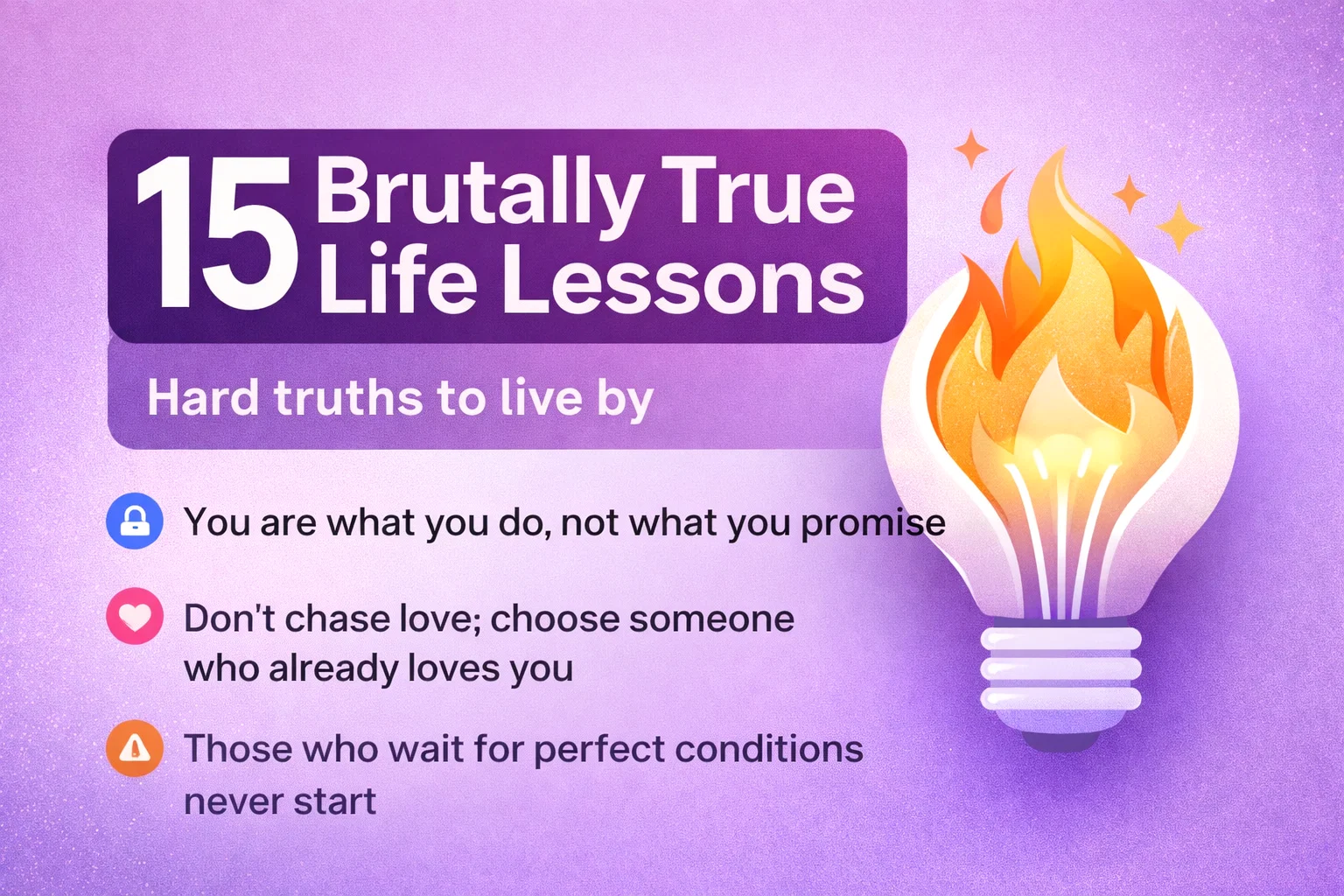
15 Brutally True Life Lessons for Personal Growth and Mental Clarity Wisdom Quotes
Life has a funny way of repeating its lessons until we finally decide to pay attention. Sometimes, those lessons are gentle nudges, but more often than not, they come as “brutal truths” that shake our foundation and force us to look in the mirror. We often spend our lives chasing external validation or waiting for the perfect moment to start our journey, only to realize that the most important growth happens in the quiet, uncomfortable moments of self-reflection. The following insights serve as a compass for anyone looking to navigate the complexities of modern existence with more grace, grit, and authenticity.
The Power of Action Over Promises
We live in a world of words. We make resolutions, we promise friends our support, and we tell ourselves that tomorrow is the day we finally start that project. However, the first brutal truth of life is that you are what you do, not what you promise. Your character is not built on your intentions; it is built on your consistent actions. People may listen to your words, but they will always believe your behavior.
When we align our actions with our values, we build self-trust. Every time you keep a promise to yourself, you are casting a vote for the person you wish to become. If you want to be seen as reliable, be reliable. If you want to be seen as kind, perform acts of kindness without expecting a spotlight. Transformation does not happen in the “planning” phase; it happens in the “doing” phase.
Understanding Value and Presence
It is a bittersweet reality that people often notice your value only when you are gone. This is not necessarily a reflection of your worth, but rather a commentary on human nature and the tendency to take consistency for granted. When you are always there, always performing, and always providing, your presence becomes the baseline. It is only when that presence is removed that the void is felt.
Protecting Your Energy
Knowing this, it becomes vital to protect your energy. You do not need to over-explain your worth to people who are determined to undervalue you. Instead, focus on being indispensable to yourself. When you cultivate a high sense of self-worth, the opinions of others become secondary. You begin to understand that your value is inherent, regardless of who is currently paying attention to it.
The Trap of Chasing Love
There is a romanticized notion in our culture about “the chase.” We are told that if we just try hard enough, or change ourselves enough, we can win over anyone. But one of the most liberating lessons you can learn is to stop chasing love. True connection should not feel like a marathon where you are constantly out of breath trying to catch up to someone who is running away.
Choose the person who already loves you. Choose the people who make space for you in their lives without you having to beg for a seat at the table. Love should be a mutual exchange of energy, not a one-sided pursuit. When you stop chasing the wrong people, you finally give the right people a chance to find you.
The Duality of the Peaceful Person
A common misconception is that peace equals weakness. In reality, a peaceful person can still be a fierce fighter. True peace is not the absence of conflict; it is the ability to maintain your center in the midst of it. It takes incredible strength to remain calm when the world is screaming, but that calmness provides the clarity needed to fight for what is right when the time comes.
Think of it like a seasoned martial artist. They do not look for a fight, and they carry themselves with a quiet humility. However, if pushed to defend their boundaries or protect the vulnerable, they possess a lethal precision. Being “harmless” is not a virtue; being capable of great force but choosing to keep it under control is the definition of true character.
The High Cost of Temporary Impulses
We have all seen it happen: a career built over decades destroyed by a single moment of greed, or a long-term relationship ruined by a fleeting moment of lust. A moment of anger, lust, or greed can ruin years of work. Our emotions are like waves; they are powerful and temporary. Our reputation and our legacy, however, are like the shoreline. They are built slowly over time but can be eroded quickly by a storm.
Building Emotional Intelligence
Developing the “pause” between an impulse and an action is the ultimate life hack. When you feel a surge of intense emotion, recognize it for what it is: a temporary chemical reaction in your brain. By waiting just ten minutes before responding to an insulting email or making a questionable choice, you save yourself from years of regret. Discipline is essentially the art of remembering what you want most over what you want right now.
The Cycle of Ignored Lessons
Have you ever noticed that you keep dating the same type of person or keep running into the same problems at every new job? Lessons ignored will keep coming back. The universe is a persistent teacher. It will present you with the same challenge in different disguises until you actually learn the underlying principle and change your behavior.
If you find yourself in a repetitive cycle of drama or failure, stop looking at the external factors and start looking for the common denominator. Usually, that denominator is you. Instead of asking “Why is this happening to me?”, ask “What is this trying to teach me?”. Once the lesson is learned, the cycle usually breaks on its own.
The Danger of the Wrong Path
The longer you stay on the wrong path, the harder it is to return. This applies to careers, habits, and relationships. There is a psychological phenomenon called the “Sunk Cost Fallacy,” where we continue to invest in something purely because we have already invested so much. We think, “I can’t quit this job I hate; I have been here for five years.”
But those five years are gone regardless. The question is: do you want to waste the next five years too? Admitting you were wrong or that a path is no longer serving you is not a sign of failure; it is a sign of intelligence. The sooner you pivot, the less distance you have to travel to get back to where you belong.
Starting Before You Are Ready
Those who wait for perfect conditions never start. If you are waiting for the “right time” to start a business, write a book, or get in shape, you will be waiting for the rest of your life. Perfectionism is often just procrastination in a fancy suit. It is a defense mechanism designed to keep us safe from the possibility of failure.
The secret to success is not having a perfect plan; it is having the courage to start with a messy one. You can iterate, pivot, and improve as you go. You cannot steer a parked car. Get the wheels moving, even if you are just coasting at first, and the momentum will eventually provide the clarity you are looking for.
Reclaiming Your Life from Fear
Fear is a natural survival instinct, but in the modern world, it often does more harm than good. Fear doesn’t stop death; it ruins life. When we live in a constant state of “what if,” we rob ourselves of the beauty of “what is.” We become so afraid of losing what we have or failing at what we want that we stop truly living.
Acknowledge your fears, but do not let them sit in the driver’s seat. Treat fear like a nervous passenger in your car. You can hear them, you can acknowledge their concerns, but your hands stay on the wheel. Life is inherently risky, but the greatest risk of all is reaching the end and realizing you never actually showed up for it.
The Environment of Healing
You can’t heal in the place that made you sick. This is a profound truth that applies to both physical and mental health. If you are trying to recover from burnout while staying in a toxic work environment, or trying to heal your self-esteem while staying with someone who belittles you, you are fighting an uphill battle.
Your environment acts as a container for your habits and your mindset. Sometimes, the most “spiritual” or “productive” thing you can do is pack your bags and move. Whether that means a physical move, a career change, or simply setting hard boundaries with certain people, you must create a safe space where healing is actually possible.
The Tragedy of Unused Potential
Nothing is worse than avoiding your full potential. Most people do not fail because they lack talent; they fail because they are afraid of the responsibility that comes with being great. Stepping into your potential requires you to leave your comfort zone, and the comfort zone is a very addictive place.
However, there is a specific kind of internal rot that happens when you know you are capable of more but settle for less. It leads to bitterness and resentment. Don’t let your “potential” become a haunting ghost of what could have been. Lean into the challenge, do the hard work, and see how far you can actually go.
Health as the Ultimate Currency
We often trade our health for wealth in our youth, only to spend all our wealth trying to regain our health in our old age. True wealth is good health. Without a functioning body and a clear mind, every other achievement is hollow. You can have millions in the bank, but if you cannot walk up a flight of stairs or enjoy a meal without pain, those millions matter very little.
Invest in your body now. Sleep, movement, and nutrition are not “luxury” items; they are the fundamental building blocks of a life well-lived. Treat your body like it is the only place you have to live, because it is.
The Value of Setbacks
Every failure is a data point. Save every setback; they will help build your future. When things go wrong, we often feel like we are falling behind. In reality, setbacks are often the very things that give us the perspective and the resilience needed for the next level of success. You learn more from a “no” than you ever do from a “yes.”
The Strength in Asking for Help
There is a toxic myth of the “self-made” individual who does everything alone. The truth is that nobody works harder than someone who refuses to ask for help. Independence is great, but hyper-independence is often a trauma response. By refusing to delegate or seek support, you hit a ceiling very quickly.
Asking for help is not a sign of weakness; it is a sign of efficiency. It shows that you value the goal more than your ego. When we collaborate, we combine our strengths and mitigate our weaknesses. Surround yourself with people who are smarter than you in different areas, and watch how much faster you progress.
Embracing the New Ending
Finally, remember that starting over can lead to a better story with a new ending. Many people stay in miserable situations because they are afraid of the “gap” between who they were and who they are becoming. They think that starting over means they have lost time. But you aren’t starting from scratch; you are starting from experience.
Whether you are 25 or 65, it is never too late to turn the page. The previous chapters of your life are not wasted; they are the foundation upon which the rest of your story is built. If the current plot isn’t working, pick up the pen and start writing a new one.
Life is not a destination to be reached, but a series of lessons to be integrated. By embracing these brutally true insights, we stop fighting against reality and start working with it. It isn’t always easy, and it certainly isn’t always comfortable, but it is the only way to build a life that feels as good on the inside as it might look on the outside. Take these truths, sit with them, and let them guide you toward a more intentional and fulfilling future.
Would you like me to generate a specific SEO meta description or a set of social media captions to go along with this blog post?