7 Types of Wealth You Need Beyond Money for a Balanced and Successful Life
Have you ever reached the end of a packed workweek, glanced at your (perhaps growing) bank account, and still felt a persistent sense of empty fatigue? Maybe your finances are on track, but your relationships are fraying, your health is a footnote, and you can’t remember the last time you did something purely for the joy of it. This all-too-common feeling highlights a profound truth: true wealth is far richer and more complex than just the money in your bank account.
For decades, we have been sold a singular vision of success, a relentless pursuit of financial accumulation as the ultimate metric of a well-lived life. We sacrifice sleep, skip family dinners, and put our mental health on the back burner, all in the name of professional advancement and financial gain. But a mountain of research—and our own internal barometers—suggests that this financial-first approach is fundamentally flawed and ultimately unsustainable.
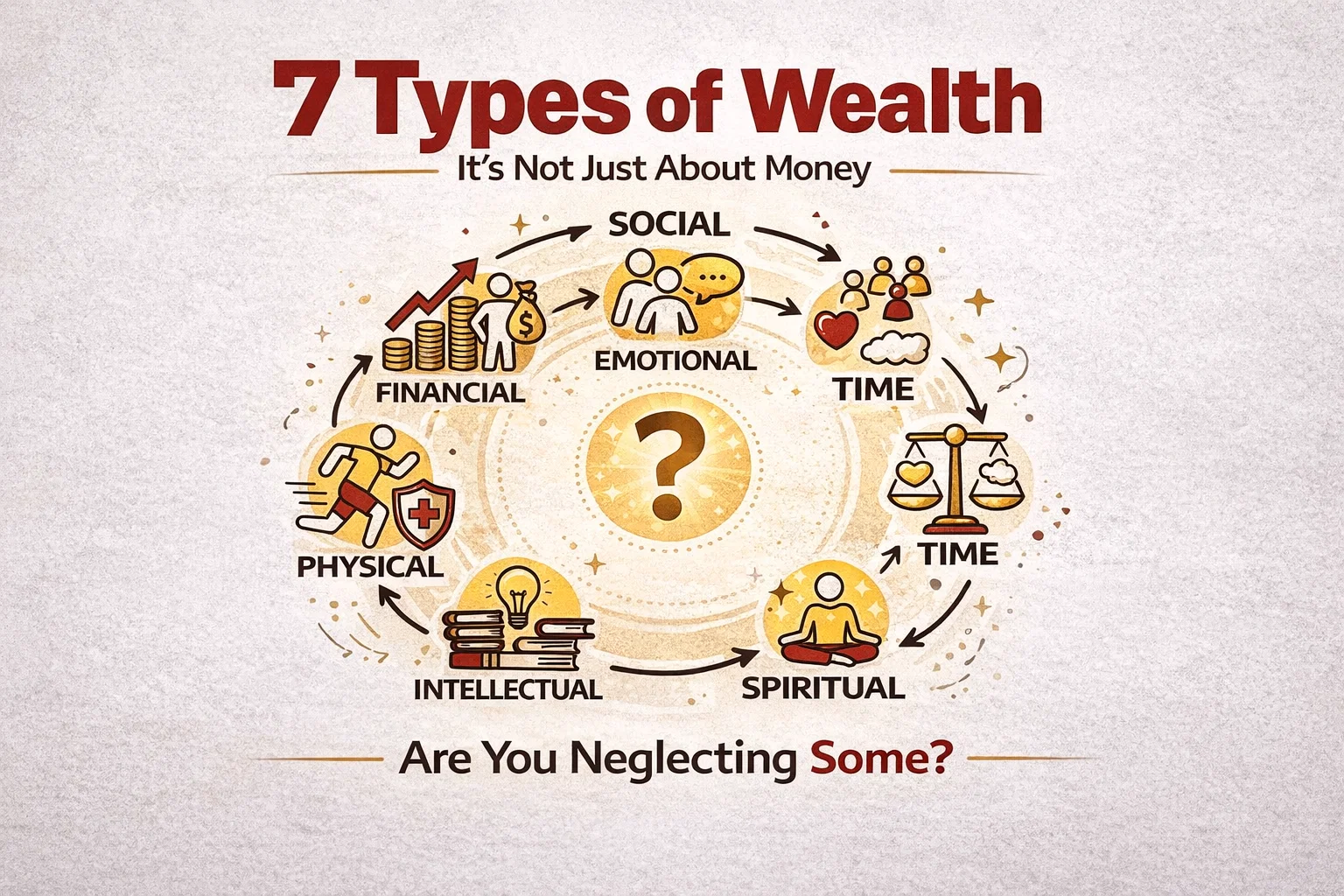
Real, sustainable, and satisfying wealth is multidimensional. It’s a holistic ecosystem of interconnected elements that, when properly cultivated, lead to a life of profound fulfillment, purpose, and joy. This infographic on the “7 Types of Wealth” isn’t just a clever list; it is a vital new blueprint for modern success, a roadmap to breaking free from the burnout culture and designing a truly rich life. By understanding and actively investing in each of these pillars, we can create a life that feels as good on the inside as it looks on the outside.
The Trap of One-Dimensional Success
The “grind culture” we often operate in is seductive. It offers tangible rewards—promotion, praise, and a bigger salary. But it also has a dark side. A single-minded focus on financial and professional achievement can inadvertently lead to the neglect of other critical areas of our well-being. We become like a stool with only one, albeit very strong, leg: impressive in its height but fundamentally unstable.
This neglect has a cost. The statistics on workplace stress, burnout, and chronic diseases are alarming. We see marriages strain, friendships fade, and people lose their sense of self and purpose. We are richer in currency but poorer in so many other vital ways. The “7 Types of Wealth” framework is a powerful antidote to this imbalance, urging us to step back and re-evaluate our definition of “success.”
Deconstructing the 7 Types of Wealth
Let’s take a deep dive into each of these fundamental components of a truly wealthy life. When you look at them individually, it becomes clear how essential each is and how they all rely on one another to create a harmonious whole.
1. Financial Wealth: More Than Just a Number
The infographic starts here, and for good reason. Financial wealth is a foundational element. Money is a tool; it provides choices, security, and a measure of freedom from immediate survival concerns. The image defines it beautifully: The ability to manage your life without being dictated by bills.
It’s not necessarily about becoming a billionaire; it’s about achieving a level of financial stability and security that reduces stress and allows you to focus on other things.
Key areas include robust retirement funds, an emergency savings buffer, and managing debt effectively. The target mentioned—retirement funds equal to 25x annual expenses—is a standard rule of thumb for financial independence, but your personal “enough” number will vary. The key is to manage it well, not to make it your life’s only obsession. Investing in financial education is perhaps the most critical step you can take to grow this type of wealth.
2. Social Wealth: The Currency of Connection
We are, at our core, social creatures. The infographic captures this with the phrase A healthy relationship ecosystem.
This includes your core family and friends, but also your broader professional network, neighbors, and community connections. Deep, meaningful relationships are not just a nice-to-have; they are vital for our well-being. Study after study has shown that strong social ties are one of the single best predictors of happiness and longevity.
Social wealth means prioritizing quality communication at home
and actively nurturing your support network. This requires regular, intentional effort. It means putting down the phone during dinner, scheduling that catch-up coffee with a friend, and genuinely listening. This isn’t just about networking for professional gain; it’s about building a web of mutual support and shared experiences that enrich your life immeasurably.
3. Physical Wealth: Your Foundation for Everything
You can have all the money and relationships in the world, but if your health is compromised, your ability to enjoy them is significantly diminished. Physical wealth is defined as the Energy to enjoy your achievements.
This is your raw vitality, your strength, and your resilience. It’s built on a foundation of regular exercise, sound nutrition, proper sleep, and preventative health care (or health protection
).
Investing in your physical health pays compound interest. It fuels your brain, manages your stress levels, boosts your immune system, and extends the active, joyful years of your life. Neglecting your health in exchange for overtime hours is one of the most short-sighted trades you can make. Start small: a 30-minute walk daily, making better food choices one meal at a time, and prioritizing sleep. Consistency is far more important than intensity.
4. Emotional Wealth: Navigating Your Inner Landscape
The infographic uses a scale to represent this type of wealth, with a smiling face on one side and a cloud on the other. This symbolizes Mental health and stress management.
Emotional wealth is your capacity for self-awareness, resilience, empathy, and joy. It involves maintaining a healthy work-life balance
and having the tools to navigate the inevitable challenges and setbacks that life throws our way.
Are you self-aware? Can you manage stress effectively without reverting to unhealthy coping mechanisms? Do you possess emotional intelligence and empathy? These are critical questions to ask. Investing in your emotional wealth might mean seeking therapy, practicing mindfulness or meditation, developing a regular journaling practice, and learning to set healthy boundaries. It’s about being wealthy on the inside, which is a state of being that money can’t buy.
5. Intellectual Wealth: The Joy of Lifelong Learning
A curious and expanding mind is a wealthy mind. Intellectual wealth is about Growing knowledge and skills
and the desire to Continuously sharpen skills to stay relevant.
This is more than just formal education; it’s about having a mindset of lifelong learning. In today’s rapidly changing world, this is also a pragmatic requirement for remaining adaptable and employable.
How do you cultivate intellectual wealth? Read voraciously (beyond just your field), listen to podcasts, watch documentaries, take online courses, learn a new language, pick up a musical instrument, or engage in stimulating debates and conversations. Stay curious about the world around you. When you stop learning, you stop growing, and your world begins to shrink. Investing in your brain keeps you sharp, creative, and engaged with life.
6. Time Wealth: Your Most Irreplaceable Asset
Money can be made and lost, but time is a non-renewable resource. This is perhaps one of the most overlooked forms of true wealth. The image defines it powerfully: The luxury of full control over your schedule.
This is the ultimate freedom: the ability to choose how you spend your days, who you spend them with, and what you focus your energy on.
Do you have the Freedom to choose meaningful activities
? Are you constantly rushing, stressed, and at the mercy of others’ demands? Time wealth isn’t about having an endless amount of idle time; it’s about having autonomy and agency over your schedule. Building time wealth might require financial wealth (to buy you options), but it also requires setting strong boundaries, learning to say “no,” and being ruthless about prioritizing your energy and time for what truly matters to you. It’s the difference between being constantly busy and being intentionally effective.
7. Spiritual Wealth: Connecting with Purpose
The infographic wisely includes spiritual wealth not once, but twice, which underscores its importance as a concluding thought and a constant undertone for everything else. It defines it as Inner peace & living aligned with your values
and possessing A life purpose beyond material wealth.
This is not necessarily about organized religion, although it certainly can be for many. At its core, spiritual wealth is about meaning and purpose.
Are you connected to something larger than yourself? Does your daily work and life feel aligned with your deepest core values? Cultivating spiritual wealth often involves deep introspection, mindfulness practices, spending time in nature, volunteer work, or engaging in artistic creation. It is the deep well from which we draw our sense of belonging, value, and lasting inner peace, a peace that is independent of external circumstances.
Finding Your Unique Wealth Balance
The core message here is not to suggest that money is unimportant. It’s crucial. But a life well-lived is a life of balance. It’s about recognizing that all these forms of wealth are interconnected and that sacrificing one completely for the pursuit of another will eventually lead to a sense of impoverishment and dissatisfaction.
Consider this. Financial wealth can buy you the time and healthcare to improve your physical wealth. Your physical wealth provides the energy to build intellectual wealth. Your intellectual wealth can, in turn, help you build social and financial wealth. Your spiritual and emotional wealth provide the foundation for your relationships and your overall sense of peace. They all fuel each other. But if you relentlessly pursue one to the complete detriment of the others, you create a system that will eventually fail.
The Question on the Screen: An Invitation to Act
This entire graphic culminates in a powerful and practical question: Which of these 7 do you most often neglect because of overtime work?
This is your call to action. Take a moment. Be brutally honest with yourself. Is it your physical health that you’re trading for those extra billable hours? Is it your family relationships? Your mental peace? Or perhaps that long-held dream to learn a new skill?
This simple question is your entry point to reimagining your own definition of a rich life. It’s an invitation to stop operating on autopilot and start intentionally designing your life around a more holistic view of success.
Conclusion
Rethinking your relationship with wealth isn’t a simple, one-time task. It’s a journey, a conscious shift in perspective that requires ongoing attention and adjustment. Start by acknowledging the 7 types of wealth and rating your current level of “wealth” in each. The exercise itself is illuminating and will help you identify which areas need the most immediate attention. Perhaps your focus for the next few months will be to block off time for regular exercise, or to commit to that book list you’ve been ignoring, or to simply make time for dinner with your family every night.
You don’t have to change everything all at once. Even small, incremental shifts can make a profound difference. As you move through this process, keep asking yourself that guiding question: are your choices leading to a more comprehensive and sustainable sense of prosperity, or are they leading to burnout in the narrow pursuit of one-dimensional gain?
A truly rich life is one of deep relationships, robust health, mental resilience, continuous growth, purpose, and the precious freedom to spend your time on what truly matters. Money is part of that, for sure, but it is not the whole story. Start investing in all the parts of your life that bring you joy, purpose, and vitality. It is a long-term strategy that pays off in ways that a simple bank balance could never measure. Go build yourself a truly wealthy life. It’s the only one you’ve got.