Sugar to Honey Conversion Chart Baking Substitutions Guide Sweetener Swaps
There is something undeniably magical about the golden glow of a honey jar sitting on a sunlit kitchen counter. For generations, sugar has been the undisputed king of the pantry, but as more of us look toward natural, unrefined alternatives, honey is reclaiming its throne. Transitioning from granulated sugar to liquid honey is not just a health conscious choice; it is a culinary adventure that adds depth, moisture, and a distinct floral note to your favorite bakes. However, if you have ever tried a straight one to one swap only to end up with a soggy cake or a burnt batch of cookies, you know that honey plays by its own set of rules.
Understanding the science of sweetness is the first step toward becoming a master of the honey swap. Honey is naturally sweeter than white sugar, meaning you actually need less of it to achieve the same impact. It also contains water, which affects the hydration of your dough or batter. In this comprehensive guide, we are diving deep into the art of the sweet swap, breaking down the exact conversions you need and sharing the professional secrets that ensure your treats come out perfect every single time.
The Golden Ratio: Master Your Honey Conversions
The most common mistake bakers make is assuming that a cup of sugar equals a cup of honey. Because honey is more dense and concentrated in its sweetness, using a direct replacement will often result in a dessert that is cloying and structurally unsound. To keep your recipes balanced, you must follow a specific conversion scale. This ensures the flavor remains pleasant and the texture stays true to the original intent of the recipe.
Small Batch Conversions
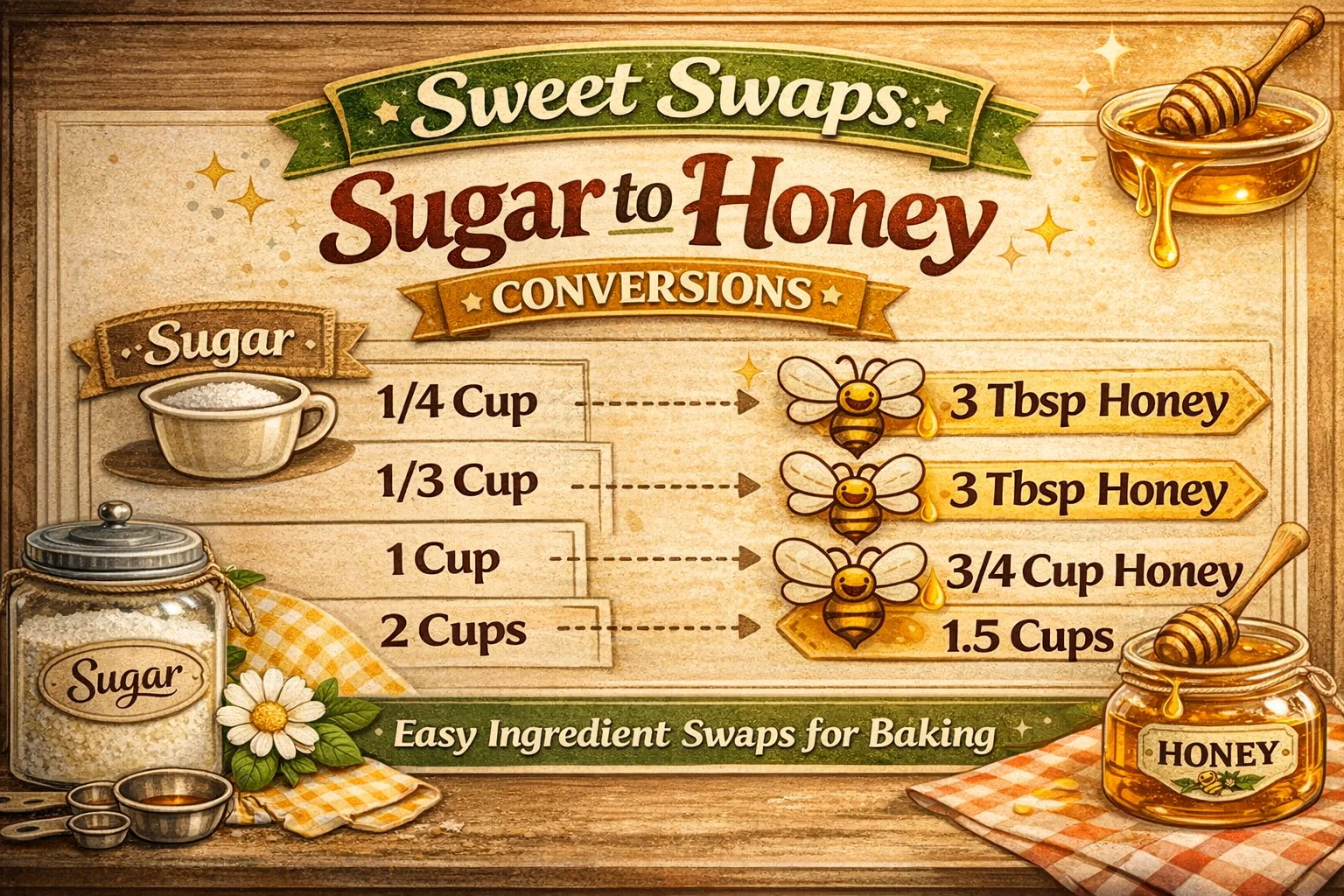
For smaller measurements, the difference is subtle but vital. If your recipe calls for 1/4 cup of sugar, you should reach for 3 tablespoons of honey. When you move up to 1/3 cup of sugar, the recommendation stays around the 3 tablespoon mark, perhaps a very slightly heaped one, because the intensity of honey fills that gap easily. These small adjustments prevent the tiny treats, like muffins or single tray brownies, from becoming overly saturated with moisture.
Standard Baking Volumes
As we get into larger volumes, the gap between sugar and honey wider. For a recipe requiring 1/2 cup of sugar, 1/3 cup of honey is your magic number. If you are scaling up to a full cup of sugar, you only need 3/4 cup of honey. Finally, for those large holiday batches requiring 2 cups of sugar, 1.5 cups of honey will provide more than enough sweetness and a beautiful, rich aroma.
Why Honey Changes the Baking Game
Honey is a complex ingredient. Unlike white sugar, which is pure sucrose, honey is a mixture of fructose, glucose, and water. This composition gives it hygroscopic properties, a fancy way of saying it attracts and holds onto moisture. This is a dream for bakers who love soft, chewy textures, but it requires a bit of tactical thinking during the mixing process.
When you bake with honey, your finished products will generally stay fresh and moist for longer than those made with sugar. This is why honey is a favorite for gingerbread, rye breads, and heavy fruitcakes. The fructose in honey also caramelizes at a much lower temperature than sucrose. While sugar starts to brown around 320 degrees Fahrenheit, honey begins the process much earlier. This leads to that beautiful, dark golden crust we all love, but it also means you have to keep a close eye on the oven timer.
Three Essential Rules for Successful Swapping
To ensure your kitchen experiments are successful, there are three secondary adjustments you must make alongside the measurement conversion. Think of these as the structural supports for your recipe.
1. Reduce the Liquid Content
Since honey is roughly 15 percent to 20 percent water, adding it to a recipe is essentially adding extra liquid. To compensate and prevent your batter from becoming too thin, you should reduce the other liquids in the recipe. A good rule of thumb is to remove about 1/4 cup of liquid (like milk, water, or juice) for every full cup of honey used. If the recipe has no other liquids, you might need to add a tablespoon or two of extra flour to find that perfect consistency.
2. The Baking Soda Secret
Honey is naturally acidic. White sugar, on the other hand, is neutral. If your recipe does not already call for baking soda, you should add about 1/4 teaspoon for every cup of honey used. The baking soda neutralizes the acidity of the honey, which helps the dough rise properly and prevents the finished product from tasting slightly sour. It also aids in the browning process, ensuring an even color.
3. Lower Your Oven Temperature
As mentioned earlier, honey browns quickly. To prevent your cake from looking burnt on the outside while remaining raw in the middle, lower your oven temperature by about 25 degrees Fahrenheit. If a recipe calls for 350 degrees, try baking at 325 degrees instead. You may need to leave the item in the oven for a few extra minutes, but the result will be a perfectly baked, evenly colored masterpiece.
Choosing the Right Honey for the Job
Not all honey is created equal, and the type you choose will dramatically impact the flavor of your bake. Honey takes on the characteristics of the flowers the bees visited, leading to a massive spectrum of taste profiles. Selecting the right one is just as important as the measurement itself.
- Clover Honey: This is the most common variety found in grocery stores. It has a mild, classic taste that works well in almost any recipe without overpowering other flavors.
- Orange Blossom Honey: This variety has a subtle citrus undertone. It is absolutely wonderful in fruit based muffins, scones, or light summer cakes.
- Buckwheat Honey: Very dark and strong, almost like molasses. Use this sparingly or in hearty recipes like whole wheat breads and spicy ginger snaps.
- Wildflower Honey: This can vary by region and season, but it generally offers a complex, floral punch. It is perfect for recipes where you want the honey flavor to be the star of the show.
The Benefits of Making the Switch
Beyond the incredible flavor, there are several reasons to choose honey over refined sugar. Honey is a natural source of antioxidants and contains trace amounts of vitamins and minerals that are completely absent in white sugar. Because it is sweeter, you consume fewer calories overall to reach the same level of satisfaction. Additionally, honey has a lower glycemic index than sugar, meaning it causes a slower, steadier rise in blood sugar levels rather than a sharp spike and subsequent crash.
From a culinary standpoint, honey provides a shelf life advantage. Because of its acidity and low moisture content, it acts as a natural preservative. Breads made with honey tend to resist mold longer, and cookies stay soft and pliable for days. It is truly a powerhouse ingredient that elevates the humble home kitchen to professional standards.
Common Challenges and How to Fix Them
Even with a chart, you might run into a few hiccups. If your cookies are spreading too much, it is likely a moisture issue. Try chilling your dough for an hour before baking to firm up the fats and the honey. If your cakes are too dense, double check your baking soda measurements. The chemical reaction between the honey and the soda is what provides that necessary lift.
If you find that the honey is sticking to your measuring cups, here is a pro tip: lightly coat the inside of your measuring spoon or cup with a flavorless oil or cooking spray before pouring the honey. It will slide right out without leaving a sticky mess behind, ensuring you get every single drop into your mixing bowl.
Conclusion: A Sweeter Way to Bake
Switching from sugar to honey is one of the easiest ways to upgrade your baking repertoire. It invites a level of soulfulness and natural richness into your kitchen that refined sugar simply cannot match. While it requires a bit of math and a few minor technical adjustments, the rewards are well worth the effort. You will find yourself creating desserts that are more flavorful, more moist, and just a little bit better for you.
The next time you pull out your mixing bowl, don’t just reach for the bag of white sugar out of habit. Consult your conversion chart, grab that jar of local honey, and see how much of a difference a natural sweetener can make. Whether it is a simple morning loaf or an elaborate birthday cake, the golden touch of honey is sure to make it a memorable one. Happy baking!
Would you like me to create a specific recipe using these honey conversion rules for you to try?