
12 Powerful Habits to Build Mental Strength and Resilience Mental Toughness Guide
Building mental strength is a journey that does not happen overnight. It is a continuous process of refining your thoughts, Managing your emotions, and choosing productive behaviors regardless of the circumstances you face. Many people believe that being mentally strong means suppressing emotions or never showing weakness, but the reality is quite different. True resilience is about understanding your vulnerabilities and developing the tools to navigate life’s challenges with grace and determination.
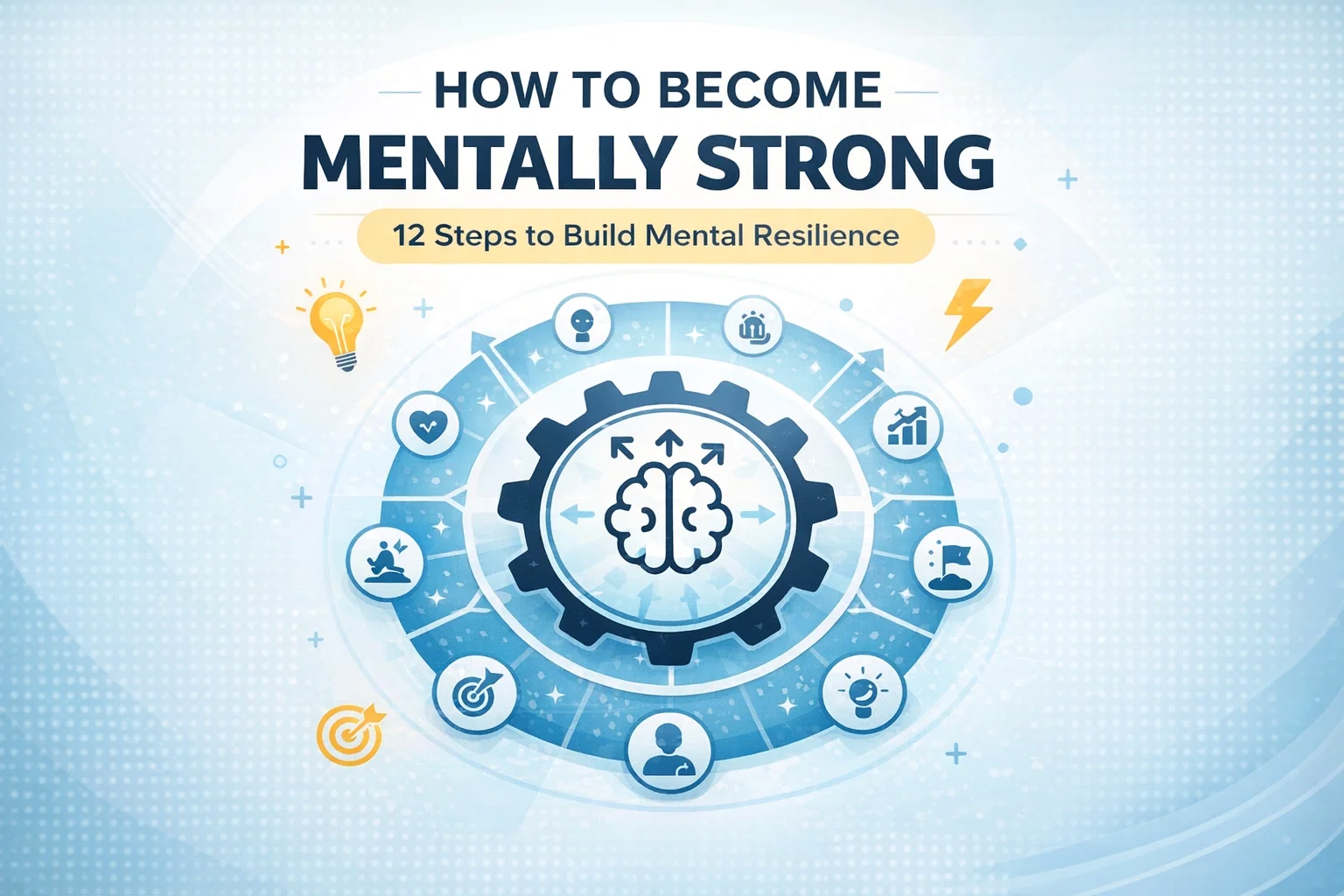
The visual guide provided offers a comprehensive 12-step cycle that serves as a roadmap for anyone looking to fortify their mind. By breaking down these complex psychological concepts into daily actionable habits, we can begin to see real, lasting change in how we perceive the world and ourselves. Let’s dive deep into these twelve pillars of mental toughness and explore how you can integrate them into your own life to become the most resilient version of yourself.
1. Embracing Difficult Situations as Opportunities
Most of us have a natural tendency to avoid discomfort. When a difficult situation arises, the instinct is often to retreat or find the path of least resistance. However, mentally strong individuals view these moments through a different lens. They see challenges as a necessary “gym” for the mind. Just as physical muscles require resistance to grow, your mental capacity expands when it is tested by adversity.
When you encounter a setback at work or a personal conflict, try to ask yourself: “What is this situation trying to teach me?” By shifting your perspective from being a victim of circumstances to being a student of life, you reclaim your power. This mindset shift is the first step in building a foundation that cannot be easily shaken by external events.
2. Confronting Your Fears to Diminish Their Power
Fear thrives in the dark. The more we avoid the things that scare us, the larger and more intimidating they become in our imagination. Confronting what scares you does not mean you have to be fearless; it means you take action despite the fear. This process, often referred to as exposure, helps your brain realize that the perceived threat is often much more manageable than anticipated.
Start small. If you fear public speaking, start by sharing your ideas in a small group setting. If you fear failure, take on a project where the stakes are low but the learning potential is high. Each time you face a fear, you diminish its power over your decision-making process, allowing you to move forward with increased confidence.
3. Challenging Negative Thoughts with Evidence
Our brains are wired with a negativity bias, an evolutionary trait designed to keep us safe from danger. In the modern world, however, this often manifests as a constant stream of self-criticism and catastrophic thinking. To become mentally strong, you must become an active observer of your thoughts rather than a passive believer of them.
When a negative thought enters your mind—such as “I am not good enough” or “Everything will go wrong”—stop and look for the evidence. Ask yourself if there is factual proof to support this thought. More often than not, you will find that these thoughts are based on feelings rather than reality. Replacing irrational fears with evidence-based outcomes allows you to maintain a balanced and realistic perspective.
4. Staying on Your Path and Ignoring Distractions
In the age of social media, it is easier than ever to fall into the trap of comparison. We see the “highlight reels” of others and feel like we are falling behind. This distraction can be detrimental to mental strength because it shifts your focus away from your own goals and values. Mental toughness involves the discipline to stay on your own path, regardless of what others are doing.
The Danger of Social Comparison
Comparing your “behind-the-scenes” with someone else’s “stage performance” is a recipe for unhappiness. Your journey is unique, and your timeline is your own. When you focus on your own progress, you conserve the mental energy that would otherwise be wasted on envy or inadequacy.
Building Internal Validation
To stay on your path, you must develop a strong sense of internal validation. This means your sense of worth comes from your own efforts and alignment with your values, not from the approval or the perceived success of those around you. When you are centered in your own purpose, the noise of the world becomes much easier to ignore.
5. Using Failures as Lessons for Improvement
Failure is not the opposite of success; it is a vital part of it. Many of the most successful people in history have failed more times than they have succeeded. The difference lies in how they responded to those failures. Instead of letting a mistake define their worth, they used it as data to refine their approach.
When things don’t go as planned, conduct a “post-mortem” on the situation. What went wrong? What could have been handled differently? What skills do you need to develop to ensure a better outcome next time? By treating failure as a lesson, you remove the emotional sting and turn it into a stepping stone for future achievement.
6. Building a Strong Support Network
No one is an island. While mental strength is an internal quality, it is significantly bolstered by the people you surround yourself with. A strong support network provides a safety net during challenging times and offers diverse perspectives that can help you see solutions you might have missed on your own.
Cultivate relationships with people who encourage your growth, challenge your excuses, and provide emotional support when you are struggling. Having a group of trusted friends, mentors, or family members creates a sense of psychological safety, which is essential for taking risks and building resilience.
7. Practicing Mindfulness and Staying Present
Stress often lives in the past or the future. We stress about mistakes we made yesterday or worry about things that might happen tomorrow. Mindfulness is the practice of bringing your attention back to the present moment, which is the only place where you actually have the power to act.
By practicing mindfulness—whether through meditation, deep breathing, or simply paying full attention to your current task—you reduce the physiological symptoms of stress. This presence allows you to respond to situations with clarity and calm rather than reacting impulsively out of anxiety.
8. Stimulating the Brain with Creative Activities
Mental strength is not just about grit and discipline; it is also about flexibility and innovation. Engaging in creative activities stimulates different parts of the brain and provides a healthy outlet for stress. Whether it is painting, writing, gardening, or cooking, creativity allows your mind to enter a “flow state” where time seems to disappear and worries fade away.
Setting aside dedicated time for creativity helps prevent burnout and keeps your mind sharp. It encourages you to think outside the box, a skill that is incredibly useful when you are trying to solve complex problems in other areas of your life.
9. Regularly Reflecting on Your Progress
It is easy to get caught up in the hustle of daily life and forget how far you have come. Regular reflection is the practice of looking back at your actions and decisions to see what is working and what isn’t. This reinforces positive behaviors and helps you stay aligned with your long-term goals.
Consider keeping a journal where you record your wins, your struggles, and your insights. This tangible record of your journey provides perspective during difficult times. When you feel like you aren’t making progress, you can look back and see the evidence of your growth, which provides a powerful boost to your mental resilience.
10. Consistently Pushing Your Limits
Mental resilience is built in the “extra mile.” If you only do what is comfortable, your mental capacity stays the same. To grow, you must consistently push your limits, even in small ways. This might mean staying focused on a task for ten minutes longer than usual or choosing to be patient when you feel like losing your temper.
Every time you push past your perceived limitations, you prove to yourself that you are capable of more than you thought. This builds a reservoir of confidence that you can draw upon when life throws significant challenges your way. Consistency is key; it is the daily small stretches that lead to massive transformations over time.
11. Understanding That Real Change Takes Time
In a world of instant gratification, we often expect immediate results. However, deep psychological change and the building of mental strength are slow processes. Understanding and accepting that real change takes time is crucial for staying the course when progress feels stagnant.
Impatience is a major enemy of resilience. When we don’t see results right away, we are tempted to give up. By adopting a long-term perspective, you protect yourself from the frustration of slow progress. Trust the process, stay committed to your habits, and know that the seeds you are planting today will eventually bloom.
12. Focusing on Control and Staying Optimistic
One of the fastest ways to drain your mental energy is to worry about things you cannot control. You cannot control the weather, the economy, or the opinions of others. You can, however, control your effort, your attitude, and your reactions. Mentally strong people focus their energy exclusively on their “circle of influence.”
The Power of Realistic Optimism
Staying optimistic does not mean ignoring problems or pretending everything is perfect. It means maintaining a belief that you have the capacity to handle whatever comes your way and that a positive outcome is possible through effort and persistence. This brand of realistic optimism keeps you motivated and solution-oriented.
Choosing Your Reactions
Between a stimulus and a response, there is a space. In that space lies your freedom to choose your reaction. By focusing on what you can control, you maximize your effectiveness and maintain a sense of agency even in the most chaotic environments. This is the ultimate hallmark of a mentally strong individual.
Conclusion: Your Roadmap to a Resilient Future
Becoming mentally strong is not a destination but a way of living. The 12 steps outlined in this guide provide a holistic approach to strengthening your mind, from the way you handle fear and failure to the way you manage your daily habits and social connections. By integrating these practices into your life, you are not just preparing yourself for the bad times; you are enhancing your ability to enjoy and succeed in the good times as well.
Remember that you do not have to master all twelve areas at once. Start by picking one or two pillars that resonate with you and focus on practicing them consistently. Over time, these habits will become second nature, and you will find yourself navigating the complexities of life with a newfound sense of power, clarity, and peace. The journey to mental strength begins with a single choice to be better than you were yesterday. Embrace the challenge, stay the course, and watch as your world transforms from the inside out.