
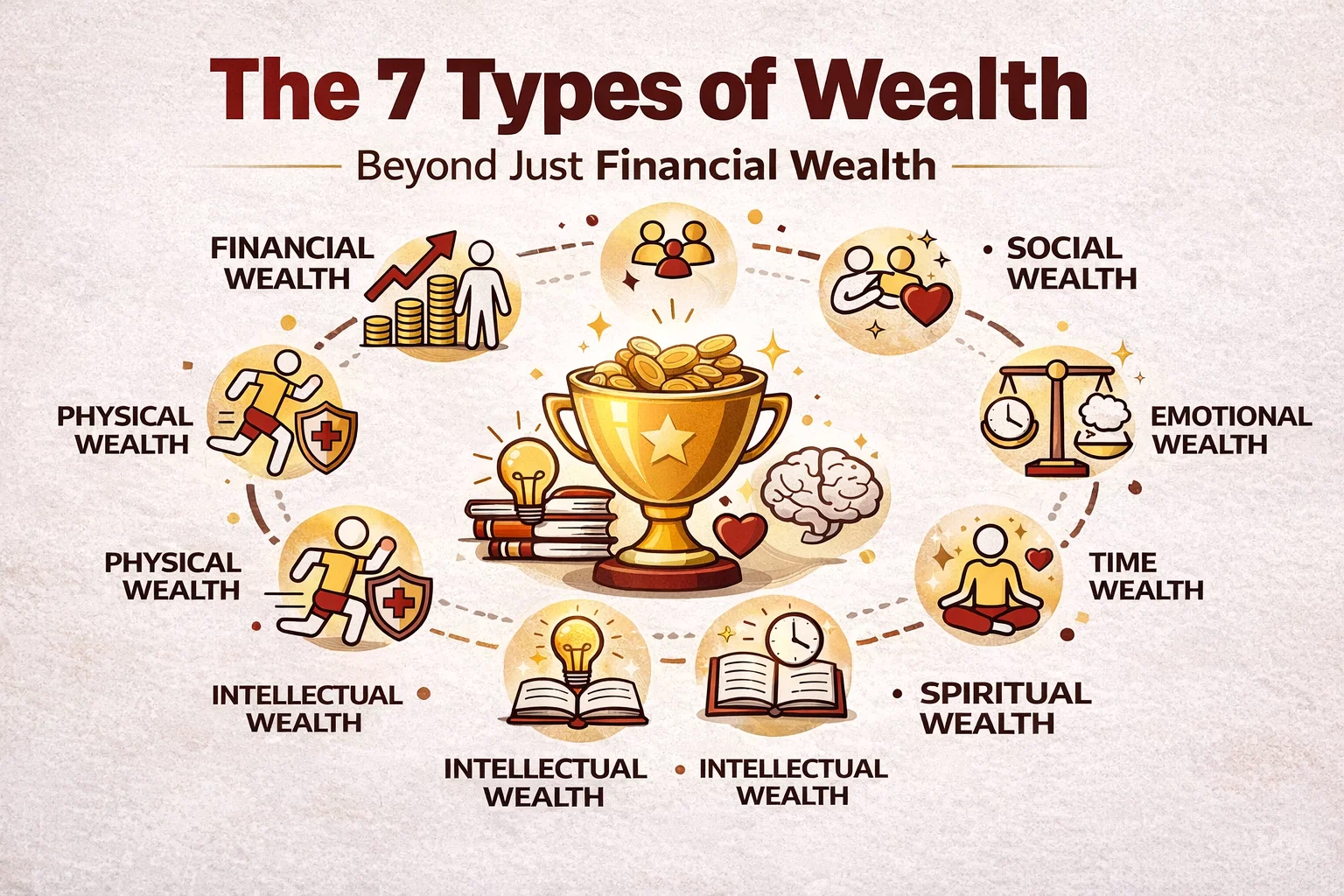
7 Types of Wealth Beyond Money Why Time and Health Matter More Than Your Bank Account
True prosperity is often measured by the digits in a bank account, but most people who reach the pinnacle of financial success find that money alone feels surprisingly hollow. We are living in an era where burnout is a badge of honor and overtime work is seen as the only path to security. However, the concept of wealth is far more diverse than your net worth. It is a multidimensional ecosystem that requires balance across various areas of your life to truly flourish. If you are constantly trading your health for a paycheck or your relationships for a promotion, you are not actually getting richer; you are simply shifting your poverty to a different department.
The Hidden Cost of the Modern Hustle
In our current professional landscape, the pressure to perform often leads to a phenomenon known as the arrival fallacy. We tell ourselves that once we hit a certain income bracket or job title, we will finally have the time to exercise, the energy to play with our children, or the mental space to pursue a hobby. The reality is that these different types of wealth are not sequential. You cannot ignore your physical or social wealth for twenty years and expect them to be waiting for you when you retire. Real wealth is about having the resources to live a life aligned with your values right now.
Understanding these categories helps you identify where you are currently over-investing and where you are dangerously bankrupt. By diversifying your personal portfolio across financial, social, physical, emotional, intellectual, time, and spiritual sectors, you create a resilient foundation that can withstand the ups and downs of any economy.
1. Financial Wealth: The Foundation of Freedom
Financial wealth is the most visible form of prosperity. It is characterized by the ability to manage your life without being dictated by monthly bills. While it is not the only form of wealth, it is a significant tool that provides the security needed to focus on other areas. When you are constantly stressed about rent or debt, it is nearly impossible to find inner peace or spiritual alignment.
Calculating Your Target
A common benchmark for true financial independence is having retirement funds that equal twenty-five times your annual expenses. This provides a safety net that allows you to make choices based on passion rather than necessity. Financial wealth is not about greed; it is about autonomy. It is the power to say no to a toxic work environment or a project that does not align with your ethics.
2. Social Wealth: Your Relationship Ecosystem
Social wealth is the quality of your connections. You could be a billionaire, but if you have no one to share a meal with or no one who truly understands your heart, you are experiencing a form of poverty. A healthy relationship ecosystem includes your family, your friends, and your professional network. It is built on trust, vulnerability, and consistent effort.
- Quality Communication: Prioritizing deep, honest conversations at home rather than just logistical updates.
- Support Systems: Having a group of people who celebrate your wins and hold you up during your losses.
- Community Engagement: Feeling a sense of belonging within your local area or a niche group of like-minded individuals.
Social wealth requires time, which is why it is often the first thing to suffer when someone becomes obsessed with financial gain. Remember that at the end of your life, you will likely remember the laughter shared with friends far more clearly than the spreadsheets you finished on a Friday night.
3. Physical Wealth: The Energy to Enjoy Your Life
Physical wealth is often taken for granted until it starts to diminish. It is the energy required to enjoy your achievements. What is the point of having a luxury car if you are too exhausted to drive it? What is the point of a beautiful home if you are too sick to enjoy the space? Physical wealth is maintained through regular exercise, proper nutrition, and health protection.
Investing in your body is the ultimate long-term play. It means choosing movement even when you are busy and prioritizing sleep over one more hour of scrolling. When you are physically wealthy, you have a vibrant immune system and the stamina to pursue your goals with enthusiasm. You become a participant in your life rather than a tired spectator.
4. Emotional Wealth: Mastering Your Inner World
Emotional wealth is the state of your mental health and your ability to manage stress. It involves self-awareness, resilience, and the capacity to process difficult feelings without becoming overwhelmed. People with high emotional wealth understand that their internal weather does not always have to match the external circumstances.
The Work-Life Balance Equation
Maintaining a work-life balance is a key component of emotional wealth. It requires setting boundaries and knowing when to unplug. If you find yourself constantly thinking about work during your off-hours, your emotional bank account is likely running low. Cultivating this form of wealth might involve therapy, journaling, or simply learning the art of saying no without guilt.
5. Intellectual Wealth: The Currency of Curiosity
Intellectual wealth is the continuous growth of your knowledge and skills. In a rapidly changing world, the ability to stay relevant is a massive asset. However, intellectual wealth goes beyond professional training. It includes reading for pleasure, exploring new philosophies, and staying curious about the world around you.
When you sharpen your mind, you expand your perspective. This allows you to solve problems more creatively and connect with a wider variety of people. Intellectual wealth keeps life interesting and prevents the stagnation that often leads to mid-life dissatisfaction. It is the commitment to being a lifelong learner.
6. Time Wealth: The Ultimate Luxury
Time wealth is perhaps the most underrated form of prosperity in the modern world. It is the luxury of having full control over your schedule. True time wealth means having the freedom to choose meaningful activities over mandatory ones. It is the ability to spend a Tuesday afternoon hiking or a rainy morning reading a book without asking for permission.
Many people trade their time wealth for financial wealth, only to realize that time is the one resource they can never earn back. You can always make more money, but you can never make more hours. Achieving time wealth often requires simplifying your life, delegating tasks, and choosing a career path that offers flexibility over a rigid corporate ladder.
7. Spiritual Wealth: Living with Purpose
Spiritual wealth is the sense of inner peace that comes from living in total alignment with your values. It is the realization that there is a life purpose beyond material accumulation. This does not necessarily require religion, though for many it does. At its core, spiritual wealth is about connection to something greater than yourself.
When you are spiritually wealthy, you have a clear sense of why you are here. Your actions are driven by your heart rather than by ego or external validation. This provides a deep sense of calm that helps you navigate the challenges of the other six types of wealth. It is the anchor that keeps you steady when the winds of life start to blow.
The Danger of Overtime and Neglect
Why do we so often neglect these areas for the sake of work? The answer usually lies in societal conditioning. We are taught that financial wealth is the primary metric of success. Because financial wealth is easily measurable, we gravitate toward it. It is much harder to measure your “inner peace” or your “relationship ecosystem” on a graph.
Overtime work acts as a thief that steals from your other accounts. When you work extra hours, you are literally withdrawing from your time wealth. That lack of time leads to a withdrawal from your physical wealth because you skip the gym. It leads to a withdrawal from your social wealth because you miss dinner with your partner. Eventually, you find yourself with a slightly larger paycheck but a life that feels empty and exhausted.
How to Rebalance Your Personal Portfolio
If you realize that your life is currently lopsided, do not panic. Like any portfolio, you can rebalance it with intentionality. Start by auditing your current state. Which of these seven areas feels the most depleted? Often, small changes can yield massive results.
Small Steps Toward Holistic Wealth
You do not need to quit your job to gain time wealth. You might start by reclaiming your lunch break or setting a strict “no emails after 7 PM” rule. To build social wealth, you might schedule a recurring coffee date with a friend. To build intellectual wealth, you might listen to an educational podcast during your commute instead of the news.
The goal is not to have a perfect score in all seven categories every single day. That is impossible. The goal is awareness. When you know that you are currently trading physical health for financial gain, you can make an informed decision about how long you are willing to make that trade. You move from being a victim of your schedule to being the architect of your life.
Conclusion: Building a Rich Life
Real wealth is the ability to fully experience life. It is the combination of a healthy body, a curious mind, a peaceful spirit, and a circle of people who love you. While financial stability provides the floor, these other forms of wealth provide the ceiling. By recognizing that prosperity comes in seven different flavors, you give yourself permission to pursue a more balanced and joyful existence.
Take a moment today to look at your own life through this lens. Are you spending all your currency in one place? It is never too late to start investing in your relationships, your health, and your peace of mind. After all, the richest person is not the one who has the most, but the one who needs the least and enjoys the most. Start building your holistic wealth today and discover what it truly means to live a life of abundance.