High Porosity vs Low Porosity Hair Care Best Oils for Natural Hair Guide
Navigating the world of natural hair care often feels like a complex science experiment. One day your curls are popping and hydrated, and the next they feel brittle or coated in greasy buildup. If you have ever wondered why your favorite hair butter works wonders for your friend but leaves your hair feeling like straw, the answer likely lies in a single word: porosity. Understanding hair porosity is the ultimate cheat code for a successful hair journey. It is the foundation upon which every moisturizing routine should be built. Instead of guessing which products to buy, learning your porosity allows you to choose ingredients that actually penetrate the hair shaft and stay there.
What Exactly Is Hair Porosity?
In simple terms, hair porosity refers to your hairs ability to absorb and retain moisture. This is determined by the condition of the cuticle, which is the outermost layer of your hair strand. Think of the cuticle as a series of shingles on a roof. When those shingles are raised, water gets in easily but escapes just as fast. When they are laid tightly and flat, water has a hard time getting past the barrier. Generally, hair porosity falls into three categories: low, medium, and high. Most people find themselves on either end of the spectrum, requiring a specific approach to oiling and moisturizing to keep their strands healthy.
The Anatomy of High Porosity Hair
High porosity hair has cuticles that are raised or even have gaps and holes in them. This can be a genetic trait, but it is often the result of damage from heat styling, chemical processing, or environmental stress. Because the cuticles are open, this hair type drinks up moisture instantly. However, because the gate is left wide open, that moisture evaporates almost as soon as it enters. This leads to hair that gets dry very quickly, tangles easily, and often looks dull or frizzy. The goal for high porosity hair is to use heavy, occlusive ingredients that can fill those gaps and seal the cuticle shut to trap moisture inside.
The Characteristics of Low Porosity Hair
On the flip side, low porosity hair has cuticles that are tightly bound and lay very flat. This hair type is typically very healthy and resistant to outside damage, but it is notoriously difficult to moisturize. If you notice that water beads up on the surface of your hair when you are in the shower, or if products seem to sit on top of your strands without ever sinking in, you likely have low porosity hair. Because the cuticle is so tightly closed, it resists moisture. However, once you successfully get moisture in, it stays there for a long time. The challenge here is avoiding heavy products that cause massive buildup and choosing lightweight oils that can sneak past that tight cuticle barrier.
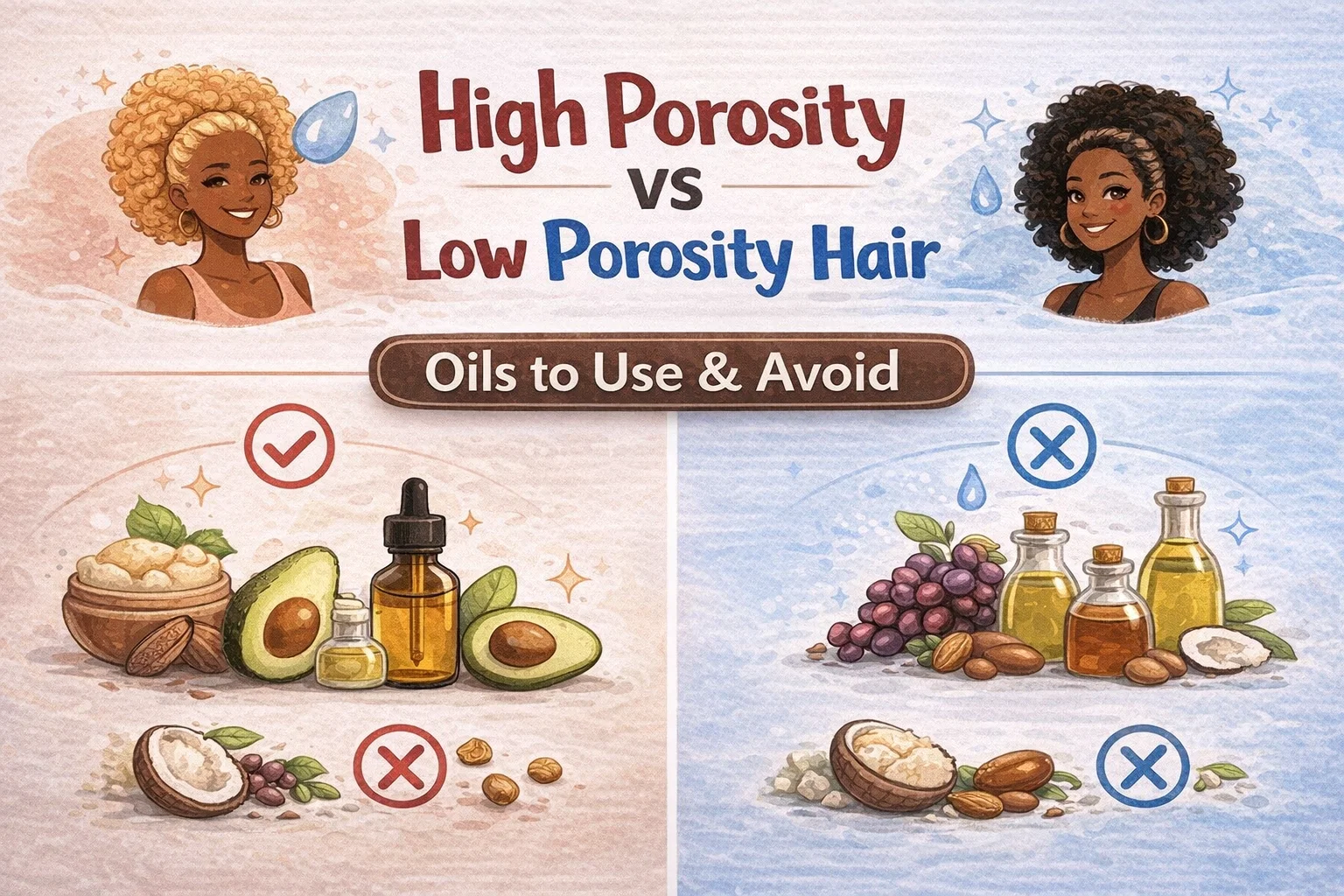
The Best Oils for High Porosity Hair
If you have high porosity hair, you need “sealing” oils. These are typically heavier, thicker oils that create a protective barrier over the hair shaft. Because your hair loses moisture so fast, these oils act as a plug to keep your hydrating creams and water safely tucked away inside the strand.
- Shea Butter: While technically a fat, shea butter is a powerhouse for high porosity hair. It is incredibly thick and provides a heavy coating that mimics a closed cuticle, preventing water loss throughout the day.
- Castor Oil: This is one of the thickest oils available. It is rich in ricinoleic acid, which helps to nourish the scalp while providing a dense protective layer over the hair. It is excellent for keeping high porosity ends from splitting.
- Coconut Oil: This is a unique oil because it can actually penetrate the hair shaft to prevent protein loss. For high porosity hair that might be damaged, coconut oil helps strengthen the structure from within while adding shine.
- Avocado Oil: Packed with vitamins A, D, and E, avocado oil is heavy enough to seal the hair but also contains monounsaturated fats that help strengthen the hair fiber against breakage.
- Olive Oil: A kitchen staple that doubles as a high porosity hero. It is an emollient that improves hair elasticity and creates a smooth surface on the hair, reducing the appearance of frizz.
Oils to Avoid with High Porosity Hair
It is not necessarily that certain oils are “bad” for high porosity hair, but rather that they are ineffective. Lightweight oils like Grapeseed, Jojoba, and Argan oil are often too thin to provide the sealing power that high porosity strands require. If you use these exclusively, you might find that your hair still feels dry a few hours after styling because the oil was too light to stop the moisture from evaporating.
Mastering the Routine for Low Porosity Hair
Low porosity hair requires a completely different strategy. Since the cuticle is closed tight, you need to use heat to open it up and lightweight oils that wont weigh the hair down or create a sticky film. Using heavy butters on low porosity hair is a recipe for limp, greasy curls that eventually become brittle due to lack of actual water penetration.
- Jojoba Oil: This oil is chemically very similar to the natural sebum produced by your scalp. It is incredibly lightweight and mimics your natural oils, making it easy for low porosity hair to accept without feeling greasy.
- Grapeseed Oil: Known for its high smoke point in cooking, in hair care, it is prized for being non-greasy. It acts as a lightweight heat protectant and adds a beautiful shine without clogging the cuticle.
- Sweet Almond Oil: This oil is fantastic for adding softness. It is light enough to penetrate the tight layers of a low porosity cuticle, delivering moisture and nutrients deep into the strand.
- Argan Oil: Often called liquid gold, Argan oil is rich in antioxidants. It is small enough in molecular structure to get into low porosity hair, providing hydration and a silky finish without the heavy buildup.
Oils to Avoid with Low Porosity Hair
Low porosity hair should generally stay away from heavy hitters like Coconut oil, Olive oil, and Shea butter. These ingredients are too large to penetrate the tight cuticle. Instead of helping, they sit on the surface, attracting dust and lint, and creating a barrier that actually prevents future moisture from getting in. This leads to “product buildup,” which can make the hair feel stiff and straw-like over time.
How to Test Your Hair Porosity at Home
Before you run out to buy new oils, you should confirm your porosity type. The most common method is the Float Test. Take a couple of clean, product-free strands of hair and drop them into a glass of water. Let them sit for about five minutes. If the hair floats on the surface, you have low porosity hair. If it sinks slowly to the middle, you have medium porosity. If it sinks straight to the bottom, you have high porosity hair. Another way to tell is by simply observing your hair during a wash. If it takes forever to get fully wet, it is low porosity. If it gets soaked instantly but dries in thirty minutes, it is high porosity.
Tips for Managing Both Porosity Types
Regardless of where you fall on the spectrum, there are some universal rules that can help you maintain a healthy balance. For low porosity individuals, always use warm water when washing and deep conditioning. The warmth helps to gently lift the cuticle so the moisture can enter. For high porosity individuals, try finishing your wash with a cool rinse or an Apple Cider Vinegar (ACV) rinse. The acidity helps to flatten the cuticle and lock in the work you did during your routine.
The Importance of Clarifying
Low porosity hair needs frequent clarifying to remove the buildup of lightweight oils. High porosity hair needs clarifying too, but it should be followed by a protein treatment to help “patch” the holes in the hair shaft. Balancing moisture and protein is essential, especially for high porosity strands that have been chemically treated.
Consistency is the Key to Healthy Curls
Learning your porosity is the first step toward a simplified and effective hair care routine. Once you stop fighting against your hairs natural structure and start working with it, you will see a massive improvement in length retention, shine, and overall hair health. It is not about having the most expensive products; it is about having the right products for your specific needs. Use this guide as a roadmap to audit your current stash and make the necessary swaps for your healthiest hair yet.
By tailoring your oil selection to your porosity, you are ensuring that every drop of product you use is actually doing its job. Whether you are sealing in moisture with a heavy castor oil or providing lightweight shine with jojoba, your hair will thank you for the specialized attention. Remember that your hair can change over time due to age, weather, or treatments, so stay in tune with how your strands feel and adjust your routine as needed. Happy hydrating!