
How to Build a Study System for Consistency 4 Essential Layers
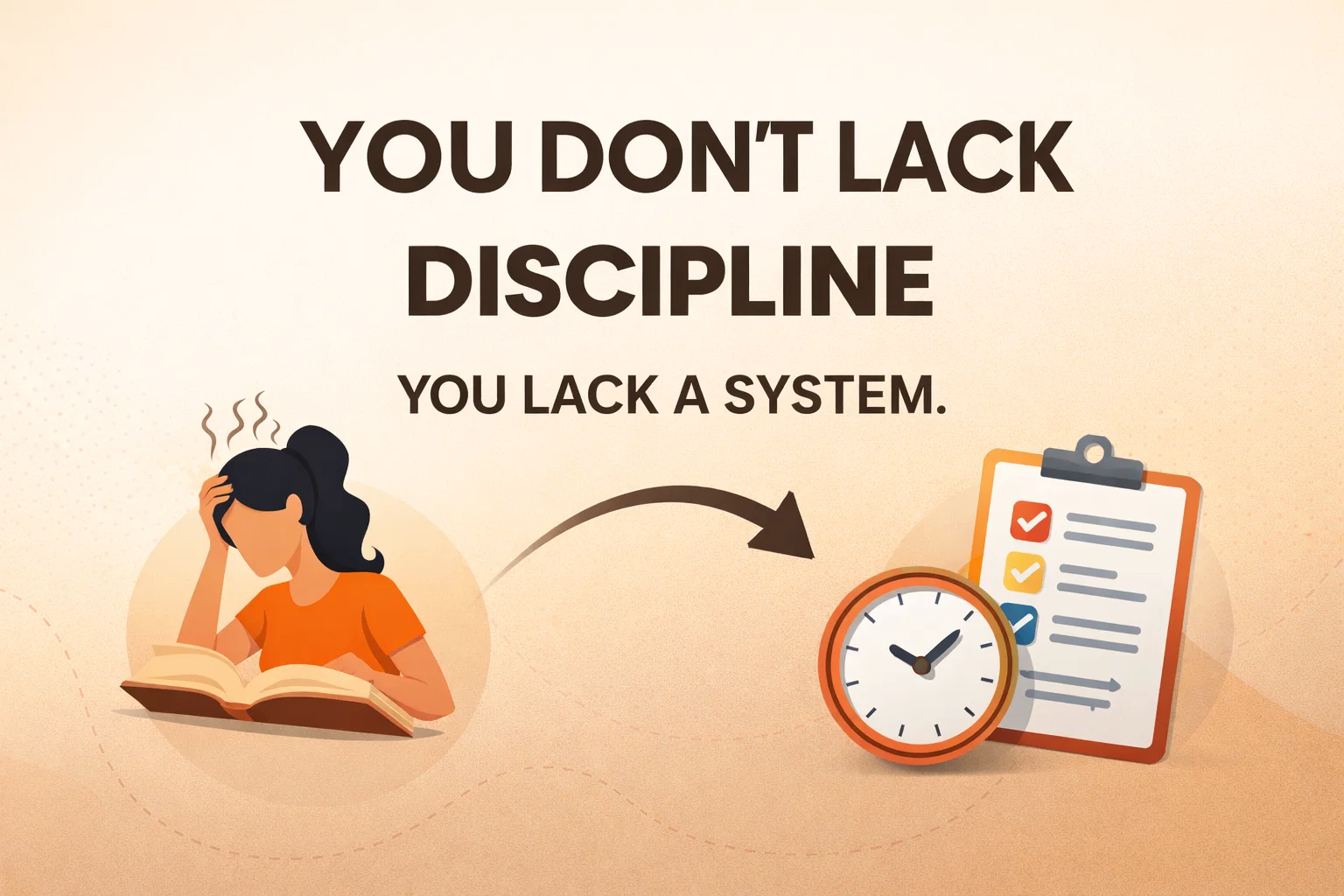
Most students and professionals spend their lives chasing a ghost called discipline. They wake up with grand intentions, fueled by a burst of morning motivation, only to find themselves doom-scrolling or staring blankly at a textbook by noon. When the productivity crumbles, the internal monologue begins: I am just lazy. I don’t have the willpower. I lack discipline. But if you look closely at the highest achievers in academia and creative industries, you will find that they aren’t necessarily more disciplined than you are. They simply have better systems. As the image reminds us, you do not lack discipline; you lack a system. A system is a safety net for those days when your motivation is at zero. It is the repeatable framework that turns a daunting mountain of study material into a series of manageable, automated steps.
Understanding the Discipline Myth
We have been conditioned to believe that success is a matter of character. We think that if we were just “better” or “stronger,” we would be able to study for six hours straight without a break. This is the discipline myth. Discipline is a finite resource, much like the battery on your phone. If you rely solely on your internal battery to power you through an entire exam season, you will eventually run out of juice. This leads to burnout, guilt, and a cycle of procrastination.
A system, on the other hand, is like plugging your phone into a charger. It provides a constant flow of energy and direction that does not require you to make difficult choices every five minutes. When you have a 4-layer study system, you don’t have to decide what to study, where to sit, or how to begin. The system has already made those decisions for you, allowing your brain to focus entirely on the cognitive task at hand.
Layer 1: The Environmental Foundation
The first layer of a truly consistent study system isn’t about what is in your head; it is about what is around you. Your environment acts as a silent trigger for your habits. If you try to study in the same place where you sleep or watch movies, your brain will struggle to enter a deep work state because it is receiving conflicting signals.
Designing a High-Focus Zone
You do not need a home office to create a great environment. You just need consistency. This could be a specific corner of a library, a particular desk in your room, or even a specific coffee shop. The key is that when you enter this space, your brain knows it is time to work. Keep this area free of digital distractions. Leave your phone in another room or use an app blocker. A clean, dedicated space reduces the “friction” of starting, which is often the hardest part of the process.
The Power of Sensory Cues
You can “prime” your brain for focus using sensory triggers. Many successful students use a specific playlist of lo-fi beats or brown noise that they only play when they are studying. Over time, the sound itself becomes a signal to the nervous system to settle down and focus. Lighting also plays a role. A dedicated desk lamp that you only turn on during study sessions can act as a physical “on switch” for your concentration.
Layer 2: The Cognitive Architecture
Once your environment is set, the second layer involves how you actually process information. This is where most people fail because they rely on passive learning. Reading a textbook and highlighting sentences feels like work, but it is often an illusion of competence. Real learning is active and, quite frankly, a bit uncomfortable.
Active Recall and Spaced Repetition
The core of your cognitive system should be built on active recall. Instead of reading, you should be testing yourself. Close the book and try to explain the concept out loud or write down everything you remember on a blank sheet of paper. This forces your brain to retrieve information, which strengthens the neural pathways. Pair this with spaced repetition, which involves reviewing the material at increasing intervals (1 day, 3 days, 1 week, 1 month). This system combats the forgetting curve and ensures that what you learn today stays with you until exam day.
The Feynman Technique
A great way to test if your cognitive layer is working is the Feynman Technique. Try to explain a complex topic as if you were teaching it to a ten-year-old. If you find yourself using jargon or getting stuck, you have found a gap in your understanding. This simple system ensures you aren’t just memorizing words but actually grasping the underlying logic of the subject.
Layer 3: The Temporal Framework
The third layer is about how you manage your most precious resource: time. Most people approach their schedule by saying “I will study tonight.” This is too vague. A system requires specific, time-bound structures that protect you from the temptation of “just five more minutes” on social media.
Time Blocking and the Pomodoro Method
Instead of a to-do list, use a calendar. Block out specific hours for specific subjects. This prevents “decision fatigue” because your schedule tells you exactly what to do. Within those blocks, use a method like the Pomodoro Technique (25 minutes of work followed by a 5-minute break). This system works because it makes the task feel temporary. It is much easier to convince yourself to work for 25 minutes than it is to face an undefined afternoon of labor.
Protecting Your Peak Energy Hours
Everyone has a “chronotype” or a natural peak in energy. Some are morning larks, while others are night owls. Your temporal system should align your hardest tasks with your highest energy levels. Save the heavy lifting, like writing an essay or solving complex math problems, for when you are most alert. Use your lower-energy periods for administrative tasks, like organizing your notes or checking emails.
Layer 4: The Emotional and Physical Maintenance
The final layer is often ignored, yet it is the one that prevents the entire system from collapsing. You are not a machine. If you do not maintain your physical and emotional well-being, your cognitive and temporal layers will eventually fail. Consistency is built on the foundation of health.
Sleep and Brain Performance
Sleep is not a luxury; it is a cognitive necessity. While you sleep, your brain flushes out toxins and consolidates memories. A study system that involves pulling all-nighters is a broken system. You might cover more pages, but you will retain less and perform worse on the actual test. Aim for seven to nine hours of sleep to ensure your brain is physically capable of the discipline you are asking of it.
Managing Stress and Burnout
A sustainable system includes scheduled downtime. You need “guilt-free” rest where you are completely disconnected from your work. This could be a hobby, exercise, or spending time with friends. When you know that rest is coming, you are more likely to stay focused during your work blocks. Think of it as a reward system that keeps your morale high and your stress levels low.
Building Consistency through Automation
The ultimate goal of this 4-layer system is to reach a state of automation. In the beginning, setting up these layers takes effort. You have to consciously choose to go to your study spot, set your timer, and use active recall. However, after a few weeks, these actions become habits. They become your default mode of operation.
Consistency is not about being “perfect” every day. It is about having a system that is so robust that even on your worst day, you still get the essentials done. When the system is in place, you stop negotiating with yourself. You don’t ask, “Do I feel like studying?” You simply follow the protocol. This is how high achievers maintain their momentum over months and years without burning out.
Common Pitfalls to Avoid
Even with a great system, there are traps that can catch you off guard. One major pitfall is “procrastivity,” which is doing productive-looking things to avoid the actual hard work. This might look like spending three hours color-coding your planner instead of actually studying the material. Your system should prioritize results over aesthetics.
Another trap is the “all-or-nothing” mindset. If you miss a study block, don’t throw away the whole day. A good system is flexible. If Layer 3 (Time) fails for an hour, lean on Layer 1 (Environment) to get back on track as soon as possible. Resilience is a key component of a long-term system.
Summary of the 4-Layer System
- Layer 1 (Environment): Create a dedicated, distraction-free space that signals focus.
- Layer 2 (Cognitive): Use active recall and spaced repetition to move information into long-term memory.
- Layer 3 (Temporal): Use time-blocking and Pomodoro sessions to manage your energy and prevent burnout.
- Layer 4 (Maintenance): Prioritize sleep and recovery to keep your biological “hardware” running smoothly.
Wrapping Up: System Over Willpower
The next time you feel like you are failing because you can’t stay consistent, stop looking at your character and start looking at your strategy. Discipline is a wonderful trait, but it is a shaky foundation for a long-term goal. By implementing a 4-layer study system, you take the pressure off your willpower and put it onto a framework that is designed to succeed. You have the potential to achieve incredible things; you just need the right engine to get you there. Start by tweaking one layer today, perhaps your environment or your study method, and watch how much easier it becomes to stay on track. Remember, you don’t need more discipline. You just need a better system.
Would you like me to help you design a specific study schedule or explain more about the science of active recall?