10 Sentences That Hit Like A Train Powerful Mindset Life Lessons Truth
Life has a way of delivering lessons when we least expect them, but some truths are so profound that they change our trajectory the moment we hear them. We often go through our daily routines on autopilot, accepting situations and relationships that no longer serve our highest good. However, when you encounter a sentence that hits like a train, it acts as a much needed wake up call. These are not just words on a page; they are psychological triggers designed to shift your perspective and demand a higher standard for your life. By leaning into these uncomfortable truths, we begin the real work of personal transformation and mental resilience.
The Power of Presence and the Weight of Absence
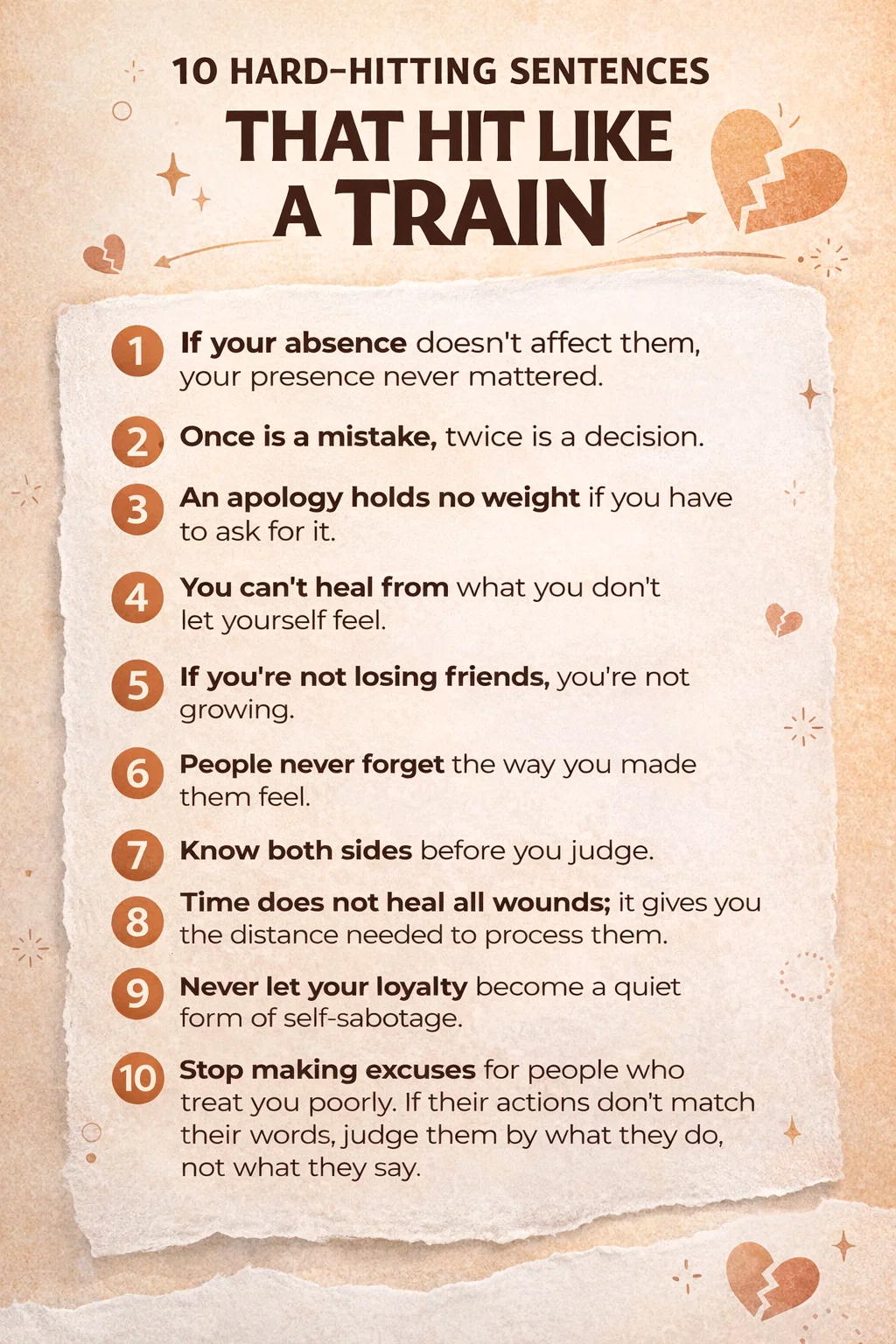
The first step in any mindset shift is auditing where we place our energy. One of the most piercing realizations is that if your absence does not affect someone, your presence never truly mattered to them. This is a hard pill to swallow because it forces us to look at our closest circles with radical honesty. We often over-invest in people who only value us for our convenience rather than our essence. Recognizing this allows you to stop auditioning for a lead role in someone else’s life when you are barely a background character to them.
When you stop filling spaces where you are not celebrated, you create room for the people who actually value your contribution. This is not about being cynical or cold; it is about self-preservation. High-value individuals understand that their time and energy are finite resources. By withdrawing from environments where your presence is taken for granted, you reclaim your dignity and start building a life surrounded by mutual respect and genuine connection.
Distinguishing Between Mistakes and Decisions
We often use the word mistake as a safety net to catch our recurring poor choices. However, there is a clear psychological boundary between a genuine error and a pattern of behavior. Once is a mistake, but twice is a decision. This mindset shift is essential for anyone looking to build discipline or evaluate the integrity of others. A mistake is an outlier; a repetition is a choice that reflects a person’s true priorities or character.
Applying the Two-Time Rule to Personal Growth
- Self-Accountability: If you miss a workout once, it is a lapse. If you miss it twice, you are starting a new habit of avoidance.
- Relationship Integrity: If someone lets you down once, they might need grace. If they do it again in the same way, they are showing you how they intend to treat you.
- Boundary Setting: Use this rule to decide when to offer a second chance and when to walk away to protect your peace.
The Truth About Apologies and Accountability
An apology holds no weight if you have to ask for it. This sentence hits hard because it highlights the difference between genuine remorse and performing a script to end an argument. When you have to beg someone to acknowledge the pain they caused, the resulting apology is usually a tool for manipulation rather than a bridge to healing. A real apology is prompted by the offender’s internal realization of their impact, not by the victim’s demand for validation.
To change your mindset, you must learn to accept the apology you never received. Waiting for someone else to say they are sorry gives them power over your emotional state. When you realize that their lack of an apology is actually a loud statement about their character, you can stop waiting for their permission to move on. True closure is something you give yourself by acknowledging the truth of the situation, regardless of what the other person chooses to say or do.
Healing Through Feeling: The Emotional Work
You cannot heal from what you do not let yourself feel. In a world that prizes constant productivity and toxic positivity, we are often told to just keep moving. However, suppressed emotions do not disappear; they simply find a home in your body as stress, anxiety, or resentment. Whether it is grief, anger, or disappointment, you must give your emotions a seat at the table before you can show them the door.
Healing is a messy, non-linear process that requires you to sit in the discomfort of your own experiences. When you avoid your feelings, you are essentially putting a bandage over an infected wound. It might look clean on the surface, but the underlying issue is still festering. By allowing yourself to feel the full weight of your experiences, you begin to process the trauma and eventually release it. This is the only way to reach a state of true emotional freedom.
Growth Often Leads to a Smaller Circle
If you are not losing friends, you might not be growing. This sounds counterintuitive because we are taught that a large social circle is a sign of success. In reality, as you evolve, your values, interests, and boundaries change. Not everyone who started the journey with you is equipped to handle the version of you that is focused on growth. Sometimes, people are only comfortable with you as long as you stay at their level.
Growth acts as a natural filter. As you become more confident and assertive, those who benefited from your lack of boundaries will naturally drift away. This can be painful, but it is a necessary part of the process. You are not losing friends; you are refining your community. The goal is to surround yourself with people who challenge you to be better, rather than those who encourage you to stay the same for the sake of their own comfort.
The Lasting Impact of Emotional Impressions
People never forget the way you made them feel. While they might forget your words or your specific actions over time, the emotional imprint you leave behind is permanent. This is a powerful reminder to lead with empathy and kindness, but it is also a reminder to evaluate how others make you feel. If someone consistently leaves you feeling drained, anxious, or small, that is the most important data point you have about that relationship.
Your reputation is not built on your accomplishments, but on your character and how you treat people when there is nothing to gain. By focusing on creating positive emotional experiences for others, you naturally attract better opportunities and deeper connections. Conversely, you must be brave enough to distance yourself from those who consistently leave a negative emotional footprint in your life. Trust your gut; it remembers the feeling even when your mind tries to rationalize the behavior.
Judgment Requires Perspective
Know both sides before you judge. In an era of instant reactions and social media outrage, we often jump to conclusions based on snippets of information. A mature mindset requires the patience to look for the full story. This applies to how we view the world, but more importantly, it applies to how we view our own conflicts. We are often the heroes in our own stories and the victims in everyone else’s, but the truth usually lies somewhere in the middle.
Practicing Intellectual Humility
- Ask Better Questions: Instead of assuming intent, ask for clarification to understand the context.
- Check Your Bias: Recognize that your own past experiences color how you interpret a situation.
- Delay the Reaction: Give yourself twenty four hours before forming a final opinion on a high emotion situation.
The Myth of Time as a Healer
Time does not heal all wounds; it simply gives you the distance required to actively process them. This is one of the most important mindset shifts for anyone dealing with past trauma or heartbreak. Passively waiting for years to go by will not make the pain disappear. Time is merely a container; what you do inside that container is what determines your healing. You can spend ten years staying bitter, or you can spend one year in therapy and deep self-reflection.
Healing is an active verb. It requires you to do the work of dissecting your patterns, forgiving yourself, and learning new ways to cope. The distance that time provides allows the raw intensity of the emotion to fade so that you can look at the wound without flinching. Once you can look at it clearly, you can start the repair work. Don’t wait for time to do the job that only you can do.
The Danger of Quiet Self-Sabotage
Never let your loyalty become a quiet form of self-sabotage. Many of us pride ourselves on being loyal friends, partners, or employees. However, loyalty to someone who is hurting you is not a virtue; it is a lack of self-respect. When you stay in a toxic situation because you feel an obligation to be loyal, you are essentially betraying yourself to remain faithful to someone who does not value you.
Healthy loyalty is a two way street. It should be earned and maintained through mutual respect and shared values. If you find yourself making excuses for someone else’s poor behavior at the expense of your own mental health, your loyalty has turned into a weapon against yourself. Breaking free from this cycle requires the courage to prioritize your own well-being over a misguided sense of duty. You owe yourself the same loyalty that you so freely give to others.
Actions Speak Louder Than Excuses
Stop making excuses for people who treat you poorly. If their actions do not match their words, judge them strictly on their actions. We often fall in love with people’s potential or the versions of them that exist in our heads. We listen to their promises and ignore the reality of their behavior. A mindset shift occurs when you stop listening to what people say and start watching what they do. Words are cheap and easy to manufacture, but consistent action is the true indicator of character.
When you stop accepting excuses, you simplify your life. You no longer have to wonder where you stand or try to decode mixed signals. If someone wants to be in your life, they will make the effort. If they value you, they will treat you with respect. By holding people accountable to their actions, you set a high standard for how you are treated, and you naturally repel those who are looking for an easy target for their inconsistencies.
Conclusion: Integrating These Truths for a Better Life
Changing your mindset is not a one time event but a daily practice of choosing truth over comfort. The ten sentences we explored today are designed to disrupt your current patterns and force you to look at your life through a clearer lens. Whether it is re-evaluating your social circle, taking an active role in your healing, or stopping the cycle of self-sabotage, these shifts require bravery and a commitment to your own growth.
As you move forward, carry these lessons with you. Use them as a compass when you feel lost or as a shield when you feel pressured to settle for less. Remember that you are the architect of your own reality, and the quality of your life is directly related to the truths you are willing to accept. Embrace the discomfort of growth, trust the process of healing, and never apologize for demanding a life that reflects your true worth. The train of truth may hit hard, but it clears the tracks for a much brighter future.