6 ADHD Secrets Mental Load Symptoms Time Blindness, Paralysis Executive Dysfunction
Living with ADHD is often simplified into stereotypes about high energy or lack of focus. However, the reality of the ADHD experience is much more complex, often involving a heavy internal mental load that remains invisible to the outside world. When we look at the core of executive dysfunction, we find a series of challenges that can make the simplest daily activities feel like navigating an obstacle course. Understanding these lesser-known symptoms is essential for anyone looking to bridge the gap between struggling and thriving.
The Invisible Weight of Message Reply Paralysis
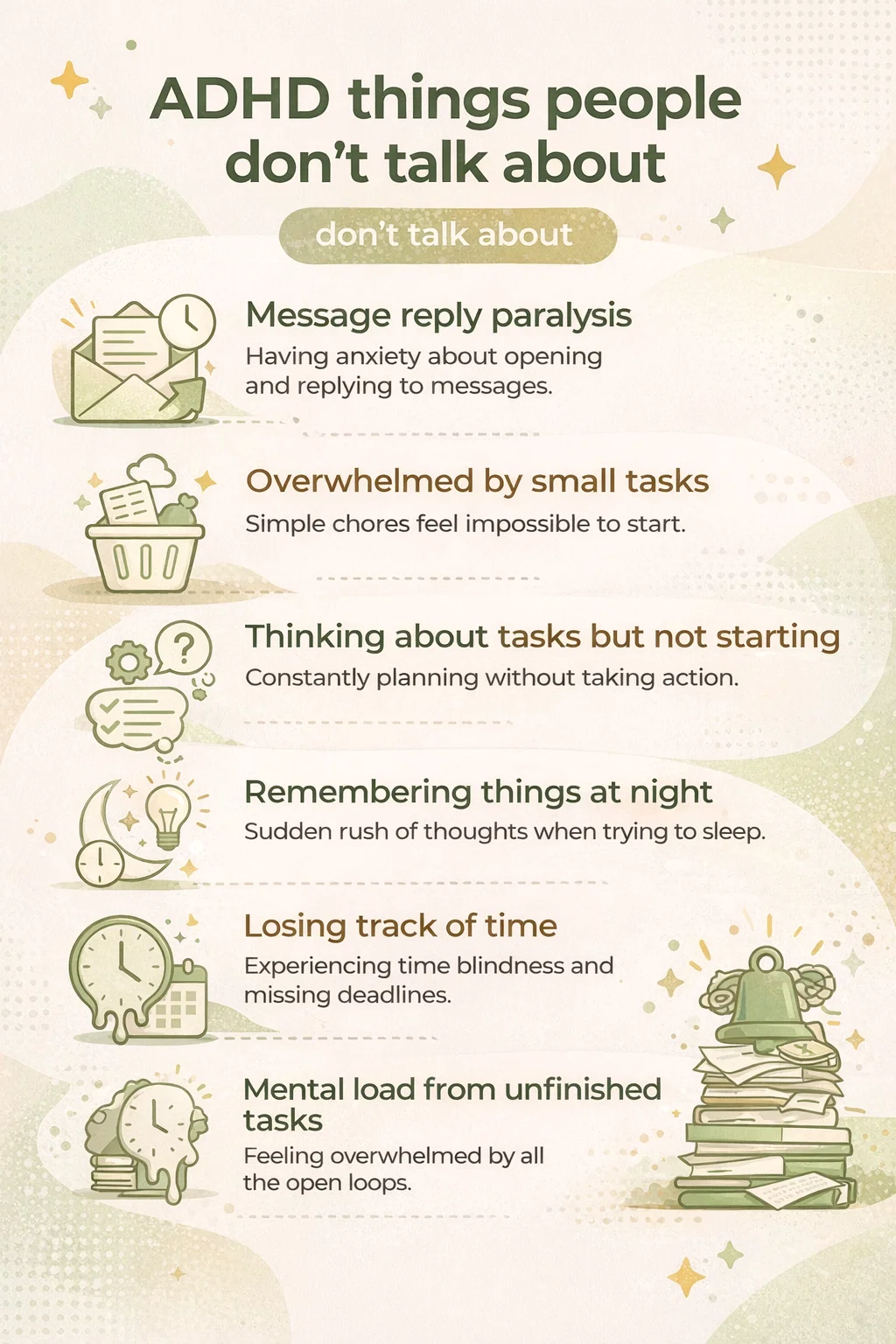
One of the most common yet rarely discussed aspects of the ADHD brain is the phenomenon of message reply paralysis. This is not about being rude or lazy. Instead, it is a complex intersection of overthinking and executive dysfunction. When a notification pops up, the brain immediately begins to simulate the entire conversation. You might worry about the tone of your response, the perfect choice of words, or the potential follow up questions that might require even more mental energy.
This overthinking leads to a state of avoidance. The longer a message sits unanswered, the more the anxiety grows. It becomes a cycle where the guilt of not replying makes the act of replying feel even more daunting. Breaking this cycle requires a shift in perspective. Giving yourself permission to send a short, imperfect response or using voice-to-text can help bypass the perfectionism that keeps you stuck.
When Small Tasks Feel Like Insurmountable Mountains
To a neurotypical brain, a task like doing the dishes or making a phone call is a single step. For someone with ADHD, that same task is perceived as a dozen separate, demanding actions. This is why small daily chores can lead to significant stress and overwhelm. The brain struggles to prioritize and sequence these steps, making the entire project feel like an insurmountable mountain.
This feeling of overwhelm often leads to task paralysis. You might find yourself staring at a cluttered counter, knowing exactly what needs to be done, but feeling physically unable to start. Understanding that this is a neurological hurdle rather than a character flaw is vital. By breaking these “mountains” into tiny, almost ridiculous steps, you can slowly build the momentum needed to reach the summit.
The Paradox of Thinking Without Acting
Many people with ADHD spend a massive amount of energy on their to-do lists without ever actually ticking an item off. This is the mental load of constant planning. Your brain might spend hours iterating on the best way to organize a closet or the most efficient route for errands. By the time you are ready to start, your mental battery is already drained from the sheer effort of thinking about the work.
This “waiting mode” is a common experience where you feel you cannot start anything else because you have a task looming in the future. It is a state of high alertness that yields zero productivity. Learning to move from the planning phase into the action phase often requires external cues, such as timers or body doubling, to jumpstart the brain out of its internal loop.
Why the Brain Wakes Up Just as You Need to Sleep
There is a peculiar trend in the ADHD community where the most brilliant ideas and the clearest memories of forgotten tasks appear right as your head hits the pillow. This late-night brain activity is often a result of the world finally becoming quiet enough for the ADHD mind to process the day. Without the distractions of daytime noise and social demands, the brain finally has the space to run at full speed.
While this can lead to bursts of creativity, it often results in sleep deprivation and increased anxiety about the following day. To manage this, many find success in keeping a “brain dump” notebook by the bed. Writing down every lingering thought or task allows the brain to release the “open loop” and feel secure enough to rest, knowing the information is saved for later.
Navigating the Fog of Time Blindness
Time blindness is a foundational element of the ADHD experience that affects almost every aspect of life. It is not just about being late; it is about a fundamental difficulty in perceiving the passage of time. For someone with ADHD, time is often divided into two categories: “now” and “not now.” This makes it incredibly difficult to estimate how long a task will take or how much time has passed since you started a project.
The Impact on Deadlines and Relationships
When hours pass unnoticed, deadlines can sneak up with terrifying speed. This often leads to a “crunch mode” where the individual relies on the adrenaline of a looming disaster to finally get the work done. In social settings, time blindness can be misinterpreted as a lack of respect for others’ time, causing strain in friendships and professional relationships. Utilizing visual timers and frequent alarms can provide the external structure that the internal clock lacks.
Strategies for Mapping Your Time
To combat time blindness, it helps to make time visible. Digital tools are great, but analog clocks and sand timers provide a physical representation of time “disappearing.” Routine also plays a massive role. By anchoring tasks to specific daily events, you can create a reliable rhythm that relies less on your internal sense of time and more on the environment around you.
The Heavy Toll of Unfinished Projects
Walking through the home of someone with ADHD often reveals a trail of “open loops.” These are the half-painted rooms, the half-read books, and the hobby supplies for a craft that was abandoned weeks ago. Each of these unfinished tasks carries a mental weight. Every time you walk past an incomplete project, your brain registers a small hit of guilt and a reminder of a perceived failure.
This background noise contributes to a constant state of low-level stress. The mental load of these open loops drains your energy even when you aren’t actively working on them. Coping with this involves practicing radical self-forgiveness and “closing” loops intentionally. This might mean admitting you won’t finish a project and putting the supplies away, or simply deciding that “good enough” is a valid stopping point.
Building a System for Emotional Regulation
Beyond the logistical challenges, ADHD involves a significant amount of emotional labor. Managing the frustration of forgotten keys or the rejection sensitivity that comes with social interactions is exhausting. Developing emotional intelligence is a key part of the wellness journey for neurodivergent individuals.
Mindfulness and self-reflection are powerful tools here. By recognizing the physical signs of overwhelm before they turn into a full meltdown, you can take proactive steps to regulate your nervous system. This might involve sensory breaks, deep breathing exercises, or simply stepping away from a stressful environment for a few minutes of quiet.
The Importance of Community and Shared Experience
Isolation is one of the hardest parts of living with these invisible symptoms. When you don’t talk about message paralysis or time blindness, you tend to assume you are the only one struggling. This leads to deep-seated feelings of shame. Finding a community where these experiences are normalized is life-changing.
Whether through support groups, online forums, or simple conversations with friends, sharing the load makes it lighter. When you realize that your “shortcomings” are actually recognized symptoms shared by millions, the shame begins to dissolve. This allows you to focus on finding solutions rather than punishing yourself for your brain’s natural wiring.
Designing a Space That Supports Your Brain
Your environment can either be a source of chaos or a sanctuary for your mind. For those with ADHD, minimalist and organized spaces are often highly beneficial, though difficult to maintain. The goal is to reduce the number of visual “shouts” that demand your attention. Every object out of place is a tiny distraction that can pull you away from your current goal.
Using organizational systems that prioritize visibility, such as clear bins or open shelving, helps prevent the “out of sight, out of mind” trap. When you can see your belongings, you are less likely to forget they exist or buy duplicates. A well-designed space acts as a prosthetic for the executive functions your brain finds challenging.
Nutrition and Physical Health as a Foundation
While ADHD is a neurological condition, it is heavily influenced by physical health. Nutrition plays a significant role in managing energy levels and cognitive function. Incorporating protein-rich meals and staying hydrated can help stabilize the dopamine levels that the ADHD brain craves. Similarly, regular physical activity is a natural way to boost neurotransmitters that aid in focus and mood regulation.
It is important to approach health from a place of curiosity rather than strict rules. Experimenting with different types of movement, from yoga to high-intensity training, can help you find what truly nourishes your body and mind. When your physical foundation is strong, the mental load of ADHD becomes much easier to carry.
Final Thoughts on Embracing the ADHD Journey
Understanding the things people don’t talk about regarding ADHD is more than just a lesson in symptoms; it is an invitation to view yourself with more kindness. The mental load map is a tool for navigation, helping you identify where the road gets rocky so you can prepare accordingly. By addressing message paralysis, time blindness, and the weight of unfinished tasks with practical strategies and self-compassion, you can navigate the world with greater ease.
Remember that your brain’s unique way of processing the world also brings with it incredible strengths, such as hyperfocus, creativity, and a unique perspective on problem-solving. The goal is not to “fix” your ADHD, but to build a life that accommodates your needs and celebrates your strengths. Keep exploring, keep learning, and most importantly, keep being kind to yourself as you manage the invisible load.