Stop Procrastinating Study Tips for Students and Last Minute Exam Prep
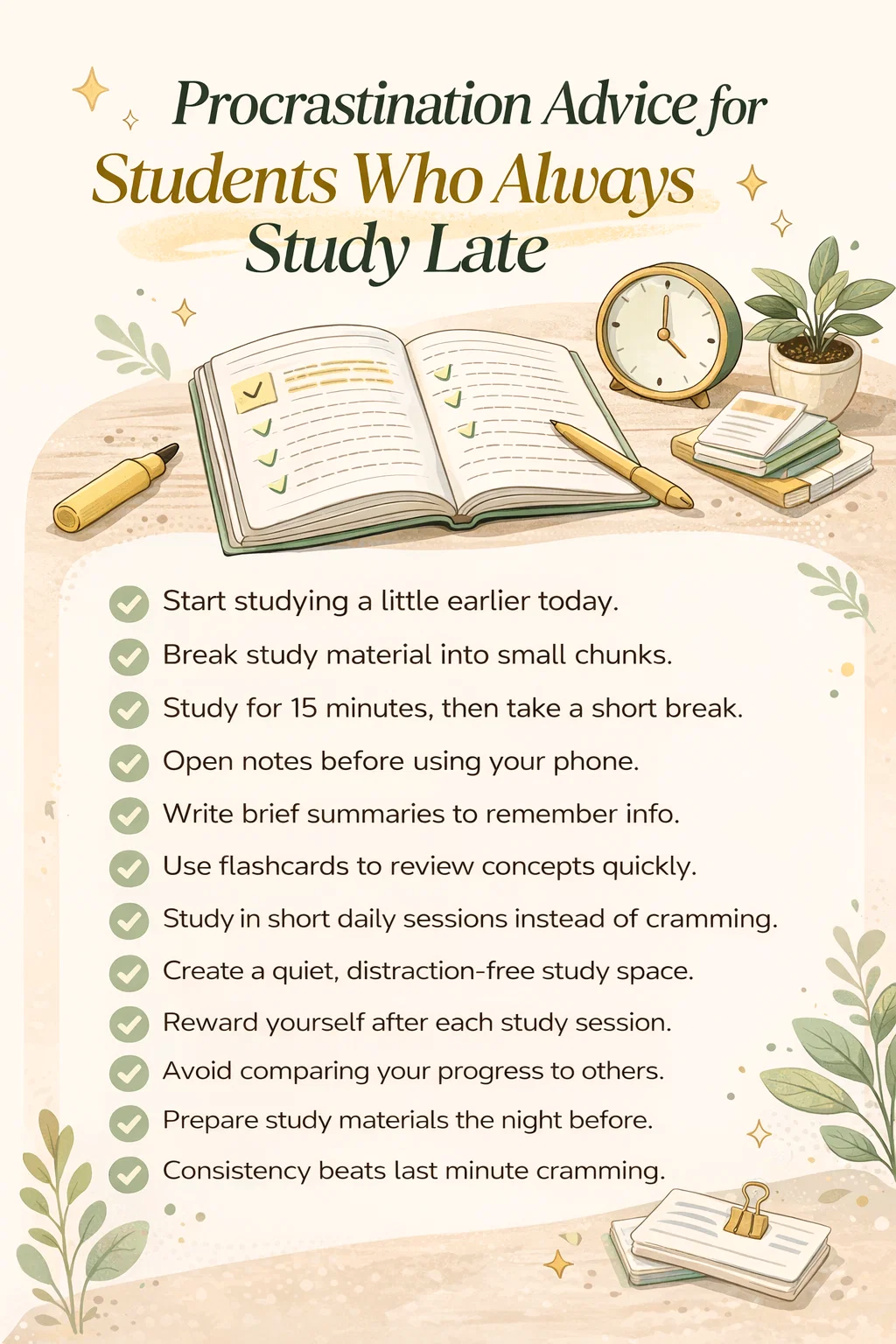
The crushing weight of an impending deadline, the familiar urge to “do it later,” and the inevitable late-night panic that follows – sound familiar? If you’re a student who constantly finds yourself studying at the eleventh hour, you’re not alone. Procrastination is a common struggle, particularly for students facing demands and countless distractions. But the cycle of procrastination can be broken, and the key lies not in some magic pill but in adopting smarter, more manageable habits that work for your brain, not against it. That beautiful infographic you see on your screen is your roadmap away from late-night cram sessions and towards a more peaceful, productive study life. It’s filled with simple, actionable steps, and in this article, we’re going to dissect each one, giving you the complete context and motivation you need to make them stick.
The advice in this image isn’t just a list of random tips; it’s a strategic system designed to gently guide your brain out of the fight-or-flight response that triggers procrastination. Let’s dive deep and understand how to apply each piece of this wisdom to your life, right now, today.
Understanding the Procrastination Trap: More Than Just Laziness
Before we break down the practical steps, it’s crucial to understand what procrastination really is. It’s not simply a matter of being lazy or having poor time management skills, though those elements can play a role. Procrastination is often a subconscious emotional defense mechanism. When faced with a large, overwhelming, or perhaps even boring task like studying for a major exam, your brain perceives it as a threat – a threat to your comfort, to your free time, or to your ego (what if you try hard and still fail?). In response, your amygdala (the brain’s emotional processing center) goes into overdrive, triggering a desire to avoid that threat by seeking immediate, easy gratification (cue the phone scrolling). This creates a temporary feeling of relief, which then reinforces the urge to procrastinate again. It’s a powerful, self-perpetuating loop. The tips in our image are powerful because they tackle this problem at its core: by making the “threat” smaller and more manageable, and by slowly building your brain’s tolerance for work and focus. They’re about gentle coaxing, not self-flagellation.
The First, Crucial Baby Step
Start Studying a Little Earlier Than Usual Today
This is the cornerstone. The problem with planning to start your entire studying routine over from scratch is that it’s too big of a goal. You will just procrastinate starting your new study routine. Instead of overhauling your whole life, just focus on this single action. If you typically start studying at 9:00 PM, challenge yourself to start at 8:45 PM. Or even 8:55 PM. The important thing is to prove to yourself that you can shift the dial, even a little. This small win creates momentum. It breaks the first, hardest resistance point, and that fifteen-minute difference can mean the difference between getting into a good groove and starting already exhausted. It’s about a 1% improvement, which, when compounded over time, leads to massive change.
Making the Material Less Intimidating
Break Your Study Material into Tiny Sections
One major reason we procrastinate is that the volume of study material feels mountainous and impossible. Looking at a 200-page textbook can induce instant paralysis. The trick is to stop looking at the mountain and start looking at the first pebble. A “tiny section” isn’t just a chapter; it’s not even a whole section. It could be two paragraphs, a single page, a list of definitions, or one example problem. By defining the next task so small that it feels laughable to ignore, you remove almost all initial resistance. Your brain sees “read two paragraphs” as a non-threatening, two-minute task. It’s a micro-goal that feels incredibly achievable, making it almost impossible to put off.
Study for Fifteen Minutes Before Taking Breaks
The standard Pomodoro Technique uses 25-minute work intervals, but for a chronic procrastinator, 25 minutes can still feel like a long time. Fifteen minutes is the perfect middle ground. It’s long enough to get something meaningful done, but short enough that your brain won’t revolt at the idea. This is the “just get in the door” approach. You can commit to 15 minutes. And here’s the secret: more often than not, once you get through that initial 15-minute resistance, you’ll find you have the momentum to continue. But even if you don’t, you have still made genuine progress, which is far better than zero.
Removing Friction and Creating Focus
Open Your Notes Before Touching Your Phone
Our phones are the absolute worst enemies of focus, specifically designed to trigger dopamine releases that keep us hooked. This tip is about creating environmental cues and positive associations. If the first thing your brain does when you sit down is scroll, it has just received a hit of easy reward, making it that much harder to shift into a work mindset. By making the deliberate choice to get your study material ready before succumbing to the phone, you’re creating a new ritual. This simple rule adds a friction point to the phone and makes the study materials your immediate focus, reducing the immediate pull of a distraction.
Focus on Understanding Instead of Memorizing Blindly
Let’s be honest, rote memorization is boring, feels endless, and is not particularly effective. Trying to blindly memorize a bunch of facts is a guaranteed recipe for burnout and procrastination. When you focus on truly understanding the concepts, the connections between ideas, and the “why” behind the material, you activate your brain in a completely different way. Understanding makes studying more engaging, and you will actually remember the information better in the long run. It shifts the task from being a chore to being an intellectually stimulating puzzle.
Tools for More Efficient Learning
Highlight Key Points Instead of Rereading Everything
Rereading entire chapters is one of the most passive and time-consuming study methods. It gives you a false sense of familiarity (“Oh, I know this,” you think as you skim) without truly cementing the information in your long-term memory. Instead of this “re-reading without thinking” approach, become an active reader. Use a highligher to pick out only the most critical points – key definitions, main arguments, crucial equations, or summarizing statements. This forces your brain to process the information to determine what is important, which is a powerful form of active learning. Later, when you review, you will only be engaging with the high-yield information, making your review sessions significantly more efficient.
Write Simple Summaries to Remember Information Faster
If you can’t explain a concept simply, you probably don’t understand it. That’s a powerful quote to keep in mind. After reading a section or chapter, challenge yourself to write a one or two-sentence summary of the core idea in your own words. This act of synthesizing and restating forces you to actively process and internalize the information. It’s one of the most effective techniques for encoding memories. It transforms you from a passive consumer of information to an active learner and will help you spot any gaps in your understanding instantly.
Use Flashcards to Review Concepts Quickly
Flashcards are the quintessential active recall tool. Instead of just looking at information, you are forcing your brain to retrieve it from memory, which is exactly what you will be doing on your exam. For every concept, definition, formula, or dates you need to know, make a flashcard. The process of making the cards is itself a form of study, and then you have a highly effective, portable review tool that can turn a five-minute wait for the bus or a quick coffee break into a powerful micro-study session.
Consistency and Self-Compassion are Key
Study in Short Daily Sessions Instead of Cramming
This is the golden rule that underpins the entire philosophy. Cramming is stressful, inefficient, and does not lead to long-term memory formation. Your brain learns best when information is spread out over time (the spacing effect). Imagine trying to eat all the food for a week in one sitting; it’s impossible and makes you sick. Cramming is the study equivalent of that. By studying in short, consistent, daily chunks, you will learn more effectively, retain the information longer, and experience significantly less stress. It’s about building a sustainable and healthy habit.
Reward Yourself After Completing Each Study Section
We are simple creatures. We repeat actions that give us immediate rewards. You have to actively build positive reinforcement into your study sessions. Since the main reward for studying (a good grade) is far in the future, you need to create your own smaller, immediate rewards. After finishing one of your “tiny sections” or a 15-minute chunk, allow yourself a five-minute break to listen to a favorite song, check Instagram, or have a small snack. This simple act tells your brain: “work equals reward.” The work is no longer just pain; it’s a necessary step to a tangible benefit, which is incredibly powerful motivation.
Track Study Time to Build Discipline Slowly
What gets measured, gets improved. The simple act of logging your study time can be highly motivating. Use a simple notebook or a time-tracking app to note down when you start and stop studying each day. Don’t overthink it; just a simple entry will do. After a week, look at your progress. You will likely be surprised at how those small sessions add up. Seeing the tangible evidence of your work can provide a huge sense of accomplishment and help build a habit that feels grounded in real-world actions, not just vague intentions.
Create a Quiet Study Environment Free from Distractions
Your environment dictates your behavior far more than you realize. If you try to study in front of the TV or in a noisy coffee shop, you are setting yourself up for failure. Our brain only has so much willpower, and fighting off constant distractions will quickly deplete it. Create a sacred space that signals “time to work” to your brain. This could be a specific desk in your room, a quiet corner of the library, or a designated study group room. The key is to remove as many visual and auditory distractions as possible so your brain can fully dedicate its focus to the material.
Avoid Comparing Your Progress with Classmates Constantly
In the social media age, this is a major source of stress. You see a classmate’s post about finishing their second textbook while you haven’t even cracked your first. This is a comparison trap that only serves to make you feel bad and demotivated. Remember, every person’s learning journey is unique. Someone might be re-reading everything passively while you are using high-value active learning techniques. Focus on your own growth and your own small, consistent wins. The only person you should be trying to beat is the version of you that procrastination wants to keep in its grip.
Focus on Progress Instead of Perfect Preparation
Perfectionism is another powerful engine for procrastination. You can spend days planning, organizing, finding the perfect highlighters, and organizing your binders, all while never actually cracking a book. You are “preparing to work” rather than actually working. This tip is about letting go of the perfect and embracing the good. Your study session won’t be perfect, you might not get through as much material as you want, and your summary sentences might not be elegant prose. But any work is better than no work. Focus on the simple fact that you are moving forward, one small step at a time.
Conclusion
The core message of this infographic is a profound and powerful one: change doesn’t have to be a monumental, painful event. It can be a series of very small, manageable shifts in behavior. By adopting just one or two of these tips today, you are starting to rewrite the script of your academic life. Don’t wait for the new semester or the new month. Start with something tiny, right now. Consistency always beats last minute panic studying. The path from a procrastinating night owl to a calm, productive student isn’t a single giant leap; it’s a long, steady walk, and these simple, actionable habits are your map for the journey.