
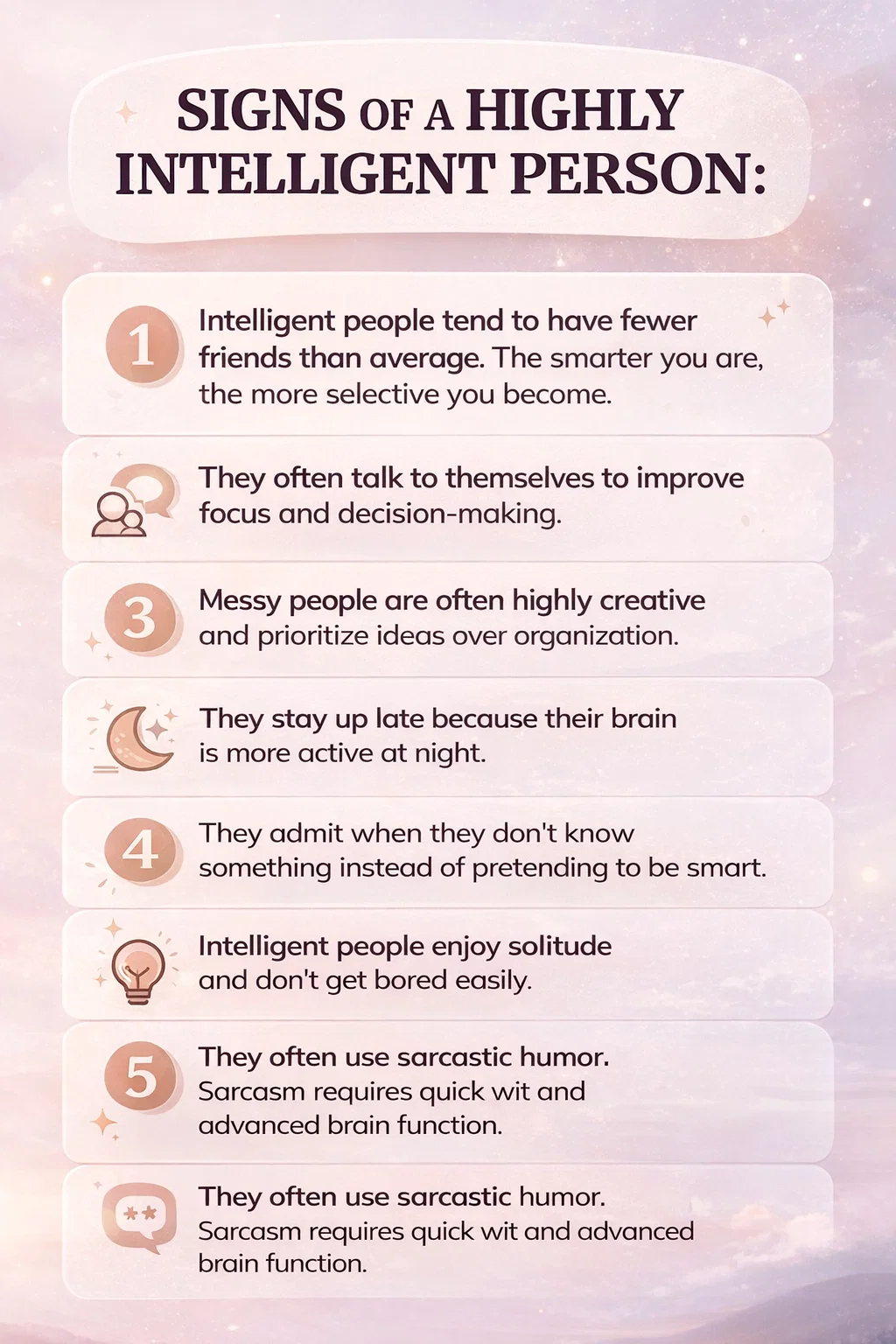
7 Surprising Signs of a Highly Intelligent Person You Might Have
Have you ever wondered if your quirks and habits are actually indicators of a sharper mind? Many of us go through life feeling a bit out of step with the crowd, perhaps preferring a quiet night in over a loud party or finding that our desks are perpetually buried under a mountain of papers. While society often pushes us to conform to a specific standard of organization and social butterfly behavior, science and psychology suggest that some of the most unconventional traits are actually hallmarks of high intelligence.
Understanding the architecture of the human mind is a complex task, but researchers have identified several consistent patterns among those who possess superior cognitive abilities. It is not just about IQ scores or academic achievements. Rather, intelligence often manifests in how we process information, interact with others, and manage our personal environments. If you have ever been called a night owl or been teased for talking to yourself, you might actually be displaying the traits of a genius. Let us dive deep into the fascinating signs that suggest you are highly intelligent.
1. The Power of a Small Social Circle
There is a common misconception that highly intelligent people are antisocial or lonely. In reality, they are simply highly selective. Research suggests that people with higher intelligence tend to have fewer friends than the average person. This is often referred to as the Savannah Theory of Happiness. While most people feel happier when they spend more time with friends, highly intelligent individuals often report lower life satisfaction when they socialize too frequently.
This happens because intelligent minds are often focused on long term goals and complex projects. Socializing, while enjoyable, can sometimes feel like a distraction from their intellectual pursuits. Furthermore, smart people tend to seek out deep, meaningful connections rather than a high volume of superficial acquaintances. If you find yourself perfectly content with just one or two close confidants, it is likely a sign that your brain is wired to prioritize quality over quantity.
2. The Benefits of Self Talk
If you have ever been caught whispering to yourself while solving a problem, you might have felt a bit embarrassed. However, talking to yourself is a classic sign of advanced brain function. This habit is not about losing your mind; it is about organizing it. When we speak our thoughts out loud, it helps us externalize our internal dialogue, making it easier to process complex information and stay focused.
Self talk serves as a powerful cognitive tool for decision making and memory retention. By narrating your actions, you are essentially reinforcing your brain’s executive functions. This practice helps in filtering out distractions and keeping the task at hand front and center. Great thinkers throughout history have been known to pace their rooms while debating with themselves, proving that the most brilliant conversations often happen within one’s own mind.
3. Creativity in the Chaos
Are you frequently told to clean your room or organize your workspace? Before you reach for the filing labels, consider this: a messy environment is often a breeding ground for creativity. Highly intelligent people often prioritize ideas and innovation over physical organization. When your mind is racing with new concepts and solutions, the placement of a coffee mug or a stack of mail becomes secondary.
A study from the University of Minnesota found that participants in a messy room came up with more creative ideas than those in a tidy room. A cluttered desk suggests that the person is breaking away from tradition and looking at things from a fresh perspective. If you thrive in a bit of chaos, it is because your brain is more concerned with the big picture than the minutiae of tidiness. Your mess is not a sign of laziness; it is a sign of a busy, creative mind.
4. The Brilliance of the Night Owl
While the world often rewards the early bird, many of the world’s greatest thinkers have been night owls. There is a strong correlation between high intelligence and the tendency to stay up late. This preference for nocturnal activity is thought to be an evolutionary shift. In ancient times, the night was a time of danger, and those who were clever enough to navigate the darkness developed different circadian rhythms.
In the modern world, the quiet hours of the night provide a sanctuary for deep work. Without the interruptions of emails, phone calls, or social obligations, the brain is free to explore complex thoughts. If you find that your best ideas come to you after midnight, it is because your brain is naturally more active during these quiet hours. Your late night sessions are a testament to your mind’s desire for uninterrupted intellectual exploration.
The Science of Circadian Rhythms and IQ
Studies have shown that children who grow up to be more intelligent are more likely to be nocturnal adults. This does not mean that morning people are not smart, but rather that the ability to override the natural light dark cycle of the sun is a sign of cognitive flexibility. Being a night owl allows you to claim a part of the day that is entirely your own, fueling a unique sense of independence and creativity.
5. Intellectual Humility: Knowing What You Do Not Know
One of the most profound signs of intelligence is the ability to admit when you do not know something. This is often linked to the Dunning-Kruger effect, a cognitive bias where people with low ability at a task overestimate their ability. Conversely, highly intelligent people tend to underestimate their own competence because they are acutely aware of how much information is actually out there.
Instead of pretending to be an expert in every field, a smart person is comfortable saying, I do not know, but I am willing to learn. This intellectual humility is a major asset. It opens the door to growth, curiosity, and the acquisition of new skills. By recognizing the limits of your knowledge, you show a level of self awareness and honesty that is rare and highly valuable in any professional or personal setting.
6. Valuing Solitude and Avoiding Boredom
Highly intelligent people rarely get bored when they are alone. In fact, they often cherish their alone time. For a sharp mind, solitude is not about being lonely; it is about having the space to think, reflect, and engage in hobbies. Whether it is reading, coding, painting, or simply pondering the mysteries of the universe, an intelligent person’s internal world is rich and stimulating.
Because their brains are constantly processing information, they do not need external stimulation to feel entertained. This independence from social validation or constant activity allows them to develop a strong sense of self. If you find that you are your own best company and that a weekend alone feels like a luxury rather than a punishment, your intelligence is likely the reason why.
7. Sarcasm: The Language of the Quick Witted
Do you have a dry sense of humor or a penchant for sarcasm? While it can sometimes be misunderstood, sarcasm is actually a sign of advanced brain function. Utilizing sarcasm requires a person to recognize the discrepancy between literal meaning and intended meaning, which is a sophisticated linguistic and social exercise.
Research has shown that being able to understand and use sarcasm requires a high level of theory of mind. You have to understand the mental state of the person you are talking to and anticipate how they will interpret your words. Furthermore, sarcasm has been linked to increased creativity. It forces the brain to think outside the box to bridge the gap between two opposing ideas. If you are the person with the quick, sarcastic comeback, your brain is operating at a high frequency.
The Social Intelligence of Wit
While sarcasm is often seen as biting, when used correctly, it demonstrates a high level of social intelligence. It shows that you can read a room, understand nuances, and manipulate language in a way that is both funny and insightful. It is a mental gymnastic that keeps the brain sharp and the conversation engaging.
Conclusion: Embracing Your Unique Mind
Intelligence is a multifaceted trait that goes far beyond what we learn in a classroom. It is reflected in our habits, our social preferences, and even our sense of humor. If you recognized yourself in these seven signs, it is time to embrace your unique cognitive blueprint. Whether you are staying up late, talking to yourself in a messy room, or choosing a quiet evening over a crowded party, remember that these are not flaws. They are the characteristics of a highly intelligent mind.
By understanding these traits, we can stop judging ourselves for not fitting into a conventional mold and start valuing the strengths that come with a high IQ. Intelligence brings with it a curiosity to explore the unknown and a resilience to seek out truth. Continue to nurture your curiosity, stay humble in your learning, and never be afraid to let your brilliant, unconventional self shine through.