
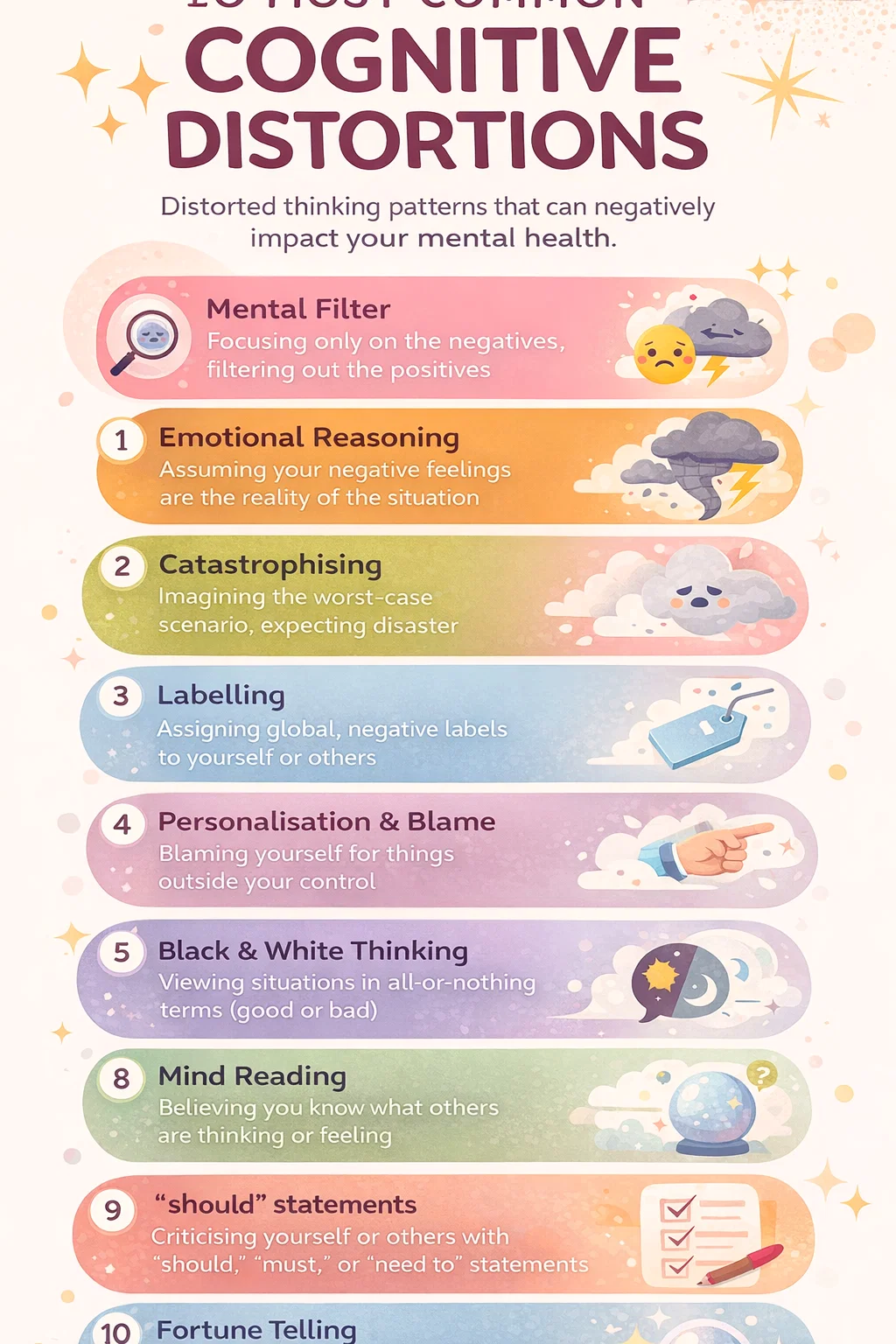
10 Most Common Cognitive Distortions CBT Therapy Guide Mental Health Tips
Understanding the inner workings of our minds is one of the most powerful steps we can take toward a healthier, happier life. Often, we feel stuck in a cycle of stress or negativity without truly knowing why. The answer frequently lies in cognitive distortions, which are essentially habitual ways of thinking that are often inaccurate and negatively biased. These mental traps can sneak into our daily lives, coloring our perceptions of ourselves and the world around us. By learning to identify these patterns, we can begin to dismantle them and replace them with more balanced, realistic perspectives.
What Are Cognitive Distortions?
Cognitive distortions are biased ways of thinking that aren’t based on facts. They are like looking through a warped lens that makes things appear more negative than they actually are. Everyone experiences them to some degree, but when they become frequent, they can contribute to anxiety, depression, and low self-esteem. The concept was popularized by psychiatrists Aaron Beck and David Burns, who identified that it isn’t necessarily the events in our lives that cause us distress, but rather the way we interpret those events.
Why Our Brains Use These Traps
You might wonder why our brains would ever choose to think in a way that makes us feel bad. Evolutionarily, our minds are wired for survival. Historically, being hyper-aware of potential threats helped us stay alive. In the modern world, this survival instinct can manifest as a “mental filter” or “catastrophizing,” where the brain fixates on the worst-case scenario to protect us. While well-intentioned, these habits often do more harm than good in our contemporary social and professional environments.
The 10 Most Common Cognitive Distortions Explained
Identifying a problem is the first step toward solving it. Let’s dive deep into the ten most common distortions so you can start recognizing them in your own internal monologue.
1. Mental Filter
The mental filter is like wearing a pair of glasses that only lets in dark light. You focus exclusively on a single negative detail and dwell on it so much that your entire vision of reality becomes darkened. If you receive a performance review with nine glowing compliments and one suggestion for improvement, a mental filter causes you to ignore the praise and obsess over the one critique.
2. Emotional Reasoning
This is the belief that your thoughts must be true because you feel them so strongly. You might think, “I feel overwhelmed, so my life must be a mess,” or “I feel guilty, so I must have done something wrong.” Emotional reasoning ignores the fact that feelings are reactions to thoughts and may not reflect the actual situation at hand.
3. Catastrophizing
Also known as “magnifying,” this distortion involves jumping to the absolute worst-case scenario. If you make a small mistake at work, you might immediately think you are going to get fired, lose your house, and never find another job. It takes a small spark and turns it into a forest fire in your mind.
4. Overgeneralization
When you overgeneralize, you take one single event and turn it into a never-ending pattern of defeat. You use words like “always” or “never.” If you go on one bad date, you might think, “I will never find love.” It is a way of predicting a global outcome based on very limited evidence.
5. Labelling
Labelling is an extreme form of overgeneralization. Instead of saying “I made a mistake,” you attach a global negative label to yourself, such as “I am a loser” or “I am a failure.” This turns a temporary action into a permanent identity, which makes it much harder to move forward and improve.
6. Personalization and Blame
This distortion works in two ways. Personalization is when you hold yourself personally responsible for an event that isn’t entirely under your control. For example, if a friend is in a bad mood, you assume it is because of something you did. Conversely, blame is when you hold others responsible for your pain while ignoring your own role in the situation.
7. Black and White Thinking
This is also called “all or nothing” thinking. You see things in extremes with no middle ground. You are either a success or a total failure, and your performance is either perfect or a disaster. This mindset makes it impossible to appreciate progress or the nuance of being human.
8. Mind Reading
Mind reading is the assumption that you know exactly what others are thinking or why they are acting a certain way without any actual evidence. You might walk past a coworker who doesn’t say hello and immediately assume they are angry with you, when in reality, they might just be deep in thought.
9. “Should” Statements
We often try to motivate ourselves with “shoulds,” “musts,” and “ought tos.” While this sounds productive, it usually results in guilt and frustration. When we direct “shoulds” toward others, we feel anger and resentment because they aren’t living up to our unspoken rules.
10. Fortune Telling
Similar to mind reading, fortune telling involves predicting that things will turn out badly before they even happen. You might skip an opportunity because you have already decided that you won’t succeed or that you won’t enjoy yourself, effectively creating a self-fulfilling prophecy.
How to Break the Cycle of Distorted Thinking
Once you recognize these patterns, you have the power to challenge them. This isn’t about forced positivity, but rather about seeking accuracy and balance.
The Power of Fact-Checking Your Thoughts
The next time you catch yourself in a “should” statement or catastrophizing, stop and ask: “What is the evidence for this thought?” Write down the facts that support the thought and the facts that contradict it. Usually, you will find that the evidence for the distortion is much thinner than you initially realized.
Reframing and Finding the Middle Ground
Instead of letting black and white thinking dominate, look for the shades of gray. If you didn’t finish your entire to-do list, instead of saying “I was lazy today,” try reframing it to “I didn’t get through everything, but I finished the three most important tasks.” This shift acknowledges reality without the unnecessary harshness.
Building Mental Resilience for the Long Term
Changing your thinking habits takes time and practice. It is like training a muscle; the more you consciously challenge your distortions, the easier it becomes to stay grounded in reality.
The Role of Mindfulness
Mindfulness helps you become an observer of your thoughts rather than a participant in them. By practicing mindfulness, you can notice a cognitive distortion as it arises, label it for what it is, and let it pass by without letting it dictate your mood or your actions.
Journaling as a Tool for Clarity
Writing your thoughts down is one of the most effective ways to spot patterns. When you see your thoughts on paper, the distortions often become much more obvious. You can look back at past entries and realize how many times your “fortune telling” was wrong or how your “mind reading” was based on nothing but your own insecurities.
Creating a More Compassionate Inner Dialogue
At the heart of overcoming cognitive distortions is the practice of self-compassion. Many of us speak to ourselves in ways we would never dream of speaking to a friend. If a loved one told you they felt like a failure because they made one mistake, you would point out all their successes and offer support. Try to offer that same kindness to yourself.
Replacing “Should” with “Could”
A simple linguistic shift can make a huge difference. Change “I should exercise today” to “I could exercise today because it makes me feel energized.” This moves the motivation from a place of pressure and guilt to a place of choice and benefit, making you much more likely to follow through without the mental burden.
When to Seek Professional Support
While self-help strategies are incredibly beneficial, sometimes these patterns are deeply ingrained and difficult to untangle alone. Cognitive Behavioral Therapy (CBT) is specifically designed to help people identify and change these exact distortions. Working with a therapist can provide you with personalized tools and a safe space to explore where these thinking habits originated and how to move past them.
The Benefits of CBT
- Develops practical coping skills for daily life.
- Helps manage symptoms of anxiety and depression.
- Improves communication and relationship dynamics.
- Builds a stronger sense of self-awareness and confidence.
Conclusion: Your Journey to a Clearer Mind
Navigating the complexities of the human mind is a lifelong journey, but it is one of the most rewarding adventures you can undertake. By shining a light on the 10 most common cognitive distortions, you have already taken a massive step toward emotional freedom. Remember that having these thoughts doesn’t make you weak or broken; it simply makes you human. The goal isn’t to never have a distorted thought again, but to become so familiar with them that they no longer have the power to control your happiness. Stay curious, stay compassionate, and keep questioning the stories your mind tells you. A more balanced and peaceful life is well within your reach.