6 Ways to Stop Procrastination From Goal Setting to Daily Action Strategies
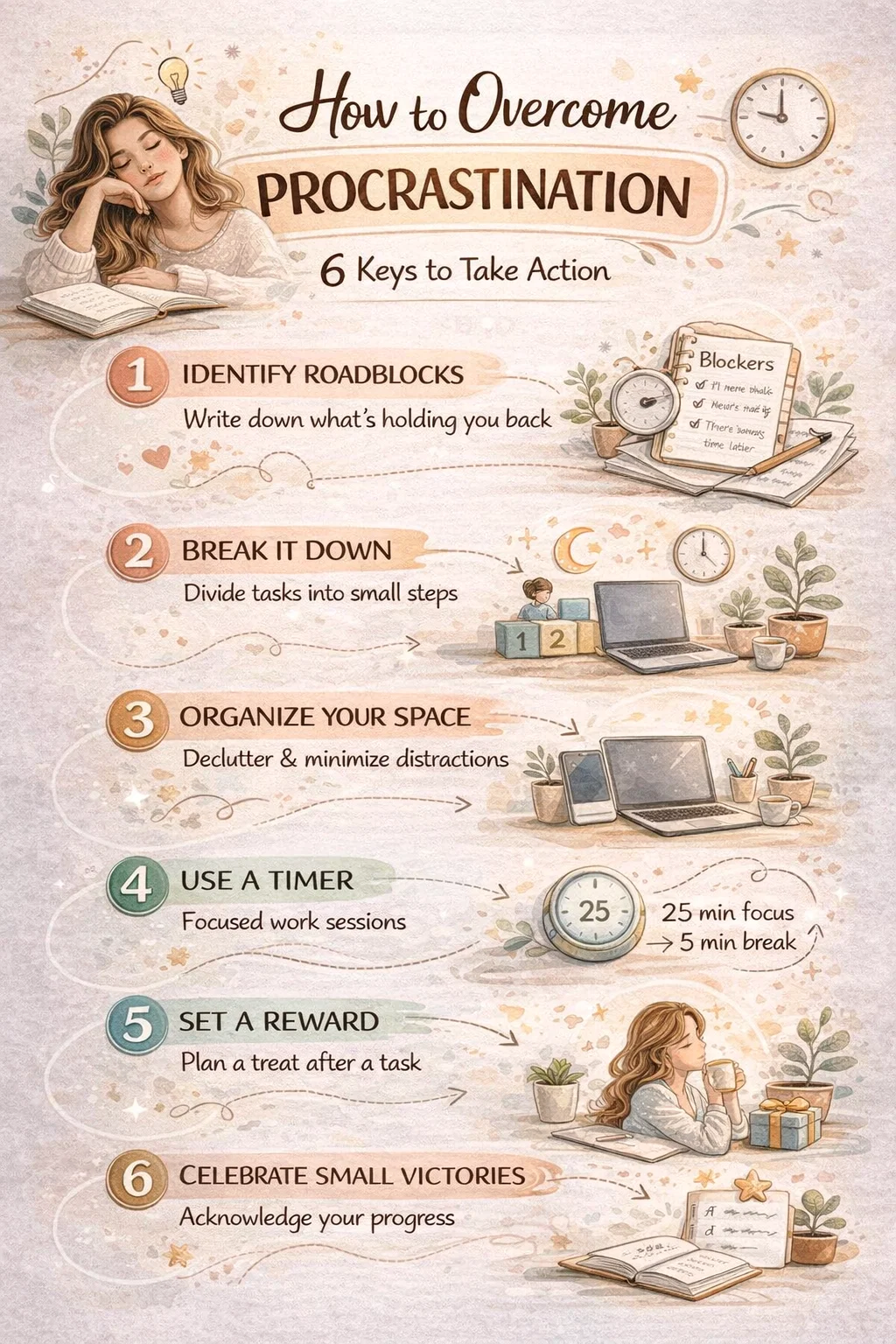
Do you ever feel like your best-laid plans go up in smoke the moment you actually sit down to work? Do you find yourself reorganizing your sock drawer when you should be writing that critical report, or doom-scrolling through social media instead of studying? You are not alone. Procrastination is the invisible weight that holds back countless dreams, and it doesn’t care about your potential. The good news is that procrastination is not a moral failing or a sign of laziness; it’s a learned behavior, often a response to overwhelm or fear. And since it is learned, it can be unlearned. The beautiful infographic we see here isn’t just a pretty picture; it is a battle plan. It lays out six simple, powerful keys that can unlock your momentum. Let’s dig deep into these strategies and figure out how to put them into action to finally conquer your procrastination.
Step One: Listen to Your Internal Obstacles
The journey from inaction to action always begins within. Often, we are our own worst enemies, but we aren’t even aware of it. The first key to combating procrastination is to pause and listen to that little voice in your head—the one that starts whispering (or sometimes shouting) roadblocks the second you think about getting started. The infographic calls this “Écoute ce qui coince” and it’s about noting the thoughts that are actively holding you back. These aren’t just thoughts; they are the very blueprints of your avoidance.
Identify the Specific “No” Thoughts
The image points out two very common examples of these internal blocks. The first is: “Je n’y arriverai jamais” (“I will never make it”). This is the voice of perfectionism or imposter syndrome. It demands that the outcome be flawless right out of the gate, and since flawless is impossible, your brain’s defensive mechanism is to avoid the task altogether. By recognizing this thought, you can challenge it. The goal isn’t to create a masterpiece immediately; it’s just to create. The second example, “J’ai le temps pour ça plus tard” (“I have time for that later”), is the classic delay tactic. This thought is a master deceiver, robbing you of the present moment and pushing your future self into a stressful corner. Identifying these specific patterns is the crucial first step in dismantling them. If you can’t see the obstacle, you can’t climb over it.
Step Two: Divide and Conquer with Tiny Tasks
Once you’ve identified your mental blocks, the actual work can still feel mountainous. That mountain is a major procrastination trigger. Your brain sees the entire project and instinctively thinks, “I can’t possibly do that all at once.” The second key, “Divise la tâche” (“Divide the task”), is about making that mountain a series of flat, easily traversable steps. The idea of “fractionner en petites étapes” (breaking into small steps) is where overwhelm dies. It transforms a paralyzing project into a checklist of manageable, non-intimidating action items.
Create Micro-Goals You Can’t Say No To
Think about a huge project like writing a twenty-page research paper. Staring at a blank document and a deadline three weeks away is a recipe for procrastination. But the infographic’s examples of dividing are brilliant. Instead of “Write the paper,” try a micro-goal like “Planifier 1ère page” (Plan the 1st page). This is so small and concrete that your brain won’t see it as a threat. Another excellent example is “Étudier 10 minutes” (Study 10 minutes). Anyone can do something for ten minutes. It removes the need for enormous willpower. You aren’t committing to an all-night study session; you are committing to a short burst. These tiny, low-stakes micro-goals are the essential fuel that builds initial momentum. The moment you complete just one, you’ve broken the spell of inaction.
Step Three: Architect an Environment for Success
You may not realize it, but your physical surroundings have a direct impact on your cognitive load and focus. A cluttered desk isn’t just a physical mess; it’s a visual representation of all the unfinished business, other projects, and distractions vying for your attention. The third key, “Créer une ambiance propice” (“Create an optimal environment”), recognizes that you need to actively shape your workspace to support your work, not hinder it. You are trying to remove every possible reason your brain has to wander, and that starts with your environment.
Your Environment Is Not Neutral
The call to action is simple: “Range et organise ton espace” (Tidy and organize your space). Before you even attempt to start your work, take five minutes to clear your physical field. If you are working on your computer, apply this digitally too. Close the fifty open tabs, turn off notifications, and create a single, clean workspace. The infographic also offers an alternative idea that many people overlook: “Bruit blanc” (White noise). For some, a perfectly silent room is full of phantom noises, or the quiet is itself distracting. White noise can create a consistent auditory field that helps drown out sudden, jarring sounds and keeps your focus locked in. Your workspace is either a launchpad or a swamp. Make sure it’s a launchpad.
Step Four: Master the Art of the Sprint
We often think that the goal is to work for hours straight, and when we can’t, we give up before even starting. The fourth key, “Fixe-toi un timer” (“Set a timer for yourself”), introduces a sustainable and surprisingly simple technique for managing time and energy. This is a game-changer for people who find their focus flickering. The core principle is “utiliser le chronomètre par séquences” (use the timer in sequences). You aren’t committing to a vague block of time; you are committing to a precise, timed sprint.
Focus with the Power of the Pomodoro
The image details a classic time-management technique that often goes by the name of the Pomodoro Technique. It is built on a simple cycle: “25 min focus → 5 min pause.” This structure is genius. First, 25 minutes is a small enough commitment that your brain doesn’t feel overwhelmed. Second, knowing that a break is guaranteed after a short, intense burst makes that focus much easier to maintain. When you work with a timer, you aren’t fighting a endless marathon; you are winning a series of short, achievable races. The break is equally essential. It gives your brain a chance to process and reset, preventing the fatigue that so often leads back to mindless scrolling. Don’t fight your brain’s natural need for rest; use it to your advantage.
Step Five: Leverage the Power of Rewards
If there’s one thing human psychology is absolutely certain about, it’s that we are driven by incentives. When we procrastinate, we are often choosing immediate gratification (the comfort of avoiding the task) over long-term reward. The sixth key (wait, why is it numbered 6? Let’s assume that’s a small design tic in our beautiful infographic and jump into its wisdom as Step Five), “Une récompense à la clé” (“A reward at the end”), is the strategy for re-aligning your incentives. Instead of just grinding away at a task with no defined positive outcome, you build a positive loop.
Create Positive Conditioning for Your Effort
The advice “Planifie une récompense après l’effort” (Plan a reward after the effort) is about creating something concrete to look forward to. This isn’t just about finishing; it’s about conditioning your brain to associate effort and focus with positive outcomes. What counts as a reward is personal, but the infographic provides excellent examples. “Lecture inspirante” (Inspirational reading) can feed your mind. “Petit plaisir” (A small pleasure), like a good cup of coffee or a walk outside, is simple yet effective. The reward doesn’t have to be large; it just has to be meaningful and, crucially, something you only get once the task is complete. This system creates a powerful sense of accomplishment and teaches you to look at work not as a punishment, but as the prerequisite for a well-earned joy. It turns a chore into a challenge with a prized finish line.
Bringing it All Together
The keys to overcoming procrastination aren’t complex secrets; they are simple, repeatable practices. You can’t just pick one and expect magic to happen. The real power comes when you combine them. The infographic isn’t just a list; it’s a toolkit. You start by quieting the internal roadblocks (Key 1). Then, you break the overwhelming task into tiny, executable pieces (Key 2). You set the scene for success by organizing your space (Key 3). To manage your energy, you work in focused bursts using a timer (Key 4). Finally, you celebrate every success, no matter how small, with a planned reward (Key 6). These strategies build on one another to create an undeniable momentum.
Your Final Step: Epingle cette liste pour passer à l’action!
The bottom of this wonderful illustration has one final, critical instruction: “Epingle cette liste pour passer à l’action!” (Pin this list to pass to action!). This is not just a polite suggestion; it is the most crucial part. Knowledge is just potential energy. It means nothing until it is put into practice. The simple act of printing this list and pinning it where you work creates a persistent visual reminder of your toolkit. In those moments when the old, familiar weight of procrastination starts to set in, you will have your battle plan right in front of your eyes. Procrastination steals time and possibility, but with these six keys, you can reclaim them both. It won’t happen all at once, and some days will be harder than others, but with each micro-goal completed and each focused sprint finished, you are building the discipline that will let you design the life you want. The time for delay is over. The time for action is now. Use these keys, and go claim your potential.