4 Psychology Tricks Everyone Needs To Know To Change Your Life For Good
Have you ever felt like your own mind is working against you? It is a common frustration. You set a goal to start a new project, hit the gym, or finally organize that cluttered closet, but suddenly your brain comes up with a dozen reasons to wait until tomorrow. This mental friction is not a sign of laziness; it is simply how the human brain is wired to avoid discomfort. However, what if you could use that same wiring to your advantage? By applying specific psychological triggers, you can bypass resistance and unlock a level of productivity and confidence you never thought possible.
The beauty of psychology is that it provides a roadmap for behavior. When you understand the “why” behind your actions, you can implement small “hows” to change them. The following strategies are designed to act as shortcuts for your brain, helping you navigate through procrastination, self-doubt, and mental fatigue. Let us dive deep into these transformative tricks and see how they can reshape your daily life.
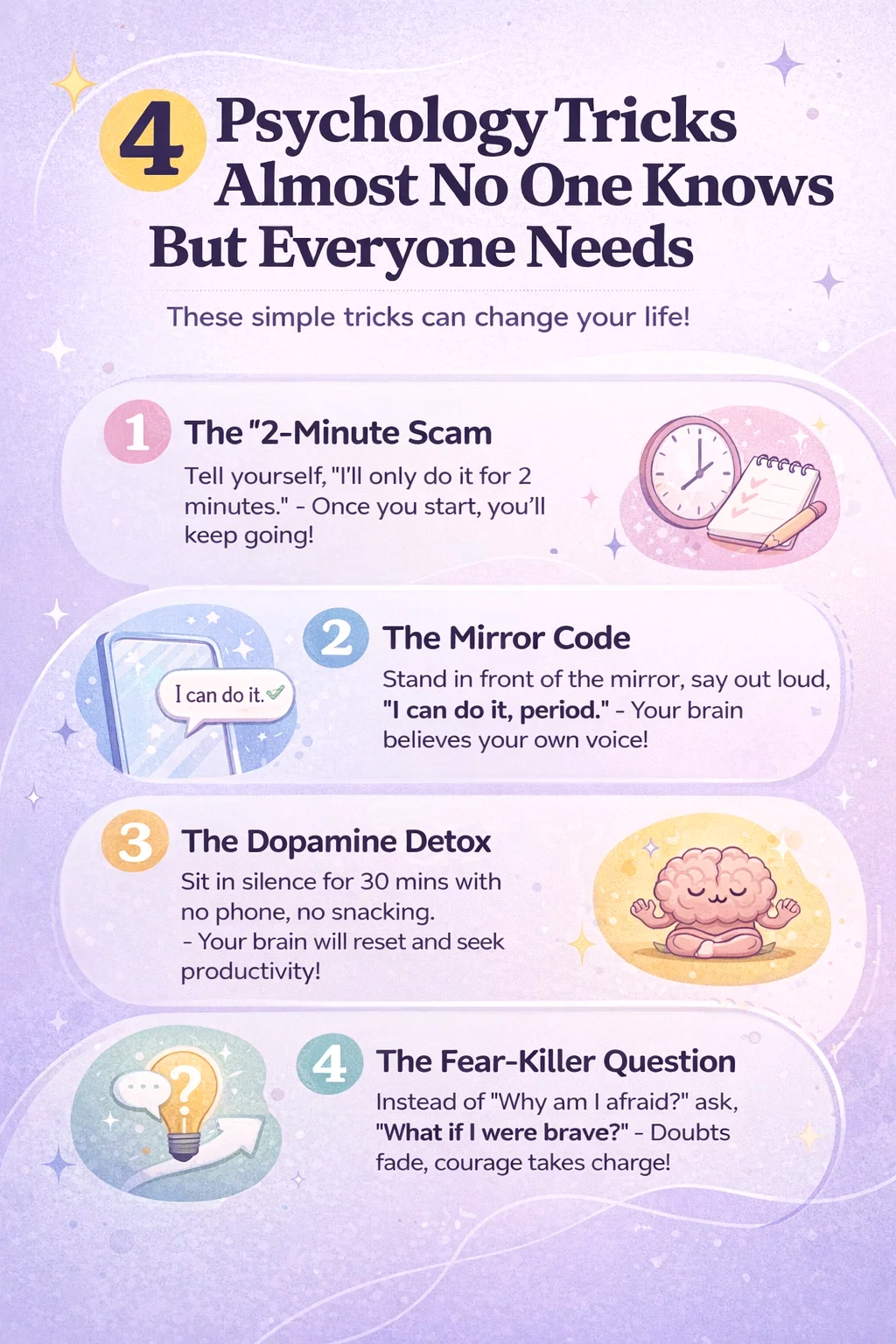
The 2-Minute Scam: Tricking Your Brain into Action
One of the biggest hurdles to success is simply starting. The human brain often views a large task as a threat to its energy reserves. This is where the 2-minute scam comes into play. The premise is incredibly simple: tell yourself that you will only work on a task for exactly two minutes. Whether it is writing a report, cleaning the kitchen, or practicing an instrument, the commitment is so small that your brain cannot find a reason to argue against it.
Why the 2-Minute Rule Works
This trick works because it addresses the “startup cost” of any activity. Most of our resistance exists in the transition from doing nothing to doing something. Once you have crossed that threshold and spent two minutes on a task, you have already broken the seal of procrastination. Usually, you will find that the momentum carries you forward. Your brain, which hated the idea of starting, now finds it more comfortable to keep going than to stop and switch gears again.
Practical Applications for Daily Productivity
- Exercise: If you cannot get motivated for a full workout, tell yourself you will just put on your shoes and stretch for two minutes.
- Reading: Commit to reading just one page or for two minutes before bed.
- Work Projects: Open the document and commit to writing just two sentences.
The Mirror Code: Harnessing the Power of Your Own Voice
We often underestimate the impact of our internal and external dialogue. The mirror code is a technique where you look at yourself in the eyes and state your intentions or capabilities out loud. By saying, “I can do it, period,” you are not just thinking a thought; you are creating a sensory experience. Your brain hears your voice as a trusted source of information, much like it would listen to a mentor or a close friend.
The Science of Self-Affirmation
When you speak to yourself in the mirror, you are utilizing several psychological mechanisms. First, you are practicing self-reflection, which helps ground you in the present moment. Second, you are providing positive reinforcement. Hearing your own voice validate your strength helps to quiet the “inner critic” that often lives in the back of your mind. Over time, this builds a stronger self-image and a more resilient mindset.
How to Practice the Mirror Code
To make this effective, consistency is key. Try doing this every morning as you get ready. Stand tall, maintain eye contact with your reflection, and speak with conviction. It might feel a bit strange at first, but the shift in your confidence levels will be undeniable. You are essentially training your brain to see you as the authority in your own life.
The Dopamine Detox: Resetting Your Motivation Levels
In today’s digital age, we are constantly bombarded with instant gratification. Between social media notifications, short-form videos, and sugary snacks, our dopamine receptors are often overstimulated. This leads to a state where “normal” productive activities like reading or working feel incredibly boring. The dopamine detox is a way to hit the reset button on your brain’s reward system.
The Power of Doing Nothing
The trick is to sit down for 30 minutes and do absolutely nothing. No phone, no music, no talking, and no reading. Just sit with your thoughts. At first, your brain will scream for stimulation. You might feel restless or bored. However, after about fifteen to twenty minutes, something fascinating happens. Your brain becomes so desperate for something to do that it begins to view productive tasks as a relief.
Finding Creativity in Boredom
When you remove the constant noise of the digital world, your brain starts searching for its own entertainment. This is often when the best ideas strike. Suddenly, cleaning your room or starting that creative project seems much more appealing than sitting in silence. By intentionally embracing boredom, you regain control over your focus and find a renewed drive to be productive without the need for constant external pings.
The Fear-Killer Question: Shifting from Fear to Bravery
Fear is a natural response, but it often keeps us stuck in a cycle of over-analysis. When we feel afraid, we usually ask ourselves, “Why am I afraid?” or “What if this goes wrong?” These questions only lead us deeper into the rabbit hole of anxiety. The fear-killer question changes the narrative entirely. Instead of focusing on the emotion, you ask yourself: “What would I do if I were brave?”
Reframing Your Decision-Making Process
This question is powerful because it shifts you from a reactive state to a proactive one. It forces your brain to visualize a version of yourself that is capable and courageous. By imagining what a brave person would do, you provide yourself with a clear action plan. It removes the emotional weight of the fear and replaces it with a logical next step. You stop debating the “what ifs” and start focusing on the “what now.”
Using the Question in High-Stakes Situations
Whether you are considering a career change, having a difficult conversation, or trying something new, this question serves as a compass. It helps you bypass the paralysis that comes with fear. Remember, bravery is not the absence of fear; it is the decision that something else is more important. Asking what a brave version of you would do gives you permission to act despite the butterflies in your stomach.
The Long-Term Impact of Psychological Habits
Implementing these four tricks is not just about a one-time success. It is about building a foundation for a healthier relationship with your mind. When you consistently use the 2-minute scam, the mirror code, the dopamine detox, and the fear-killer question, you are essentially rewiring your neural pathways. You are teaching your brain that you are a person of action, confidence, and resilience.
Building Mental Resilience
Each time you choose to follow through on a task or stand up to your fears, your mental “muscle” grows stronger. Habits that used to feel like a struggle will eventually become second nature. The psychological resistance that once felt like a brick wall will become a small hurdle that you know exactly how to clear. This is the essence of personal growth: the small, daily victories that accumulate into a transformed life.
Integrating These Tricks into a Busy Lifestyle
You do not need hours of free time to start using these techniques. In fact, they are designed for people with busy, chaotic lives. The mirror code takes thirty seconds. The 2-minute scam is, by definition, only two minutes. Even the dopamine detox can be shortened to ten minutes if that is all you have. The key is not the duration, but the intention behind the act. Start where you are, use what you have, and watch how these small shifts create a massive ripple effect in your productivity and happiness.
Conclusion: Your Mind is Your Greatest Tool
The journey toward self-improvement is often paved with complicated theories and expensive programs. However, as we have seen, some of the most effective changes come from simple psychological adjustments. By understanding how your brain works, you can stop fighting against yourself and start moving in the direction of your dreams. You have the power to “scam” your way out of procrastination, speak yourself into confidence, reset your motivation, and outsmart your fears.
These tricks are not just “hacks”; they are tools for a more intentional life. When you apply them, you are taking ownership of your mental state. You are deciding that your goals are worth the effort and that your potential is worth exploring. So, the next time you feel stuck, remember that a different outcome is only a 2-minute start or a brave question away. Take these strategies, put them into practice, and enjoy the incredible transformation that follows. Your future self will thank you for the courage you show today.