
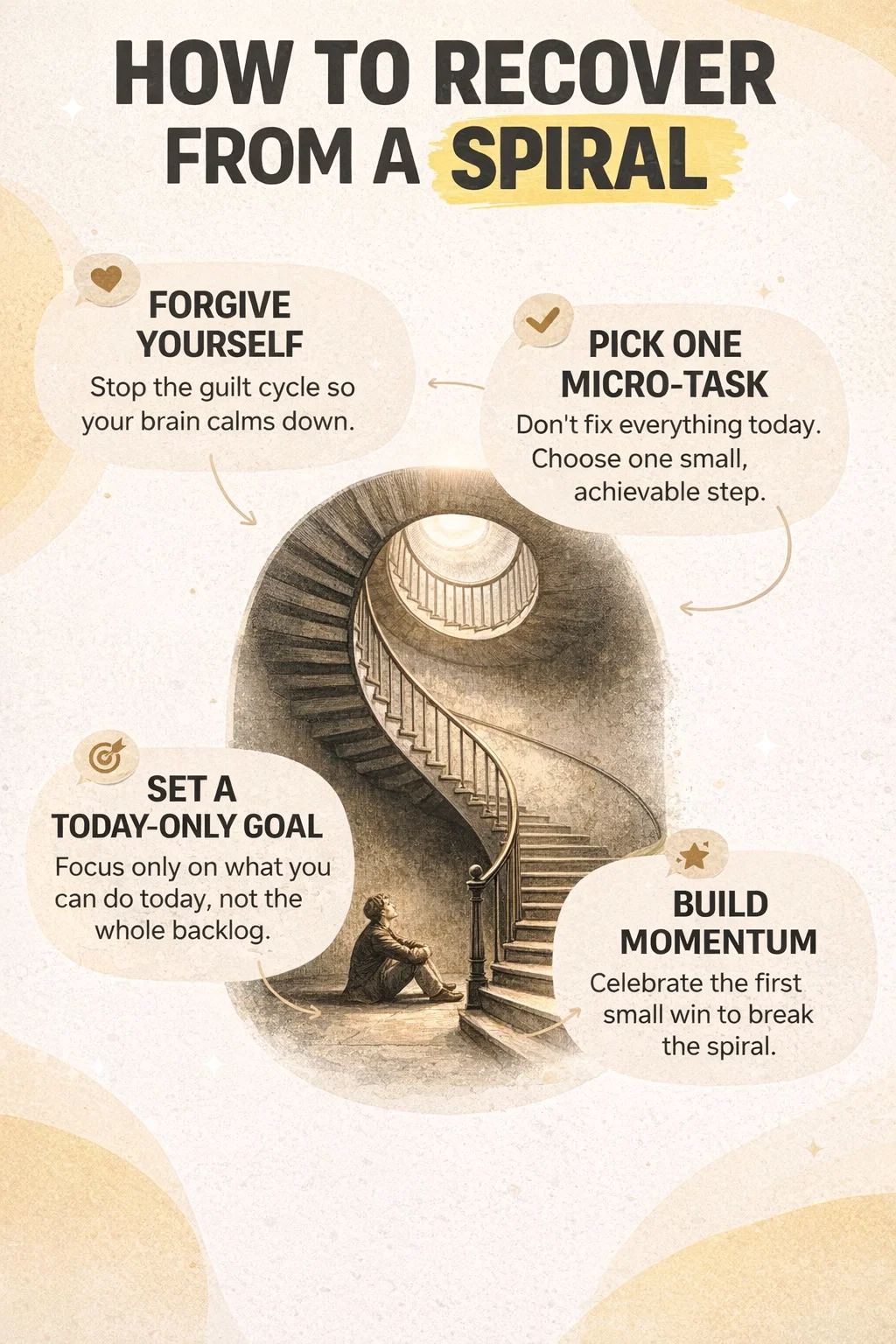
How to Recover From a Spiral 4 Steps for When Youre Behind and Overwhelmed
We have all been there. You look at your calendar, your inbox, or your physical to-do list and realize that you aren’t just a little bit behind; you are weeks behind. That realization often triggers a specific kind of mental paralysis known as a spiral. It feels like standing at the bottom of a dark, winding staircase, looking up at a summit that seems impossible to reach. When you are completely overwhelmed, your brain tends to shut down as a defense mechanism, making the climb feel even more daunting than it actually is.
The good news is that spiraling is a natural human response to high pressure, and there is a documented, psychological way to climb back out. It is not about working harder or pulling an all-nighter to catch up on everything at once. Recovery is about reclaiming your mental space and breaking the cycle of guilt that keeps you stuck. In this guide, we will dive deep into the four-step process for recovering from a spiral and regaining control of your life and productivity.
Understanding the Anatomy of a Productivity Spiral
Before we can fix the problem, we have to understand why it happens. A spiral usually begins with a small setback. Maybe you were sick for two days, or a personal emergency took you away from your desk. Instead of returning and picking up where you left off, you start to worry about the time you lost. That worry turns into guilt, and that guilt creates a heavy mental load that makes it harder to focus on current tasks. Consequently, you fall further behind, the guilt intensifies, and the spiral tightens.
Physiologically, your brain enters a state of fight or flight. When you are overwhelmed, the amygdala takes over, and the prefrontal cortex—the part of your brain responsible for logic and planning—goes offline. This is why you might find yourself staring at a screen for hours without doing anything. You aren’t lazy; your brain is literally trying to protect you from what it perceives as a threat.
Step One: The Power of Radical Self-Forgiveness
The very first thing you must do, before opening a single spreadsheet or answering an email, is to forgive yourself. This might sound like soft advice, but it is actually the most logical and practical step you can take. Guilt is a high-energy emotion that consumes the cognitive resources you need for problem-solving. As long as you are beating yourself up for being three weeks behind, you are using the fuel that you should be using to get the work done.
Stopping the Guilt Cycle
To stop the guilt cycle, you have to acknowledge the reality of the situation without judgment. Tell yourself: I am behind, and that is okay. The time has already passed, and I cannot get it back. By accepting the current state of affairs, you lower the emotional temperature. This allows your brain to shift from a state of panic back into a state of productivity. Forgiveness is the off-switch for the alarm bells ringing in your head.
Reframing Your Narrative
Instead of saying, I have failed because I am behind, try saying, I am in a recovery phase. This small shift in language changes your identity from someone who is failing to someone who is actively solving a problem. When you stop being your own harshest critic, you become your own most effective manager.
Step Two: The Magic of the Micro-Task
Once you have calmed the internal storm, the next hurdle is the sheer volume of work. When you are weeks behind, your to-do list looks like a mountain. The mistake most people make is trying to plan out the entire recovery all at once. They try to figure out how they will finish three weeks of work in three days. This lead to more overwhelm and often restarts the spiral.
Choosing One Achievable Step
Forget the big picture for a moment. You need a win, and you need it fast. A micro-task is something so small that it is impossible to fail at. It could be as simple as answering one single email, washing five dishes, or writing the first sentence of a report. The goal here isn’t to make a dent in the backlog; the goal is to prove to your brain that you are capable of movement.
Why Micro-Tasks Work
Micro-tasks work because they bypass the brain’s resistance to “big” projects. When a task is tiny, it doesn’t feel threatening. Once you complete that one micro-task, your brain releases a small hit of dopamine. This chemical reward makes you feel slightly better and creates a tiny bit of space for the next task. You aren’t fixing everything today; you are just choosing one achievable step.
Step Three: Setting a Today-Only Goal
The third step is to put up metaphorical blinders. When you are overwhelmed, your mind is constantly jumping to next Tuesday, next month, or the looming deadlines of the past. To recover, you must shrink your world down to the next eight to twelve hours. This is what we call the Today-Only Goal.
The Art of the Minimal List
Look at your massive backlog and pick two or three things that absolutely must happen today to keep things moving. Everything else—the whole backlog—does not exist for the purposes of today. By giving yourself permission to ignore the rest of the pile, you reduce the weight on your shoulders. You are focusing only on what you can do today, not the whole mountain of work that accumulated while you were spiraling.
Protecting Your Focus
A Today-Only Goal is a contract with yourself. It says: If I finish these three things, I have had a successful day, regardless of how much is still left over. This protects you from the feeling of “never doing enough” that often keeps the spiral going. Recovery is a marathon, not a sprint, and you have to pace yourself to avoid burning out again by noon.
Step Four: Building and Celebrating Momentum
The final step in recovering from a spiral is the transition from “starting” to “sustaining.” Momentum is the most powerful force in productivity. Once you get a heavy wheel spinning, it takes much less effort to keep it going than it did to start it. However, to keep that momentum, you have to acknowledge your progress.
Celebrate the Small Wins
When you finish a task, even a small one, take five seconds to acknowledge it. Check it off the list with a flourish or take a deep breath and tell yourself “good job.” Celebrating the first small win is essential to break the spiral because it reinforces the positive behavior. It signals to your nervous system that the “danger” has passed and that you are back in the driver’s seat.
Scaling Up Slowly
As you build momentum, you can slowly start to tackle slightly larger tasks. But be careful not to overreach too soon. If you try to jump from a micro-task straight into an eight-hour deep-work session, you might trigger the overwhelm all over again. Gradually increase the complexity of your goals as your confidence returns. Before you know it, that winding staircase won’t look so steep anymore.
Creating a Sustainable Environment for Recovery
While the four steps above are the core of the process, your environment plays a huge role in how quickly you can recover. If you are trying to heal from a spiral in a chaotic environment, you are fighting an uphill battle. Take five minutes to clear your physical workspace. A clean desk often leads to a clearer mind. Similarly, turn off notifications that aren’t essential to your Today-Only Goal. Every ping is a potential trigger for a new spiral.
It is also important to communicate. If you are weeks behind on professional projects, a quick, honest note to stakeholders can do wonders for your mental health. You don’t have to give a long list of excuses. A simple “I am currently catching up on a backlog and will have an update for you by [date]” can alleviate the pressure of people checking in on you, which further reduces your stress levels.
Conclusion: The Path Back to Peace
Recovering from a spiral is not about a sudden burst of superhuman energy. It is a gentle, deliberate process of reclaiming your power from guilt and overwhelm. By forgiving yourself, starting with micro-tasks, focusing strictly on today, and celebrating every bit of momentum, you turn a terrifying mountain back into a series of small, manageable steps.
Remember that being overwhelmed is a temporary state, not a permanent character flaw. Everyone falls behind at some point, but the people who thrive are the ones who know how to navigate the climb back up. Be patient with yourself, trust the process, and take that first tiny step today. You have the tools, you have the plan, and you are more than capable of finding your way back to the top of the stairs. Take a deep breath and start now.