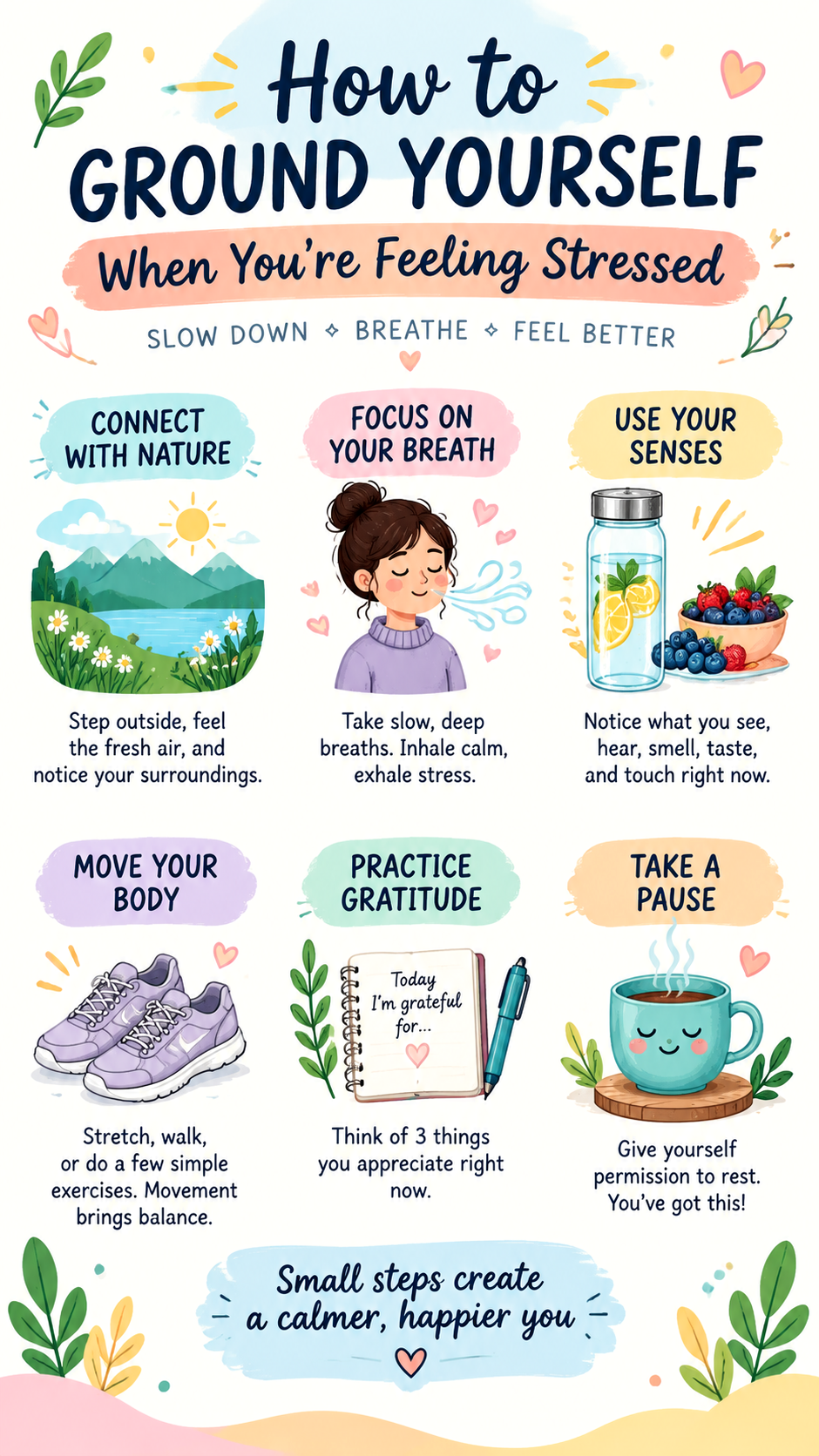
How to Ground Yourself When Feeling Stressed 6 Simple Calming Techniques
Stress can make even ordinary moments feel overwhelming, leaving you tense, distracted, or disconnected from yourself. When your thoughts begin racing, grounding techniques can help you slow down, reconnect with the present moment, and create a little breathing room. The good news is that you do not need expensive equipment, a complicated routine, or hours of free time to begin feeling more centered. Simple practices such as mindful breathing, the 5-4-3-2-1 sensory technique, gentle movement, gratitude, and soothing self-care can become valuable tools for navigating stressful days.
Learning how to ground yourself when feeling stressed is about discovering practical ways to bring your attention back to what is happening right now. Whether you are dealing with a busy schedule, emotional overwhelm, everyday worries, or a difficult moment, these six grounding techniques offer accessible ways to support relaxation and emotional well-being.
Key Takeaways
- Practice slow, comfortable breathing to create a moment of calm.
- Use the 5-4-3-2-1 grounding method to reconnect with your senses.
- Create a soothing environment with calming sounds, gentle scents, or comforting objects.
- Try mindful walking, stretching, or yoga to release physical tension.
- Use gratitude and positive mantras to encourage a kinder inner dialogue.
- Choose the grounding technique that feels most comfortable for your needs and circumstances.
What Is Grounding, and How Can It Help With Stress?
Grounding is a collection of simple practices that help direct your attention toward the present moment. Instead of becoming completely absorbed in worries about the future or thoughts about the past, you intentionally notice your surroundings, physical sensations, breathing, or immediate experiences.
Stress often affects both the mind and body. You might notice tight shoulders, shallow breathing, restlessness, difficulty concentrating, or a feeling that everything needs your attention at once. Grounding encourages you to pause and respond to the moment rather than automatically following every stressful thought.
Some grounding techniques focus on the senses, while others involve breathing, movement, self-compassion, or creating a calming atmosphere. There is no single method that works for everyone. The most helpful approach is one that feels manageable and supportive when you need it.
Important: Grounding is a self-care tool, not a promise that stress will disappear instantly. Even a brief pause can help you notice what you are experiencing and decide what you need next. If a technique feels uncomfortable or increases your distress, stop and try a gentler approach.
1. Practice Mindful Breathing to Find Your Calm
Breathwork is one of the most accessible grounding techniques because you can practice it almost anywhere. You do not need special equipment, a quiet room, or a particular level of experience. Simply noticing your breathing can help shift your attention away from stressful thoughts and toward a familiar physical sensation.
When you feel overwhelmed, you may find yourself breathing quickly or holding your breath without realizing it. Taking a comfortable pause allows you to observe this pattern without judging yourself.
How to Practice Simple Breathwork
- Find a comfortable position. Sit in a chair, stand with your feet resting on the floor, or lie down if that feels better.
- Relax what you can. Allow your shoulders to soften and unclench your jaw if you notice tension.
- Notice your natural breath. Pay attention to the air moving in and out without trying to change it immediately.
- Breathe gently. If it feels comfortable, inhale through your nose and exhale slowly through your nose or mouth.
- Add a simple word. Silently think of the word “in” as you inhale and “out” as you exhale.
- Continue for a short time. Try several comfortable breaths and return your attention to breathing whenever your mind wanders.
Make Breathwork Part of Your Daily Routine
Try mindful breathing before an important meeting, after a demanding task, while waiting in line, or when transitioning from work to personal time. Practicing during relatively calm moments can make it easier to remember the technique when stress appears.
Keep your breathing natural and comfortable. You do not need to take unusually deep breaths or hold your breath for long periods. If you feel dizzy, breathless, or uncomfortable, return to normal breathing and discontinue the exercise.
2. Use the 5-4-3-2-1 Grounding Technique
The 5-4-3-2-1 grounding technique is a practical sensory exercise that encourages you to pay attention to the world around you. It is particularly useful when worries pull your attention away from the present or when you feel mentally scattered.
The method works through five senses: sight, touch, hearing, smell, and taste. By deliberately noticing sensory details, you give your attention a specific and manageable task instead of asking yourself to stop thinking altogether.
Follow These Five Sensory Steps
5 Things You Can See
Look around and identify five things you can see. Notice their colors, shapes, textures, or positions. You might observe a blue notebook, sunlight on a wall, a plant near a window, the pattern on your clothing, or the shape of a nearby chair.
4 Things You Can Feel
Bring your attention to four physical sensations. Notice your feet touching the floor, your hands resting in your lap, the fabric of your sleeves, or the temperature of the air on your skin.
3 Things You Can Hear
Listen carefully for three sounds. They might include birds outside, a fan running, distant conversation, the sound of your own footsteps, or the gentle hum of a household appliance.
2 Things You Can Smell
Notice two scents in your environment. You might smell fresh laundry, coffee, soap, flowers, or the air after opening a window. If you cannot identify two scents, simply notice the absence of a strong smell or skip this step.
1 Thing You Can Taste
Pay attention to one taste in your mouth, such as the flavor of a recent drink or the freshness of toothpaste. You can also take a sip of water and notice its temperature and taste if that is convenient.
Pro Tip: There is no need to complete every step perfectly. Adapt the exercise to your surroundings and abilities. If a particular sense feels uncomfortable or inaccessible, spend more time with another sense that helps you feel present.
When to Try the 5-4-3-2-1 Method
Use this sensory grounding exercise during a stressful workday, before a challenging conversation, while traveling, or whenever you want to reconnect with your surroundings. You can complete it quietly without drawing attention to yourself.
With practice, the technique can become a familiar way to pause, observe, and gently redirect your attention. It does not require you to deny difficult emotions. Instead, it helps you make room for your surroundings alongside whatever you are feeling.
3. Soothe Yourself With a Calming Environment
Your surroundings can influence how comfortable and settled you feel. When your day has been demanding, creating a small pocket of calm may help you transition from constant activity to a more restful state.
Self-soothing involves using pleasant, manageable experiences to offer yourself comfort. It does not require a perfect home, expensive wellness products, or an elaborate nighttime routine. Often, small adjustments are enough to make a space feel more inviting.
Simple Ways to Create a Soothing Atmosphere
- Listen to calming music. Choose gentle instrumental music, familiar songs, nature sounds, or another audio experience you find comforting.
- Take a warm shower. Let the sensation of water help you focus on the present moment and transition away from the day’s demands.
- Use a comforting object. Hold a soft blanket, smooth stone, textured fabric, or another safe object that feels pleasant in your hands.
- Adjust your lighting. Reduce harsh lighting when practical and choose a comfortable setting that helps you unwind.
- Enjoy a gentle scent. If you like fragrances, choose a familiar scent that you find pleasant, such as a favorite soap or a flower nearby.
- Create a little breathing room. Put away a few distracting items, silence unnecessary notifications, or sit somewhere quieter.
Build a Small Self-Care Corner
Choose a comfortable spot where you can pause for a few minutes. Add a cushion, a favorite book, a soft blanket, a plant, or a small object that reminds you to slow down. Keep the setup simple enough that you can use it even on busy days.
If you enjoy candles, use them only when appropriate and keep open flames away from curtains, pets, children, and other flammable materials. Never leave a burning candle unattended. An electric candle or soft lamp can offer a similar visual atmosphere without an open flame.
Be mindful of fragrance sensitivity, asthma triggers, and other environmental discomforts. Scented products are optional, and a fragrance-free calming space can be just as effective for your personal routine.
4. Use Your Body to Release Tension
Stress is not only a mental experience. You may notice it in your shoulders, jaw, neck, hands, back, or legs. Gentle movement can help you reconnect with your body and interrupt long periods of physical stillness.
You do not need an intense workout to benefit from mindful movement. A short walk, a few comfortable stretches, or several minutes of gentle yoga can provide an opportunity to notice your body without focusing entirely on your worries.
Try These Mindful Movement Ideas
Take a Mindful Walk
Walk at a comfortable pace and pay attention to each step. Notice your feet making contact with the ground, the movement of your arms, the air around you, and the colors or sounds in your environment. You do not need to reach a particular distance or speed.
Stretch Gently
Roll your shoulders slowly, stretch your arms overhead if comfortable, or gently move your neck through a pain-free range of motion. Pause between movements and notice how your body feels. Avoid forcing a stretch or pushing through pain.
Explore Beginner-Friendly Yoga
Simple yoga movements can combine gentle stretching, body awareness, and breathing. Choose beginner-friendly positions that suit your mobility and comfort. You can also practice seated movements if standing or floor-based exercises are not appropriate for you.
Move to a Rhythm
Play a favorite song and sway gently, walk around your room, or move your hands and shoulders in a way that feels natural. Rhythm can give your attention something simple and enjoyable to follow.
Make Movement Feel Manageable
Start with a few minutes rather than setting an ambitious goal. If you spend much of the day sitting, a short movement break can be a realistic starting point. If you are tired, a slow walk or gentle seated stretch may feel more appropriate than a demanding exercise session.
Choose movements that respect your physical needs and current energy. The purpose is not to achieve a perfect workout. It is to give yourself a chance to reconnect with your body and take a supportive pause.
5. Practice Love and Gratitude
When stress takes over your attention, it can become difficult to notice anything beyond the immediate problem. A gratitude practice offers a gentle opportunity to recognize other parts of your life, including small comforts, meaningful relationships, and moments of personal progress.
Gratitude does not mean pretending that everything is fine. You can acknowledge a difficult situation while also noticing something that gives you comfort, connection, or hope. Both experiences can exist at the same time.
The Three-Things Gratitude Exercise
- Pause for a moment. Sit comfortably and allow yourself a few quiet seconds.
- Identify three things you appreciate. They can be meaningful or very ordinary, such as a supportive friend, a comfortable bed, a warm drink, or a pleasant moment outdoors.
- Notice why each one matters. Instead of simply naming an item, consider what it brings to your life.
- Let the feeling be natural. You do not need to force happiness or excitement. Quiet appreciation is enough.
- Write your thoughts down if helpful. A notebook or short note on your phone can help you revisit them later.
Create a Gratitude Jar
A gratitude jar is a simple visual reminder of moments you want to remember. Place a small container somewhere convenient and add a short note whenever you notice something you appreciate. You might write about a kind conversation, a task you completed, a moment of laughter, or a small personal achievement.
On a difficult day, read a few notes if doing so feels supportive. The goal is not to measure how positive your life is. It is to give yourself a collection of reminders that your experiences include more than the stressful moment you are facing.
Include Self-Compassion in Your Practice
Gratitude becomes more supportive when it is paired with kindness toward yourself. Instead of criticizing yourself for feeling overwhelmed, try acknowledging that you are having a difficult moment and deserve patience.
You might say, “I am doing the best I can with what I have today,” or “I can take this one step at a time.” These statements do not erase your challenges. They encourage you to respond to them with a little more understanding.
Remember: Gratitude is not a requirement to feel positive during difficult circumstances. If listing things you appreciate feels frustrating or emotionally uncomfortable, try a neutral grounding exercise instead. Your well-being matters more than completing a particular routine.
6. Use a Calming Mantra to Guide Your Thoughts
A mantra is a short phrase that you repeat to yourself as a reminder, intention, or source of encouragement. When stress makes your thoughts feel scattered, a familiar phrase can provide a simple point of focus.
For grounding purposes, choose words that feel believable, kind, and relevant to your situation. You do not need to convince yourself that everything is perfect. A useful mantra can simply remind you that you are allowed to pause, take a breath, and handle one thing at a time.
Calming Mantras for Stressful Moments
- “I can take this one moment at a time.” A reminder to focus on what is manageable right now.
- “I am allowed to pause.” Helpful when you feel pressure to keep going without a break.
- “This feeling can change.” A gentle reminder that emotions are experiences, not permanent predictions.
- “I can breathe and begin again.” Encourages you to return your attention to the present.
- “I do not have to solve everything today.” Useful when you feel overwhelmed by a long list of responsibilities.
- “I can treat myself with kindness.” Supports a more compassionate response to mistakes or uncertainty.
- “Right now, I will focus on the next small step.” Helps narrow your attention to an achievable action.
How to Build a Personal Mantra Practice
- Choose one phrase that feels reassuring rather than forced.
- Find a comfortable position and notice your breathing.
- Repeat the phrase silently or aloud at a natural pace.
- Allow your attention to return to the words whenever your thoughts wander.
- Use the phrase again when you encounter a familiar stressful situation.
You can keep your mantra on a sticky note, save it as a phone reminder, or write it in a journal. Some people prefer a single phrase for several weeks, while others choose different words for different situations.
There is no need to repeat a mantra a certain number of times. A few thoughtful repetitions may be enough to remind you of the response you want to practice.
How to Choose the Right Grounding Technique
Not every technique feels helpful in every situation. You may prefer sensory grounding when you feel distracted, movement when you feel physically restless, or a comforting environment when you need a break from a demanding day.
Rather than trying to use all six methods at once, start with the one that feels easiest to access. Pay attention to what you need in the moment and allow yourself to change approaches when necessary.
| Your Situation | Technique to Try | Simple Starting Point |
|---|---|---|
| Your thoughts feel scattered. | 5-4-3-2-1 grounding | Name five things you can see. |
| You notice physical tension. | Mindful breathing or stretching | Take comfortable breaths and relax your shoulders. |
| Your surroundings feel overwhelming. | Self-soothing | Move to a comfortable space or play gentle music. |
| You have been sitting for hours. | Mindful movement | Take a short walk or stretch gently. |
| You feel discouraged or self-critical. | Gratitude and self-compassion | Notice one small comfort and offer yourself kind words. |
| You feel overwhelmed by responsibilities. | A calming mantra | Repeat, “One step at a time.” |
Why Small Grounding Habits Matter
When life becomes busy, self-care can easily turn into another task on your to-do list. You might feel that you need a long meditation session, a complete exercise routine, or a perfectly peaceful morning before you can take care of yourself. That expectation can make it harder to begin.
Grounding practices are useful partly because they can be adapted to the time and energy you have available. You can notice three sounds while waiting for a meeting, take a few comfortable breaths between tasks, or repeat a calming phrase while walking to another room.
Why This Matters
A sustainable grounding routine should fit your real life. Choose one or two practices that are easy to remember, repeat them when appropriate, and treat each attempt as an opportunity to practice awareness rather than a test you must pass.
It can also help to recognize that progress is not always dramatic. You may still feel stressed after a breathing exercise, but perhaps you notice your shoulders are less tense or find it easier to identify your next step. These small observations can help you understand which practices work best for you.
Create a Simple Daily Grounding Routine
You do not need to practice every technique daily. A short routine with a few familiar activities may be easier to maintain than a complicated schedule.
A Gentle Morning Reset
Before checking messages or beginning your responsibilities, take a moment to notice how you feel. Try several comfortable breaths, identify one thing you appreciate, and choose a realistic intention for the day.
Your intention might be to take regular breaks, respond patiently to challenges, or focus on one task at a time. Keep it flexible enough to accommodate unexpected changes.
A Midday Grounding Break
Pause between tasks and look away from your screen if possible. Notice five things around you, stretch your shoulders, drink some water, or step outside for a short walk. Even a brief interruption can give you an opportunity to check in with yourself.
An Evening Wind-Down
As your day comes to an end, choose one calming activity. You might take a warm shower, listen to soothing music, write down three things you appreciate, or repeat a reassuring mantra.
Try to create a transition between your responsibilities and your rest time. If you cannot control your schedule completely, choose a small routine that works even on busy evenings.
Your Five-Minute Grounding Plan
- Minute 1: Notice your natural breathing and relax your shoulders if comfortable.
- Minute 2: Identify a few things you can see, hear, and feel.
- Minute 3: Stretch gently or walk around your space.
- Minute 4: Think of one small thing you appreciate or that brings you comfort.
- Minute 5: Repeat a kind mantra and choose one manageable next step.
Use this sequence as a flexible suggestion rather than a strict rule. If one step is especially helpful, spend more time on it. If you have only a minute, choose the practice that feels most appropriate.
Common Grounding Mistakes to Avoid
Grounding should feel like a supportive option, not another demand. A few common misunderstandings can make these practices less comfortable than they need to be.
Expecting Instant Results
You may not feel calmer immediately, and that does not mean you have failed. Stress can have many causes, and a short exercise may not address all of them. Focus on practicing a helpful response rather than measuring success by how quickly your feelings change.
Trying Too Many Techniques at Once
When you already feel overwhelmed, a long checklist can add pressure. Begin with one simple practice and explore other options gradually. Familiarity is often more useful than variety when you need something easy to remember.
Forcing Yourself to Feel Positive
You do not need to replace every difficult thought with a positive one. Grounding can help you acknowledge sadness, frustration, fear, or uncertainty while staying connected to the present. Allow your feelings to exist without judging yourself for having them.
Ignoring What Your Body Needs
If focusing on your breathing feels uncomfortable, try noticing objects in your environment instead. If a movement causes pain, stop and choose something gentler. You can adapt or discontinue any exercise that does not feel right for you.
When to Seek Additional Support for Stress
Grounding techniques can be useful self-care tools, but they are not a substitute for professional support when stress becomes persistent or difficult to manage. If anxiety or stress regularly interferes with sleep, relationships, work, daily activities, or your ability to feel safe, consider speaking with a qualified healthcare professional or mental health provider.
A professional can help you understand what may be contributing to your distress and explore approaches suited to your circumstances. You do not need to wait until things feel unbearable before asking for help.
If a grounding exercise makes you feel more distressed, stop and try a different approach. Some people find sensory or movement-based techniques more comfortable than focusing inward. Your experience matters, and there is no requirement to continue an exercise that feels unhelpful.
If you are in immediate danger or feel unable to keep yourself safe, contact local emergency services or a trusted person who can help you access urgent support.
Quick Points: Grounding Techniques at a Glance
- For racing thoughts: Try the 5-4-3-2-1 sensory grounding method.
- For everyday tension: Practice comfortable breathing and gentle stretching.
- For a calming atmosphere: Use soothing music, a comforting object, or a quiet space.
- For emotional encouragement: Practice gratitude and repeat a kind, realistic mantra.
- For lasting consistency: Start small and choose practices that fit your daily routine.
Conclusion: Find Your Calm One Moment at a Time
Learning how to ground yourself when feeling stressed can give you practical ways to reconnect with the present, notice your needs, and approach difficult moments with greater awareness. Mindful breathing, the 5-4-3-2-1 technique, soothing self-care, gentle movement, gratitude, and calming mantras each offer a different starting point.
You do not have to master every technique or build a perfect wellness routine. Start with one small action that feels comfortable, whether that means taking a few slow breaths, noticing the sounds around you, stepping outside for fresh air, or reminding yourself that you can take things one step at a time.
Over time, these simple practices can become familiar tools you return to when life feels demanding. Some days, you may need movement. On other days, a quiet moment or a reassuring phrase may be enough to help you pause and reflect.
Give yourself permission to slow down, listen to your needs, and begin again whenever necessary. You deserve moments of care, even on the busiest days. Save these grounding techniques for later so you can return to your favorite stress relief and mindfulness ideas whenever you need a gentle reminder to reconnect with yourself.
Tags
Grounding Techniques
Stress Relief
Anxiety Management
Mindfulness
Self-Care Ideas
Breathing Exercises
Emotional Wellness
Calming Techniques