CBT Explained Simply 5 Powerful Cognitive Behavioral Therapy Tools for Better Mental Health
Cognitive Behavioral Therapy (CBT) is a practical, evidence-based approach that can help you understand your thoughts, manage difficult emotions, and develop healthier behaviors. When anxiety, stress, low mood, or negative thinking begins to affect everyday life, CBT offers useful strategies for responding to challenges with greater awareness and confidence. Instead of trying to control every situation, this approach teaches you to recognize what you can change, question unhelpful assumptions, and take meaningful steps toward your goals.
One of the most valuable ideas behind CBT is that thoughts, feelings, and behaviors are connected. A difficult experience can influence what you think, how you feel, and what you do next. By learning to recognize these connections, you can begin to interrupt unhelpful patterns and make choices that support your well-being. The good news is that many CBT techniques can be practiced in everyday situations, making them useful tools for personal growth and emotional wellness.
Key Takeaways
- CBT explores how thoughts, feelings, and behaviors influence one another.
- Recognizing automatic thoughts can help you respond to difficult situations more thoughtfully.
- Cognitive restructuring encourages balanced thinking instead of unrealistic positivity.
- Small, purposeful actions can support motivation, confidence, and emotional well-being.
- Thought records, gradual exposure, and problem-solving are practical CBT tools.
- Professional guidance can help you adapt CBT techniques to your individual needs.
What Is Cognitive Behavioral Therapy?
Cognitive Behavioral Therapy, commonly known as CBT, is a structured form of psychological therapy that focuses on the relationship between thinking patterns, emotional experiences, and behavior. It helps people identify patterns that may contribute to distress and develop practical ways to respond differently.
Rather than focusing exclusively on the past, CBT often explores what is happening in the present. You might examine the thoughts that appear before a stressful meeting, the feelings that arise during a disagreement, or the behaviors that keep you from doing something important. Understanding these patterns can reveal opportunities for change.
CBT is used by trained mental health professionals to help people address a range of difficulties, including anxiety disorders, depression, stress, and certain other psychological concerns. Specific techniques and treatment plans vary according to the person’s needs and circumstances.
Another important feature of CBT is its practical nature. Sessions may involve identifying goals, practicing skills, completing exercises, and reviewing what happens when new strategies are used in everyday life. The aim is to build skills that can continue to be useful beyond therapy sessions.
Why CBT Focuses on Thoughts, Feelings, and Behaviors
Imagine receiving a short message from a friend that simply says, “We need to talk.” You might immediately think that the friend is upset with you. That thought could create anxiety, make you feel tense, and encourage you to avoid responding.
However, the message could have several explanations. Your friend might need advice, want to discuss a practical issue, or have something positive to share. The original message has not changed, but considering alternative explanations may change how you feel and what you decide to do.
This example illustrates how interpretations can influence emotional reactions and behavior. CBT does not suggest that every difficult feeling comes from faulty thinking. Real problems, unfair treatment, physical health concerns, and challenging circumstances can all affect well-being. Instead, CBT helps you identify where a different interpretation or response may be useful.
Understanding the CBT Model
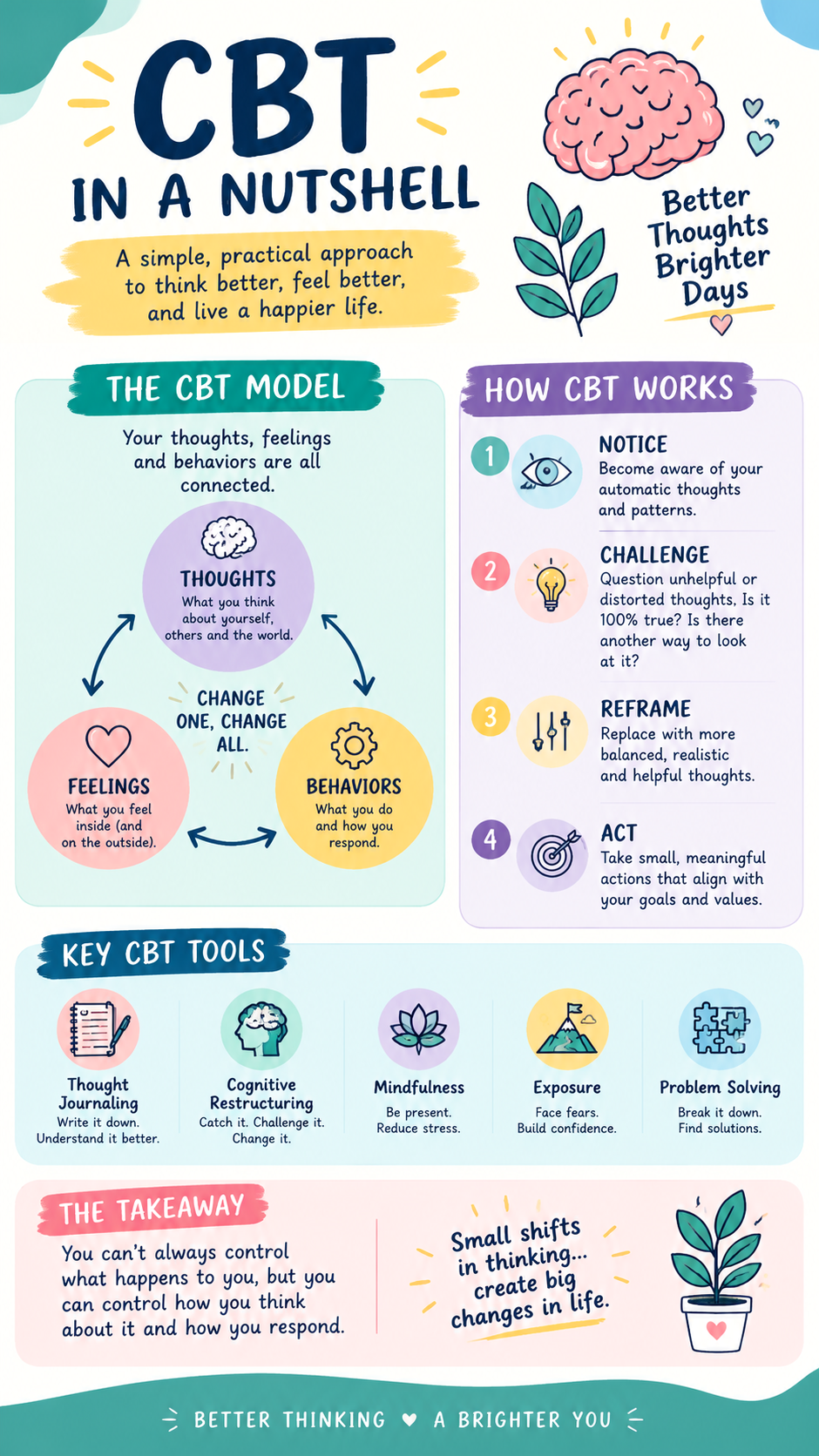
The CBT model is often illustrated using three connected elements: thoughts, feelings, and behaviors. Each element can influence the others, creating patterns that either support your well-being or make difficulties harder to manage.
1. Thoughts: How You Interpret Experiences
Thoughts include the ideas, assumptions, predictions, and interpretations that arise as you move through daily life. Some thoughts are deliberate, while others appear automatically before you have time to examine them.
For example, after making a mistake at work, you might think, “I always mess things up.” This statement turns one experience into a broad judgment about your abilities. If you accept it without question, you may feel discouraged and become reluctant to take on new responsibilities.
Learning to notice automatic thoughts is the first step toward deciding whether they accurately reflect the situation.
2. Feelings: Your Emotional Response
Feelings are emotional responses such as happiness, sadness, frustration, fear, embarrassment, or disappointment. They provide information about your experiences and can influence the way you interpret events.
If you believe that a single mistake proves you are incapable, you may experience shame or anxiety. If you view the same mistake as an opportunity to learn, you may still feel disappointed, but you could also feel motivated to improve.
CBT does not require you to eliminate uncomfortable emotions. Instead, it encourages you to understand them, make room for them, and respond in ways that are helpful rather than automatically acting on every emotional impulse.
3. Behaviors: What You Do Next
Behaviors are the actions you take, including actions you avoid. When you feel anxious about a social event, for instance, you might cancel your plans. Avoidance can provide immediate relief, but repeatedly avoiding situations may prevent you from discovering that you can manage them.
Alternatively, you might attend for a short time, speak to one person, and leave when you need a break. This approach gives you an opportunity to practice coping skills while taking a manageable step toward your goal.
Behaviors also affect thoughts and emotions. Taking a walk, completing a small task, or having an honest conversation may influence how you feel and how you view yourself.
Important: Thoughts, feelings, and behaviors form a connected system, not a simple one-way sequence. Changing one part may influence the others. You do not need to solve every problem at once. Sometimes, a small behavioral change is the most practical place to begin.
How CBT Works: Four Steps to Healthier Responses
A useful introduction to CBT is the four-step process of noticing, challenging, reframing, and acting. These steps provide a simple structure for responding to unhelpful thought patterns and moving toward meaningful change.
Step 1: Notice Your Automatic Thoughts
The first step is becoming aware of what goes through your mind when something difficult happens. Automatic thoughts can be so familiar that they feel like facts rather than interpretations.
Try to notice your thoughts when you experience a strong emotion. What happened just before the feeling appeared? What did you tell yourself about the situation? What did you expect would happen next?
For example, before giving a presentation, you might think, “Everyone will notice that I am nervous.” Simply identifying this thought creates an opportunity to examine it instead of accepting it automatically.
Step 2: Challenge Unhelpful Thinking
Once you recognize a thought, consider whether it is supported by the available evidence. This does not mean arguing with yourself or forcing yourself to believe something positive. It means approaching the thought with curiosity.
Ask yourself questions such as:
- What evidence supports this thought?
- What evidence suggests that it might not be completely accurate?
- Am I assuming that I know what someone else is thinking?
- Am I predicting the worst possible outcome?
- What would I say to a friend facing the same situation?
If you are worried that everyone will judge your presentation, you might remember that people are usually focused on the information being shared rather than examining every sign of nervousness. You may still feel anxious, but the situation can begin to seem more manageable.
Step 3: Reframe the Thought
Reframing means developing a more balanced and realistic way of interpreting a situation. The goal is not to replace every negative thought with an overly positive statement. It is to make room for a fairer understanding of what is happening.
Consider the difference between these statements:
- Unhelpful thought: “If I make one mistake, the entire presentation will be a disaster.”
- Balanced thought: “I might make a mistake, but I can pause, correct myself, and continue.”
- Unhelpful thought: “I have failed before, so I will never succeed.”
- Balanced thought: “Some attempts have not worked out, but I can learn from them and try a different approach.”
Balanced thoughts acknowledge uncertainty without treating the worst possible outcome as inevitable. They also help you focus on what you can do next.
Step 4: Take Meaningful Action
The final step is choosing an action that supports your goals and values. Thinking differently can be helpful, but new behaviors provide opportunities to put those insights into practice.
If you have been avoiding an important task because you fear making a mistake, you could begin by working on it for ten minutes. If you want to build stronger relationships, you might send a thoughtful message or arrange a conversation.
Focus on actions that are realistic and specific. Rather than promising yourself that you will never feel anxious again, aim to practice a useful skill the next time anxiety appears.
Why This Matters
Progress in CBT does not depend on having perfect thoughts or feeling confident every day. It comes from recognizing patterns, responding more flexibly, and practicing helpful behaviors over time. Even a small step can create useful information about what works for you.
Five Practical CBT Tools You Can Learn
CBT includes a variety of techniques that help people understand their experiences and respond to challenges. The most appropriate tool depends on the problem you are facing, your goals, and whether you are working independently or with a mental health professional.
1. Thought Records
A thought record is a structured way to explore a situation, your initial interpretation, your emotional response, and alternative explanations. Writing things down can make recurring patterns easier to recognize.
A simple thought record might include the following steps:
- Describe the situation: Write down what happened without adding assumptions.
- Identify the automatic thought: Record the first interpretation that came to mind.
- Name your feelings: Identify the emotions you experienced and their intensity.
- Review the evidence: Consider what supports or challenges the thought.
- Develop a balanced perspective: Write a realistic alternative interpretation.
- Review the result: Notice whether your understanding or emotional response has changed.
For example, if a colleague does not reply to your message, your first thought might be, “They are annoyed with me.” A thought record can help you consider other explanations, such as a busy schedule, a missed notification, or the need for more time to respond.
When to Use a Thought Record
Thought records can be useful when you notice repeated worry, self-criticism, conflict, or assumptions about how other people perceive you. They are particularly helpful when your reactions feel automatic and you want to slow down enough to examine them.
2. Cognitive Restructuring
Cognitive restructuring is the process of identifying and evaluating unhelpful thinking patterns, then developing a more balanced perspective. It is closely related to thought records, although it can also be practiced through guided questions and discussion.
Common thinking patterns include all-or-nothing thinking, catastrophizing, overgeneralizing, and assuming you know what others think. These patterns can influence how you interpret events, especially when you are stressed or emotionally overwhelmed.
For example, all-or-nothing thinking might lead you to believe that a project is either perfect or a complete failure. Cognitive restructuring helps you recognize the middle ground: a project can have strengths, weaknesses, and opportunities for improvement at the same time.
Pro Tip: Aim for a thought that is believable, not merely encouraging. If “Everything will be perfect” feels unrealistic, try “I cannot control every outcome, but I can prepare carefully and handle problems as they arise.”
3. Behavioral Activation
Behavioral activation focuses on increasing engagement in meaningful, rewarding, or necessary activities. It is commonly used as part of treatment for depression and can also help people understand how daily routines influence mood and motivation.
When you feel low, everyday activities may seem unusually difficult. You might stop meeting friends, exercising, preparing meals, or working on hobbies. Although withdrawing can feel easier in the moment, it may reduce opportunities for enjoyment, connection, and accomplishment.
Behavioral activation encourages you to plan manageable activities instead of waiting until motivation returns on its own.
How to Practice Behavioral Activation
- Choose one small activity that matters to you.
- Break larger tasks into short, achievable steps.
- Schedule activities at realistic times rather than relying entirely on motivation.
- Include a balance of necessary tasks, enjoyable experiences, and social connection.
- Notice how you feel before and after an activity without judging yourself.
For example, if you have been spending most of your free time alone, you could start by taking a brief walk outside or sending a message to someone you trust. The aim is not to force yourself to feel happy. It is to create opportunities for positive experiences and gradual progress.
4. Gradual Exposure
Exposure involves approaching feared situations, sensations, memories, or activities in a planned and appropriate way. It is used in certain CBT treatments for anxiety and related difficulties.
When fear leads to avoidance, you may miss opportunities to discover that a situation is more manageable than expected. Gradual exposure helps you work toward facing these situations in steps, at a pace that fits the treatment plan.
Someone who fears speaking in groups might begin by practicing aloud alone, then speaking with a trusted person, and eventually contributing a short comment during a small meeting. The sequence depends on the individual’s circumstances and goals.
Why Gradual Exposure Can Help
Repeated, planned practice can help people learn that anxiety is manageable and that feared outcomes are not always inevitable. Exposure is not about forcing yourself into overwhelming situations or ignoring genuine danger. For severe anxiety, trauma-related symptoms, or complex fears, it is best planned with a qualified mental health professional.
5. Problem-Solving Skills
Some emotional distress is connected to practical problems that need attention. Financial pressure, workplace demands, household responsibilities, and relationship disagreements can all create understandable stress.
Problem-solving techniques help turn an overwhelming concern into smaller, more manageable decisions. Instead of repeatedly thinking about everything that could go wrong, you can identify the problem, consider options, and select a practical next step.
- Define the problem: Describe the specific issue you want to address.
- Identify your goal: Decide what a useful outcome would look like.
- Brainstorm options: List possible solutions before evaluating them.
- Choose an action: Select a realistic step that fits your resources.
- Review the result: Check what worked and adjust your plan if necessary.
For instance, if a growing workload feels overwhelming, you might list your tasks, identify urgent deadlines, break a large assignment into smaller parts, and discuss priorities with your manager. You may not be able to eliminate every demand, but you can create a clearer plan for responding.
What Can CBT Help With?
CBT is used in a range of mental health treatments. Its techniques can help people understand distressing patterns, practice coping skills, and make changes that support their daily functioning. The effectiveness of a particular approach depends on the condition, treatment plan, and individual circumstances.
Anxiety and Excessive Worry
Anxiety can involve persistent worry, physical tension, restlessness, and fears about what might happen. CBT may help people recognize patterns such as catastrophizing, examine predictions, and gradually approach situations they have been avoiding.
For example, someone who worries excessively about making mistakes might learn to distinguish between reasonable preparation and repeated checking that no longer provides useful reassurance.
Depression and Low Mood
Depression can affect energy, motivation, concentration, sleep, relationships, and interest in everyday activities. CBT may help people recognize harsh self-judgments, examine hopeless predictions, and gradually reengage with meaningful activities.
It is important to remember that depression is not simply a matter of thinking negatively. It is a complex condition influenced by psychological, biological, and social factors. Professional assessment can help determine which treatments and support options are appropriate.
Stress and Everyday Challenges
Stress often increases when demands feel greater than the time, energy, or resources available to meet them. CBT-based problem-solving, realistic thinking, and planning techniques can help you identify priorities and respond more deliberately.
These skills can be useful when preparing for an important deadline, managing a difficult conversation, or adjusting to a major life change. They do not remove every source of pressure, but they may help you respond more effectively.
Low Self-Esteem and Self-Criticism
Low self-esteem can involve persistent beliefs that you are inadequate, unworthy, or less capable than others. These beliefs may influence the way you interpret feedback, approach challenges, and respond to mistakes.
CBT can help you examine the evidence behind these beliefs, recognize strengths you may overlook, and practice responding to setbacks without turning them into judgments about your entire identity.
For example, instead of thinking, “I failed at this, so I am a failure,” you could acknowledge the specific difficulty and identify what it teaches you. This shift allows room for accountability and improvement without unnecessary self-punishment.
Relationship Challenges
Relationships can become difficult when people make assumptions, react quickly during disagreements, or struggle to communicate their needs. CBT-based strategies can help you examine interpretations and consider alternative explanations before responding.
For instance, if someone cancels plans, you might immediately interpret it as rejection. Pausing to consider other possibilities can help you ask a clarifying question instead of reacting to an assumption.
CBT skills can support communication and emotional regulation, but they cannot guarantee that another person will behave fairly or that every relationship can be repaired. Healthy boundaries and appropriate support remain important.
How to Practice CBT in Everyday Life
You do not need to transform your entire routine to begin applying basic CBT principles. Starting with one recurring situation can make the process more manageable and help you discover which techniques are useful.
Start With a Brief Daily Check-In
Spend a few minutes noticing your mood, current concerns, and any thoughts that have been repeating throughout the day. You could write down one challenging situation and identify what you thought, how you felt, and what you did next.
Keep the exercise simple. A short, honest reflection is often more sustainable than an elaborate routine that becomes another source of pressure.
Choose One Thought to Examine
When a negative thought appears, resist the urge to challenge every worry at once. Select one thought that is particularly distressing or influencing an important decision.
Ask what evidence supports it, what information might be missing, and whether a more balanced interpretation is possible. You can write down the result or simply pause to reflect.
Set Small and Specific Goals
Choose actions that are clear enough to complete and review. Instead of setting a vague goal such as “be less stressed,” decide to take a short break after finishing a task, prepare for tomorrow’s priorities, or ask for clarification when instructions are confusing.
Small goals help turn an intention into observable behavior. If a step feels too difficult, reduce its size rather than treating the difficulty as proof that you cannot succeed.
Review What You Learn
At the end of the day, consider what helped, what felt difficult, and what you might try differently next time. The purpose is to learn from experience, not to judge whether you performed perfectly.
Over time, this process may help you recognize recurring triggers and understand which responses support your goals. Progress can be gradual, and difficult days do not erase the skills you have practiced.
Common CBT Mistakes to Avoid
Learning a new way to respond to thoughts and emotions takes practice. A few common misunderstandings can make the process feel more difficult than it needs to be.
Trying to Force Positive Thinking
CBT is not about pretending that everything is fine or replacing every uncomfortable thought with a cheerful statement. Some situations are genuinely difficult, and certain concerns require practical action rather than a change in perspective alone.
The goal is to develop thoughts that are balanced, realistic, and useful. You can acknowledge disappointment while recognizing your options. You can feel nervous while still preparing for an important conversation.
Expecting Immediate Results
It may take time to recognize automatic thoughts, develop alternative interpretations, and change long-standing behaviors. Some techniques may feel unnatural at first, particularly if self-criticism or avoidance has become familiar.
Focus on repeated practice rather than instant transformation. A useful outcome may simply be noticing a thought before reacting to it or taking one small action that you previously avoided.
Blaming Yourself for Difficult Emotions
Feeling anxious, sad, angry, or disappointed does not mean you have failed at CBT. Emotions are influenced by many factors, and some feelings remain even when you understand a situation clearly.
Rather than judging yourself for feeling distressed, use the experience as information. Ask what you need, what is within your control, and whether a different response could help.
Ignoring Real-World Problems
Not every difficulty can be resolved by changing your thinking. If a situation involves unsafe conditions, discrimination, unreasonable demands, or harmful relationship behavior, practical support and appropriate boundaries may be necessary.
CBT can help you manage your response while you consider realistic options. It should not be used to persuade yourself to accept mistreatment or to take responsibility for circumstances outside your control.
When to Seek Professional CBT Support
Self-guided CBT exercises can be useful for learning basic skills, but they are not a replacement for professional care when emotional difficulties are persistent, severe, or interfering with everyday life.
Consider speaking with a qualified mental health professional if anxiety, low mood, intrusive thoughts, avoidance, or stress is affecting your relationships, work, sleep, or ability to manage daily responsibilities. A professional can help you understand your difficulties, identify suitable treatment options, and adapt techniques to your needs.
When looking for support, consider a licensed or appropriately qualified therapist with training and experience in CBT and the concerns you want to address. You can ask about their approach, what treatment may involve, and how progress will be reviewed.
CBT is not identical for everyone. Some people benefit from structured thought exercises, while others need more support with behavioral change, exposure, or related treatment approaches. A personalized plan can help ensure that the techniques are appropriate and safe.
If you are experiencing severe emotional distress or feel unable to keep yourself safe, seek urgent professional help or contact local emergency services. You do not need to wait until your difficulties become overwhelming to ask for support.
Quick Points: CBT at a Glance
- Notice: Identify automatic thoughts and recurring patterns.
- Challenge: Examine evidence instead of assuming every thought is a fact.
- Reframe: Develop a more balanced and realistic perspective.
- Act: Take small steps that support your goals and values.
- Practice: Review your experiences and adjust your approach over time.
Conclusion: Small Shifts in Thinking Can Support Meaningful Change
Cognitive Behavioral Therapy offers a practical way to understand the relationship between thoughts, feelings, and behaviors. By recognizing automatic thoughts, questioning unhelpful assumptions, and choosing more balanced responses, you can develop skills for navigating everyday challenges with greater awareness.
Tools such as thought records, cognitive restructuring, behavioral activation, gradual exposure, and structured problem-solving provide different ways to put these principles into practice. You can begin with one technique, one situation, or one small action rather than trying to change everything at once.
Remember that CBT is not about thinking positively all the time, suppressing difficult emotions, or blaming yourself when life becomes complicated. It is about learning to think more helpfully, respond more deliberately, and recognize where change is possible.
The most important step is often a small one: pause before accepting a negative thought as fact, consider another perspective, and choose an action that reflects what matters to you. With patience and consistent practice, these small shifts can help you build a more flexible approach to life’s challenges.
Tags
Cognitive Behavioral Therapy
CBT Techniques
Mental Health
Anxiety Management
Stress Management
Emotional Wellness
Self-Care Strategies
Healthy Thinking