
Professional French Baguette Recipe Guide Perfect Crust Open Crumb Bakers Secrets
There is something undeniably magical about the aroma of a fresh French baguette wafting through a kitchen. That golden, crackling crust and the airy, hole-filled interior represent the pinnacle of artisanal baking. For many home bakers, the baguette is the ultimate challenge. It requires patience, precision, and an understanding of how simple ingredients like flour, water, salt, and yeast transform into a culinary masterpiece. If you have ever marveled at the sight of a perfect loaf and wondered how to achieve those professional results in your own oven, you are in the right place. This guide breaks down the science and the art of the traditional French baguette, providing you with a roadmap to success.
Understanding the Profile of a Perfect Baguette
Before diving into the mixing bowl, it is important to know what we are aiming for. A standard French baguette is more than just a long loaf of bread; it has specific characteristics that define its quality. In terms of physical dimensions, a classic loaf typically weighs between 250 and 300 grams. It should be long and slender, usually measuring between 55 and 65 centimeters. However, the true markers of quality are found in the texture.
The crust should be thin, crisp, and shards-of-glass crunchy, providing a sharp contrast to the soft interior. When you cut into it, you should see what bakers call an open crumb. This means the inside is not dense or cake-like but is instead filled with large, irregular holes. This beautiful internal structure is the result of high hydration and proper fermentation, two elements we will explore deeply in this guide.
The Magic of Baker’s Percentages
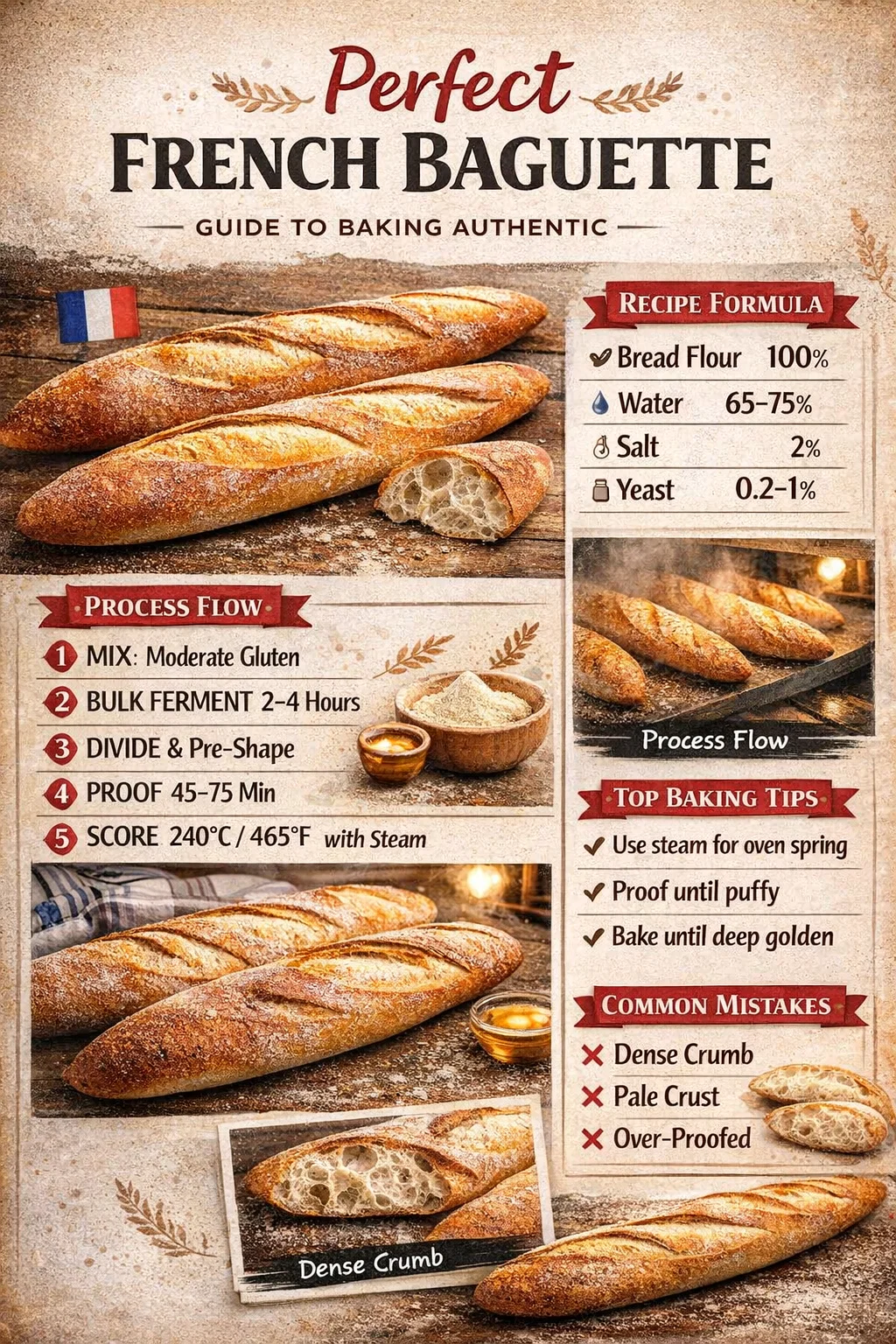
Professional bakers do not use standard cups and spoons. Instead, they use baker’s percentages, where every ingredient is measured as a percentage of the total flour weight. This allows for perfect scaling and consistency. For a traditional baguette, the formula is deceptively simple:
- Bread Flour: 100% (The foundation of the bread)
- Water: 65 to 75% (High hydration is key for that open crumb)
- Salt: 2% (Essential for flavor and controlling yeast activity)
- Yeast: 0.2 to 1% (A small amount allows for a longer, more flavorful ferment)
The Step-by-Step Process Flow
Creating a baguette is a journey that spans several hours. Each step is designed to build strength in the dough and develop complex flavors through fermentation. You cannot rush a baguette; the time spent waiting is just as important as the time spent kneading.
Mixing and Developing Gluten
The first step is combining your ingredients. When mixing, the goal is to achieve moderate gluten development. You want the dough to be strong enough to hold its shape but extensible enough to expand during the bake. Many bakers prefer a slow mix followed by a series of folds rather than aggressive mechanical kneading. This preserves the delicate gasses produced by the yeast.
The Importance of Bulk Fermentation
Once the dough is mixed, it enters the bulk fermentation stage. This typically lasts between 2 and 4 hours depending on the temperature of your kitchen. During this time, the yeast consumes the sugars in the flour, releasing carbon dioxide. This is where the flavor is born. You should look for the dough to double in size and feel full of air. A long, slow ferment is the secret to a professional-tasting loaf.
Dividing, Shaping, and Bench Resting
After fermentation, gently turn the dough onto a floured surface. Divide it into equal portions and perform a pre-shape, gently rounding the dough into rough cylinders. Let these rest for 20 to 30 minutes, a process known as the bench rest. This relaxes the gluten, making the final shaping much easier and preventing the dough from snapping back like a rubber band.
For the final shape, you want to create a tight cylinder. This creates surface tension on the outer skin of the dough, which helps the baguette expand upward rather than outward in the oven. Once shaped, the loaves undergo a final proof for 45 to 75 minutes until they feel puffy and light to the touch.
Mastering Key Techniques for Success
The difference between a good baguette and a great one often comes down to two specific techniques: scoring and steaming. These happen right at the moment the bread enters the oven and are crucial for the final appearance and texture.
The Art of Scoring
Scoring is the act of cutting the surface of the dough with a sharp blade or a bread lame. For a baguette, you want to make several overlapping longitudinal cuts at a 30 degree angle. These cuts act as a vent, controlling where the bread expands as it hits the intense heat of the oven. If you do not score, the bread will likely burst at its weakest point, resulting in a misshapen loaf. A proper score at the right angle creates those iconic ears that look so beautiful on a finished loaf.
Baking with Steam
In a professional bakery, ovens are equipped with steam injectors. At home, you have to be more creative. Steam is vital during the first few minutes of baking because it keeps the surface of the dough moist. This allows the bread to expand fully before the crust sets, a phenomenon known as oven spring. Steam also gelatinizes the starches on the surface, which is what gives the baguette its signature glossy, crispy crust. You can achieve this by placing a tray of boiling water at the bottom of your oven or by using a spray bottle to mist the oven walls.
Common Errors and How to Avoid Them
Baking is a learning process, and it is perfectly normal to run into issues on your first few tries. Understanding what went wrong is the best way to improve your next batch. Here are a few common pitfalls that many bakers encounter.
Dense Crumb and Pale Crust
If your baguette comes out dense without those beautiful holes, the culprit is often under-fermentation or low hydration. Ensure your dough has enough water and that you are giving it plenty of time to rise. On the other hand, if your crust is pale and lacks that deep golden brown color, you might be over-proofing the dough. When dough proofs for too long, the yeast consumes all the available sugars, leaving nothing left to caramelize in the oven heat. Always aim for a deep, rich golden color for maximum flavor.
The Danger of Over-Proofing
Over-proofing is a common mistake where the dough is left to rise for too long before baking. The gluten structure becomes weak and can no longer hold the air bubbles. When an over-proofed baguette is scored and put in the oven, it may collapse rather than rise. To check if your dough is ready, use the finger poke test. If the dough springs back slowly and leaves a slight indentation, it is ready for the oven.
Baking Tips for the Home Artist
To take your baguettes to the next level, keep these simple tips in mind. First, always bake at a high temperature, typically around 240 degrees Celsius or 465 degrees Fahrenheit. This intense heat is necessary for the rapid expansion and crust development. Second, be patient with the cooling process. As tempting as it is to eat a hot baguette, the bread is actually still finishing its cook on the inside while it cools. Cutting it too early can result in a gummy texture.
Third, pay close attention to your scoring angle. Keeping the blade at a shallow 30 degree angle rather than cutting straight down is what creates the beautiful overlapping pattern. Finally, remember that high hydration is your friend. While wet dough can be sticky and difficult to handle at first, it is the only way to achieve that sought-after open crumb structure.
Conclusion
Mastering the French baguette is a rewarding pursuit that combines science, physical skill, and a bit of intuition. By focusing on quality ingredients, respecting the fermentation process, and practicing your shaping and scoring, you can produce loaves that rival any Parisian boulangerie. Each bake is an opportunity to learn something new about the dough and your environment. Do not be discouraged by a few flat loaves or a dense crumb; even the most seasoned bakers had to start somewhere. With time and practice, you will find your rhythm and soon be pulling trays of perfectly golden, crackling baguettes out of your own oven. Happy baking!