How to Do Shadow Work A Step-by-Step Spiritual Healing Ritual for Inner Integration
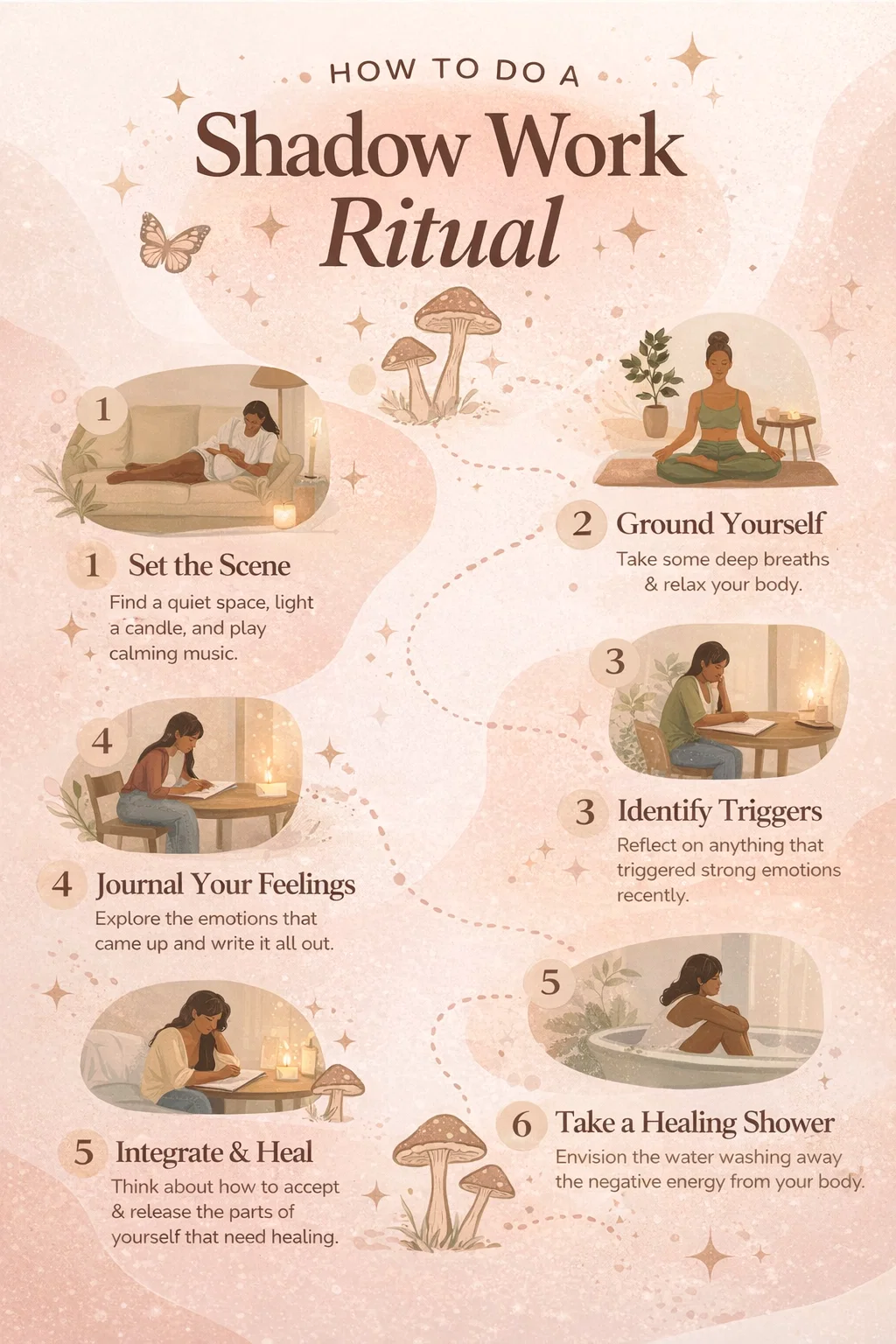
Embarking on a journey of self-discovery is one of the most profound commitments you can make to your personal well-being. In a world that often demands we present only our most polished selves, the concept of shadow work offers a refreshing and necessary alternative. It is the process of exploring the hidden corners of your subconscious, the parts of your personality that you may have pushed aside, ignored, or deemed unacceptable. By shining a light on these shadows, you do not just uncover old wounds; you unlock the potential for radical self-love and authentic living. The infographic we are exploring today provides a beautiful, six-step roadmap for a shadow work ritual that is designed to be as healing as it is transformative.
Shadow work is not about fixing something that is broken. Instead, it is about integration. It is about taking the fragmented pieces of your experience and bringing them into a cohesive whole. When we ignore our shadow, it does not go away. It often manifests as reactive behavior, unexplained anxiety, or self-sabotage. By creating a dedicated ritual, you provide yourself with a safe container to meet these parts of yourself with compassion rather than judgment. Let us dive deep into how you can structure your own ritual to foster inner peace and spiritual growth.
Step 1: Setting the Scene for Sacred Exploration
Before you begin the heavy lifting of emotional introspection, you must prioritize your environment. Shadow work requires a high level of vulnerability, and you cannot be truly vulnerable if you do not feel safe and undisturbed. Setting the scene is about more than just aesthetics; it is about signaling to your nervous system that it is okay to let down its guard.
Start by finding a quiet corner of your home where you can be alone for at least thirty to sixty minutes. Soft lighting is essential here. Bright, harsh overhead lights can trigger a state of high alertness, whereas the warm glow of a candle or a dim lamp encourages the brain to transition into a more reflective state. Many practitioners find that using intention candles, sage, or incense helps to clear the energy of the room, creating a literal and figurative fresh start for the session. Background music, particularly binaural beats or ambient nature sounds, can also help drown out external distractions and keep you centered on the task at hand.
Step 2: Grounding Yourself in the Present Moment
Once your space is ready, the next step is to bring your awareness into your physical body. It is very common for us to carry the weight of our daily stress in our muscles without even realizing it. Grounding is the bridge between the chaotic outside world and your internal landscape. Without grounding, shadow work can feel overwhelming or purely intellectual, rather than a felt experience.
Physical Check-In and Body Scanning
Take a moment to sit or lie down comfortably. Close your eyes and scan your body from head to toe. Are you clenching your jaw? Are your shoulders hiked up toward your ears? Is your stomach tight? Consciously breathe into these areas and release the tension. Lower your shoulders, soften your eyebrows, and allow your belly to expand with every breath. This physical release sends a signal to your brain that there is no immediate threat, allowing you to access deeper layers of your subconscious mind during the ritual.
Step 3: Identifying Your Emotional Triggers
The core of shadow work often begins with a trigger. A trigger is a strong emotional reaction to a situation that seems disproportionate to the event itself. Perhaps a comment from a coworker left you feeling unusually angry, or a social media post made you feel deeply inadequate. These moments are “pings” from your shadow, alerting you to an area that needs healing.
Reflect on the past day or week. Ask yourself what made you feel hurt, confused, or fearful. If you find it difficult to name the specific emotion, use a tool like the wheel of emotions. Often, what we think is anger is actually underlying grief or feelings of rejection. Identifying the specific “flavor” of your discomfort is the first step toward understanding its origin. Remember that your triggers are not your enemies; they are maps that lead you directly to the parts of yourself that are crying out for attention.
Step 4: The Power of Intentional Journaling
Journaling is where the abstract feelings of the shadow begin to take on a concrete form. Once you have identified a trigger, it is time to explore it on the page. This is not the time for perfect grammar or poetic prose. This is the time for raw, unfiltered honesty. Write down everything that comes to mind, even the details that seem silly or petty.
Exploring the Roots of Your Reactions
When journaling, ask yourself questions such as: Why did this specific comment hurt me so much? Does this feeling remind me of a time in my childhood? What am I afraid will happen if this feeling is true? By writing these things down, you externalize the emotion. It is no longer a cloud inside your head; it is words on paper that you can observe objectively. You might find that your current trigger is actually a distraction from a deeper, older wound. Journaling helps you peel back the layers of the onion until you reach the core truth.
Step 5: Integration and Embracing the Suppressed Self
Integration is the most vital phase of shadow work. It is the moment where you stop looking at your shadow as something “other” and start recognizing it as a part of you. Many of our shadow traits were formed as survival mechanisms. For instance, if you were told as a child that being loud was “bad,” you might have suppressed your assertiveness. As an adult, your shadow might manifest as resentment toward people who speak their minds.
Integration involves asking: Is there a part of me I had to suppress to survive? How can I allow this part to exist safely today? Instead of pushing the “loud” or “angry” or “needy” part away, you learn to sit with it. You acknowledge that it served a purpose once, and you find a way to honor its needs in a healthy, balanced way. This is how we become whole. We stop fighting ourselves and start embracing the parts of us that were long forgotten or shamed into silence.
Step 6: The Spiritual Shower for Energetic Release
Shadow work can be emotionally taxing. It is common to feel a sense of heaviness or fatigue after a deep session. This is why concluding the ritual with a “spiritual shower” or a bath is so effective. Water is a powerful symbol of purification and flow in almost every spiritual tradition. It represents the washing away of the old to make room for the new.
As you step into the water, do so with the conscious intention of letting the water carry away any lingering negative energy or emotional tension. Visualize the heaviness of the session swirling down the drain. This act provides a physical conclusion to the ritual, helping you transition back into your daily life with a sense of mental clarity and a lighter heart. It is a moment of self-care that reinforces the idea that you are worthy of comfort and renewal after doing the hard work of self-exploration.
The Role of Nature and Symbols in Healing
The imagery of mushrooms, butterflies, and stars in our guide reminds us that growth is a natural, cyclical process. Much like a mushroom grows in the dark, our greatest personal insights often emerge from the “darker” or hidden parts of our psyche. The butterfly symbolizes the transformation that is possible when we are willing to go through the cocoon phase of introspection. Do not rush your progress. Healing happens in its own time, and every ritual you perform is a seed planted for your future self.
Conclusion: Living in the Light of Awareness
Shadow work is not a one-time event but a lifelong practice of coming home to yourself. By following this six-step ritual—setting the scene, grounding, identifying triggers, journaling, integrating, and cleansing—you create a sustainable way to navigate the complexities of your inner world. You begin to move through life with more grace, less reactivity, and a deeper sense of compassion for both yourself and others.
The beauty of this ritual is that it is entirely yours. You can adapt it to fit your needs, whether you have five minutes or five hours. The most important element is your willingness to show up and be honest. As you continue this journey, you will find that the shadows you once feared are actually the keys to your greatest strengths. Embrace the mystery of your own mind, honor your triggers as teachers, and never forget that your wholeness is your birthright. Keep exploring, keep writing, and keep healing.