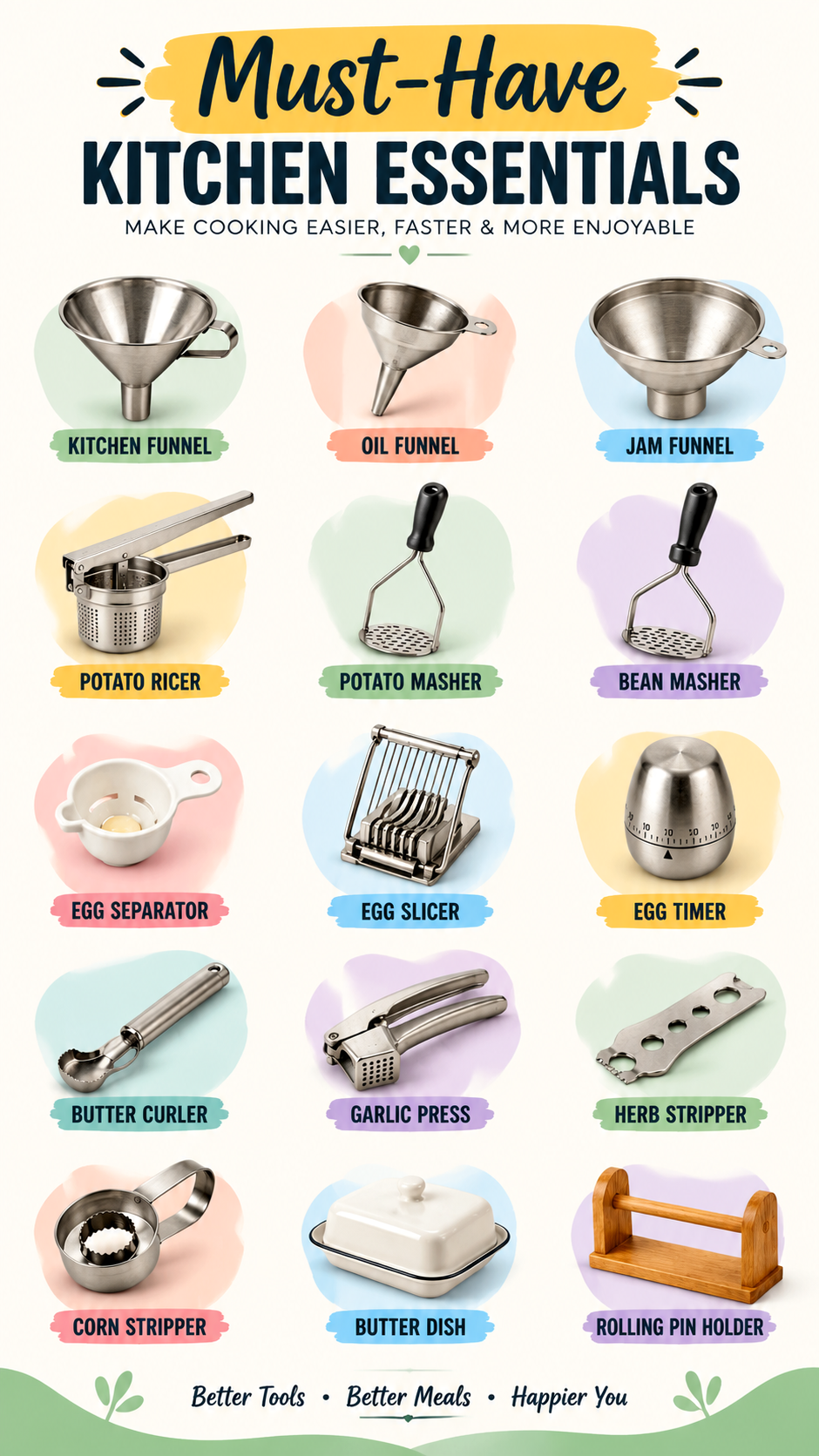
Kitchen Essentials Chart Must-Have Kitchen Tools and Gadgets
A well-organized kitchen is not just about having beautiful cabinets and tidy countertops. It is also about keeping the right tools within reach when you need them. From filling narrow bottles without spills to preparing perfectly sliced eggs and smoothly mashed potatoes, the right kitchen essentials can make everyday cooking easier, faster, and more enjoyable. While pots, pans, and knives receive plenty of attention, smaller specialty kitchen gadgets often solve some of the most frustrating food preparation problems.
Kitchen funnels, potato ricers, egg separators, garlic presses, herb strippers, and butter curlers may seem like minor additions, but each serves a useful purpose. Understanding what these tools do and when to use them can help you build a practical kitchen collection that supports your cooking habits without filling every drawer with unnecessary gadgets.
Key Takeaways
- Specialty kitchen tools simplify common tasks such as transferring liquids, mashing vegetables, and preparing eggs.
- Different funnel designs help with everything from pouring oil to filling jars with jam.
- Potato ricers and mashers create different textures for mashed vegetables and other recipes.
- Small gadgets such as garlic presses, herb strippers, and egg slicers can save preparation time.
- Choosing versatile, durable tools helps prevent kitchen clutter and unnecessary spending.
- Proper cleaning, drying, and storage keep kitchen utensils ready for everyday use.
Why Specialty Kitchen Essentials Deserve a Place in Your Kitchen
Specialty kitchen essentials are designed to handle particular jobs that ordinary utensils may not perform as neatly or efficiently. A standard spoon can transfer some ingredients into a container, for example, but a funnel makes the process cleaner. A fork can mash a few cooked potatoes, yet a potato ricer can produce a more uniform texture with less effort.
These tools are especially useful for home cooks who prepare meals regularly, preserve homemade foods, bake desserts, or enjoy experimenting with new recipes. They can also help beginners feel more confident by making unfamiliar tasks easier to manage.
The goal is not to purchase every gadget available. Instead, focus on identifying the tasks you perform most often and selecting tools that genuinely improve those routines. A small collection of useful kitchen accessories can be more valuable than a drawer full of rarely used equipment.
Kitchen Funnels, Oil Funnels, and Jam Funnels
Funnels are among the simplest yet most practical kitchen tools. Their wide openings guide ingredients into narrower containers, helping reduce spills and keeping countertops clean. Although several funnel designs look similar, differences in opening size, shape, and capacity make each useful for particular tasks.
1. Kitchen Funnel
A general-purpose kitchen funnel is useful for transferring liquids and small dry ingredients between containers. It can help when pouring water, homemade dressings, cooking liquids, or dry ingredients into bottles and jars.
Choose a funnel with an opening that fits the containers you use most frequently. A wider bowl makes pouring easier, while a sufficiently narrow stem helps guide ingredients into small bottle openings. A handle or side tab can also make the funnel easier to hold securely.
2. Oil Funnel
An oil funnel is designed to make transferring cooking oil into bottles or storage containers more controlled. Its shape can help prevent greasy drips around bottle openings, making it useful when replenishing oil dispensers or storing homemade infused oils.
After using a funnel for oil, wash it promptly with warm water and dish soap to remove the greasy film. If you frequently transfer oils, consider keeping a dedicated funnel for this purpose.
3. Jam Funnel
A jam funnel usually features a broad opening that fits over the mouth of a jar. This design is particularly helpful when filling containers with homemade jam, marmalade, fruit preserves, sauces, or other thick mixtures.
The wider opening allows thicker ingredients to pass through more easily than they would through many narrow funnels. It also helps keep sticky mixtures away from the jar rim, which is especially useful when preparing multiple containers.
Pro Tip: Match the funnel to the ingredient rather than relying on one design for everything. A narrow funnel works well for many liquids, while a wide-mouth jam funnel is often more convenient for thick preserves and chunky mixtures.
Potato Ricers and Mashers for Better Texture
Potatoes are a kitchen staple, and the tool you use to prepare them can make a noticeable difference in the final texture. Potato ricers and potato mashers are both useful, but they work differently and suit different cooking preferences.
4. Potato Ricer
A potato ricer resembles a large handheld press with a perforated basket. Cooked potato pieces are placed inside, and squeezing the handles forces the potato through small holes, creating fine, rice-like strands.
This texture is particularly useful for smooth mashed potatoes, potato-based dumplings, and certain baking recipes. The small, separated pieces are easier to mix with warm milk, butter, or other ingredients without vigorous stirring.
For best results, cook the potatoes until tender, drain them thoroughly, and work while they are still warm. Avoid overworking the potatoes after adding liquid, since excessive mixing can create a gluey consistency.
5. Potato Masher
A potato masher uses a perforated or textured metal plate attached to a handle. Pressing it into cooked potatoes breaks them apart, allowing you to control how smooth or chunky the mixture becomes.
It is a versatile option for mashed potatoes, sweet potatoes, cooked carrots, and other soft vegetables. A masher also works well for combining ingredients in soups, preparing simple vegetable mixtures, and crushing cooked beans for spreads.
Unlike a ricer, a traditional masher generally produces a more rustic texture. It is often a practical choice for cooks who prefer chunky mashed potatoes or want a single tool for several different ingredients.
6. Bean Masher
A bean masher is similar in appearance to a potato masher but can be especially useful for crushing cooked beans. Depending on its design, it may help prepare refried beans, bean dips, sandwich fillings, and hearty soups.
It offers control over the final consistency, allowing you to leave some beans whole while crushing others. This is useful when a recipe benefits from a mixture of smooth and chunky textures.
Before purchasing a separate bean masher, consider whether your existing potato masher can handle the same tasks. For many home kitchens, one sturdy masher is sufficient for both vegetables and beans.
Why Texture Matters
The right mashing tool helps you achieve the texture your recipe needs without unnecessary effort.
- Potato ricer: Fine, light, and relatively uniform potato strands.
- Potato masher: Flexible results ranging from chunky to moderately smooth.
- Bean masher: Convenient crushing for beans, dips, and hearty mixtures.
Useful Egg Preparation Tools
Eggs appear in breakfast dishes, baked goods, salads, sandwiches, and countless everyday recipes. A few simple egg gadgets can make preparation neater and help create more consistent results.
7. Egg Separator
An egg separator helps separate the yolk from the white without requiring you to transfer the yolk between eggshell halves. Many designs have a small bowl with slots or openings that allow the white to drain while retaining the yolk.
This tool is particularly helpful for recipes that require egg whites alone, such as meringues, certain cakes, and some sauces. It can also be useful when a recipe calls for yolks separately.
For the cleanest separation, work with one egg at a time over a small bowl. If a yolk breaks, it is easier to manage before the egg white becomes mixed with the rest of your ingredients.
8. Egg Slicer
An egg slicer uses thin wires or cutting elements to create even slices of a peeled, hard-boiled egg. It is useful for preparing sandwiches, salads, toast toppings, and decorative garnishes.
Consistent slices can make food look more polished, especially when preparing meals for guests or assembling several portions at once. Some slicers also allow the egg to be repositioned for a second cut, producing smaller pieces.
For best results, let hard-boiled eggs cool before slicing and peel them carefully. Press the cutting frame down gently rather than forcing it, which can help protect the wires and produce cleaner slices.
9. Egg Timer
An egg timer helps you keep track of cooking time when preparing boiled eggs. The pictured style features a compact dial that can be set for a chosen number of minutes, making it useful for monitoring cooking tasks.
Cooking time depends on egg size, starting temperature, water temperature, and the texture you want. A timer is a helpful guide, but consistent results also come from using the same cooking method each time.
If you use a traditional mechanical timer, remember to set it according to its instructions and check that the alarm works properly. A timer does not replace safe food handling or careful attention to the cooking process.
Small Gadgets That Make Everyday Cooking Easier
Some of the most useful kitchen accessories are designed for tasks that would otherwise require extra effort, less consistent results, or additional cleanup. These tools can be especially valuable when you prepare the same ingredients regularly.
10. Butter Curler
A butter curler creates decorative curls or ribbons from firm butter. It is a simple way to make a breakfast table, bread basket, or dinner setting feel a little more special.
Use it with chilled butter and draw the tool gently across the surface. The butter should be firm enough to hold its shape but not so hard that it becomes difficult to shave. Butter curls can be served with warm bread, rolls, pancakes, or other dishes.
Although it is not essential for everyday cooking, this gadget is useful for people who enjoy attractive food presentation or frequently host meals.
11. Garlic Press
A garlic press crushes garlic cloves through a grid of small holes, producing finely pressed garlic that can be added to sauces, marinades, dressings, soups, and cooked dishes.
It is convenient when a recipe calls for finely minced garlic and you want to avoid chopping several cloves by hand. Depending on the press design, peeled or unpeeled cloves may be suitable, so check the manufacturer’s instructions.
Garlic residue can dry quickly inside the small holes. Rinse the press soon after use and clean it thoroughly with a small brush if needed. This simple habit makes maintenance much easier.
12. Herb Stripper
An herb stripper helps remove leaves from the stems of herbs such as thyme, rosemary, and other suitable leafy varieties. The tool usually has several differently sized openings through which stems can be pulled.
This can speed up preparation when a recipe requires a generous quantity of fresh herbs. Once the leaves are removed, you can chop them as needed or add them directly to dishes when whole leaves are appropriate.
Choose an opening that fits the stem without crushing the leaves excessively. Tender herbs with delicate leaves may be better handled by hand, depending on their structure.
13. Corn Stripper
A corn stripper is designed to remove kernels from a cooked or raw ear of corn, depending on the tool’s instructions. Its cutting edge or circular opening helps separate the kernels while leaving the cob behind.
Fresh corn kernels are useful in salads, soups, fritters, casseroles, and side dishes. A dedicated stripper can be convenient when preparing several ears at once, particularly during summer cooking or meal preparation.
Always work on a stable cutting surface and keep your hands away from the cutting edge. If the tool requires pushing along the cob, use controlled movements rather than applying excessive force.
Kitchen Accessories for Serving and Organization
Not every kitchen essential is used directly during food preparation. Some accessories help keep food fresh, improve presentation, or make frequently used equipment easier to store.
14. Butter Dish
A butter dish provides a dedicated place to serve butter at the table or store it according to the product’s storage requirements. A covered design helps protect the butter from dust and other contaminants while creating a neat presentation.
Butter dishes come in ceramic, glass, plastic, and other materials. A ceramic dish with a fitted lid can look attractive on a breakfast table, while a dishwasher-safe design may be more convenient for everyday use.
Consider the size of the butter you typically purchase and whether the dish fits comfortably in your refrigerator. For food safety, follow appropriate storage guidance for your butter and kitchen conditions rather than assuming a covered dish makes room-temperature storage suitable indefinitely.
15. Rolling Pin Holder
A rolling pin holder keeps a rolling pin in a designated spot, helping prevent it from rolling around inside a drawer or taking up unnecessary counter space. The wooden stand shown in this style uses a simple frame to support the pin horizontally.
This accessory is especially useful for frequent bakers who regularly prepare cookies, pastry, pizza dough, or homemade bread. Keeping a rolling pin easy to reach can make baking sessions feel more organized.
Before choosing a holder, measure your rolling pin and check the available storage space. A stable holder should support the pin securely without making it difficult to remove when needed.
How to Choose the Right Kitchen Gadgets
Kitchen gadget shopping can quickly become overwhelming because many products promise to save time or make cooking easier. A practical approach is to evaluate each tool according to your cooking habits, available storage, and cleaning preferences.
Prioritize the Tasks You Perform Most Often
Start by identifying the small kitchen jobs that regularly slow you down. If you frequently prepare mashed potatoes, a good masher or ricer may be worthwhile. If you make homemade preserves, a wide-mouth jam funnel could be more useful than several general-purpose funnels.
For someone who rarely bakes or cooks with fresh herbs, an egg slicer or herb stripper may be an occasional convenience rather than a priority. The best kitchen collection is tailored to your needs, not simply the longest possible list.
Look for Durable Materials
Stainless steel is common in funnels, presses, slicers, and other kitchen tools because it is generally durable and resistant to corrosion when properly maintained. However, construction quality, joints, cutting elements, and handle design also matter.
For utensils with moving parts, check whether the mechanism feels stable and operates smoothly. Handles should be comfortable to grip, and any cutting wires or perforated sections should be securely attached.
Consider Cleaning and Storage
Tools that are difficult to clean may become frustrating to use, even if they perform their intended task well. Garlic presses, potato ricers, and egg slicers have small openings or moving parts that can trap food residue.
Check whether a tool is dishwasher-safe or requires hand washing. Measure drawers and cabinets before buying bulky accessories, and consider whether one versatile utensil could replace several specialized items.
Important: The most useful kitchen gadget is one that solves a real problem, is comfortable to use, and can be cleaned without excessive effort. Before purchasing a specialty tool, ask yourself how often you will use it and whether an item you already own can do the same job.
Simple Ways to Organize Your Kitchen Essentials
Once you have chosen your favorite tools, organizing them properly makes everyday cooking more efficient. A well-planned storage system also protects delicate components and helps you remember what you already own.
Group Tools by Purpose
Keep food preparation tools together where possible. Funnels and measuring accessories can share a drawer or container, while mashing tools can be stored near the pots and pans used to cook vegetables. Egg gadgets may fit neatly in a dedicated utensil section.
Store baking accessories close to your baking supplies, including rolling pins and other frequently used equipment. Grouping items by task reduces the time spent searching for individual utensils.
Keep Frequently Used Items Accessible
Place everyday essentials in easy-to-reach drawers or utensil containers. Tools used only for occasional recipes can be stored on higher shelves or in less accessible spaces, provided they remain easy to retrieve safely.
Avoid overcrowding drawers, which can bend delicate parts or make it difficult to locate what you need. Drawer dividers, small bins, and hooks can help create order without requiring a complete kitchen renovation.
Clean and Dry Tools Before Storing
Wash kitchen utensils according to their material and manufacturer instructions. Remove food particles from perforations and cutting wires, rinse thoroughly, and dry tools completely when appropriate before placing them in storage.
For wooden accessories, avoid prolonged soaking and follow suitable care instructions. Check metal tools periodically for loose handles, damaged cutting elements, or signs of corrosion so that they remain safe and reliable.
Which Kitchen Essentials Should You Buy First?
If you are building a kitchen collection from scratch, you do not need to buy all fifteen tools at once. Begin with accessories that support your most frequent meals and expand your collection as new needs arise.
- For everyday cooking: Start with a general-purpose funnel, a reliable potato masher, and a garlic press if you use fresh garlic often.
- For breakfast preparation: Consider an egg separator, egg slicer, or timer based on the recipes you make regularly.
- For baking: A rolling pin holder can help organize equipment, while a butter dish may be useful for serving.
- For homemade preserves: A wide-mouth jam funnel can simplify filling jars with thick mixtures.
- For vegetable-based meals: A potato ricer or masher can help create different textures, while a corn stripper may be useful for preparing fresh corn.
- For fresh herb cooking: An herb stripper can speed up preparation when recipes call for leafy herbs.
These categories are starting points rather than strict rules. Your cooking style, household size, storage space, and preferred recipes should guide the final choices.
Kitchen Essentials at a Glance
- For pouring: Kitchen funnels, oil funnels, and jam funnels.
- For mashing: Potato ricers, potato mashers, and bean mashers.
- For eggs: Egg separators, egg slicers, and egg timers.
- For food preparation: Butter curlers, garlic presses, herb strippers, and corn strippers.
- For serving and storage: Butter dishes and rolling pin holders.
Conclusion: Build a More Practical Kitchen One Tool at a Time
The right kitchen essentials can make daily food preparation more organized, comfortable, and enjoyable. From the simple convenience of a funnel to the texture control of a potato ricer, these specialty gadgets are designed to make particular cooking tasks easier without requiring complicated techniques.
Start with the tools that solve your most common kitchen challenges. Choose durable materials, prioritize easy cleaning, and store each utensil where it is convenient to use. As your cooking interests grow, you can add more specialized accessories that genuinely fit your routine.
A functional kitchen does not need to be filled with gadgets. It needs the right tools for the meals you love preparing. With a thoughtful selection of kitchen funnels, mashers, egg tools, garlic presses, herb strippers, and useful storage accessories, you can create a cooking space that works better for you every day.
Tags
Kitchen Essentials
Kitchen Gadgets
Cooking Utensils
Kitchen Organization
Food Preparation Tools
Kitchen Tools Chart
Home Cooking Tips
Must-Have Kitchen Accessories