How Big is an Acre Understanding Acre vs Hectare and Common Plot Sizes Explained
Understanding land measurements is one of those skills that feels straightforward until you are actually standing in the middle of a field trying to visualize where one boundary ends and another begins. For many new homeowners, aspiring homesteaders, and weekend gardeners, the term acre is thrown around constantly, yet few people can accurately pace one out without a bit of help. If you have ever looked at a standard residential lot and wondered how it compares to a full acre or a hectare, you are not alone. Visualizing these dimensions is the first step toward masterfully planning your property, whether you are planting a small orchard or building a sustainable off grid retreat.
The Common Misconception: Is an Acre 70 by 70?
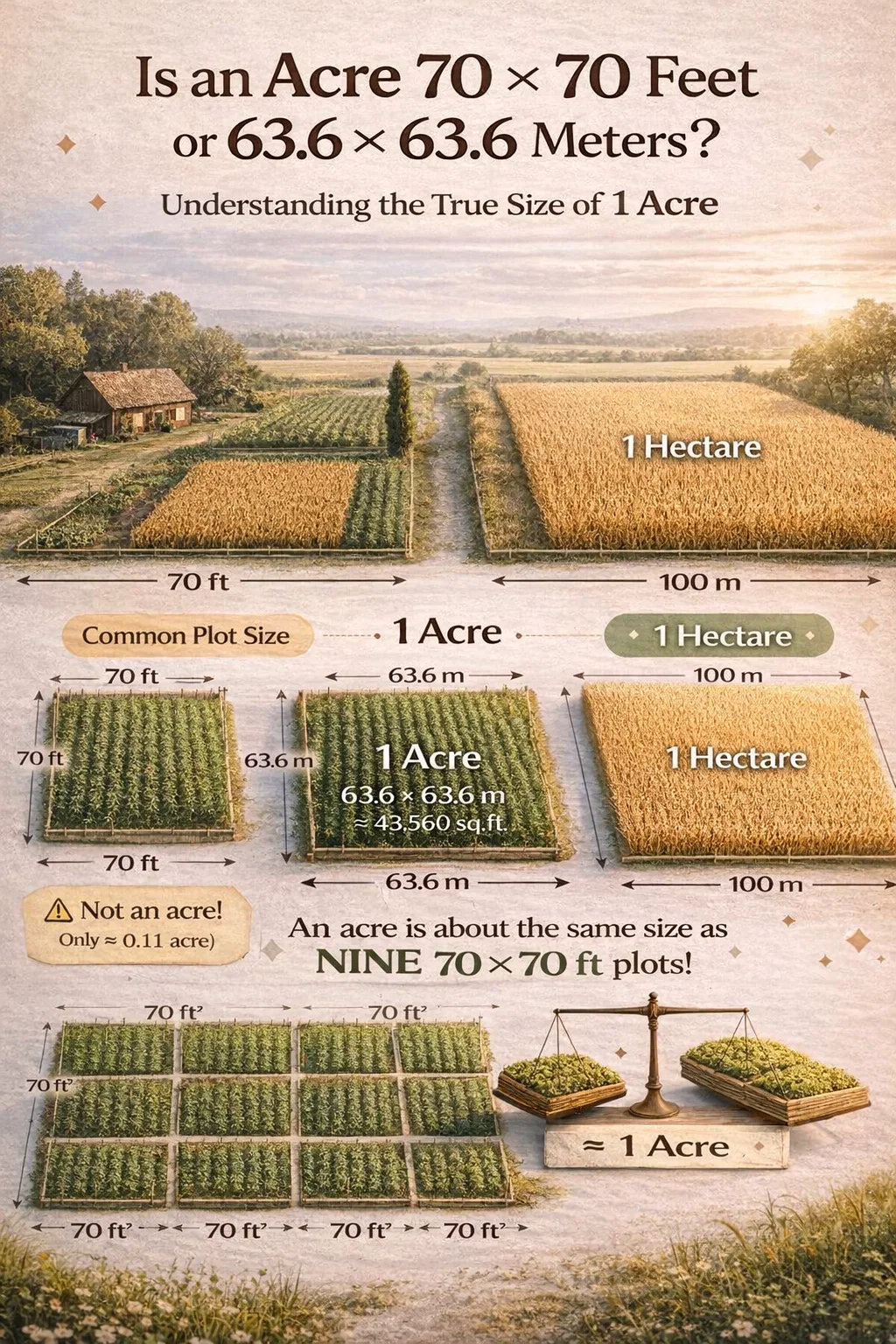
There is a very common myth in the real estate and DIY world that a 70 foot by 70 foot plot of land constitutes an acre. It sounds plausible because the numbers are round and easy to remember. However, when you do the actual math, you find that a 70 by 70 foot square only covers about 4,900 square feet. When you compare that to the actual size of an acre, which is 43,560 square feet, the reality is quite startling. That common plot size is actually only about 0.11 acres.
To put that into perspective, you would need nearly nine of those 70 by 70 foot plots to equal just one single acre. This is why many people feel disappointed when they buy an acre of land and realize it is much larger than they anticipated, or conversely, why someone living on a standard suburban lot might realize they have much less space than they thought for large scale projects like livestock or massive vegetable gardens.
Breaking Down the Math of 43,560 Square Feet
The number 43,560 is the magic figure you need to memorize if you want to understand land in the United States or the UK. An acre does not have to be a perfect square; it can be any shape as long as the total area equals this amount. Historically, an acre was defined as the amount of land a yoke of oxen could plow in a single day. While we have traded oxen for tractors, the measurement has stuck around as the gold standard for land area.
If an acre were a perfect square, each side would be approximately 208.71 feet long. In metric terms, which is often used in international contexts, an acre is roughly equivalent to a square that is 63.6 meters by 63.6 meters. Totaling 4,046 square meters, it provides a substantial amount of room for various activities, but it is still quite different from the larger metric measurement: the hectare.
Acre vs. Hectare: Understanding the Global Standard
If you travel outside of the United States, you will quickly find that the hectare is the preferred unit for measuring large tracts of land. A hectare is significantly larger than an acre, and the math for it is much more elegant because it is based on the metric system. One hectare is defined as a square that is 100 meters by 100 meters, totaling 10,000 square meters.
To visualize the difference, one hectare is roughly equal to 2.47 acres. If you are looking at a field that is one hectare in size, you are looking at an area that could fit almost two and a half full acres within its boundaries. This distinction is vital for anyone looking at international real estate or reading agricultural research from overseas. Knowing how to convert between the two ensures that you never miscalculate the potential yield of your crops or the cost per square foot of your investment.
Practical Ways to Visualize Your Land
Most people find it difficult to visualize 43,560 square feet without a reference point. One of the best ways to understand an acre is to think of an American football field. A standard football field, including the end zones, is about 1.32 acres. If you strip away the end zones, you are left with something very close to a single acre of land. If you can imagine standing on the 50 yard line and looking toward both end zones, you are getting a very accurate sense of the scale of an acre.
Another way to visualize this is through common residential structures. If you have a house that is 2,000 square feet, you could fit nearly 22 of those houses on a single acre of land, assuming there were no yards or driveways. When you start thinking in these terms, it becomes much easier to plan out where a barn, a greenhouse, or a secondary dwelling might fit on your property.
The Importance of Accurate Measurement for Homesteaders
For those interested in homesteading, knowing the difference between a 0.11 acre plot and a full acre is the difference between success and overcrowding. Different agricultural goals require specific amounts of space:
- Vegetable Gardening: A family of four can often be fed on as little as a quarter of an acre if intensive gardening techniques are used.
- Orchards: A full acre can hold anywhere from 100 to 150 semi dwarf fruit trees, providing a massive harvest.
- Livestock: Space requirements vary wildly. While you might keep several goats on an acre, a single cow generally requires one to two acres of high quality pasture to thrive.
By understanding that an acre is 63.6 meters squared rather than 21.34 meters squared (the metric equivalent of 70 feet), you can accurately calculate how much fencing you need to buy, which is often one of the most significant expenses for a new land owner.
How Land Shape Affects Your Perception
It is important to remember that land rarely comes in perfect squares. A long, narrow acre can feel much smaller than a wide, square acre because your line of sight is restricted. This is often referred to as a “flag lot” or a “shoestring lot.” When walking a property, always bring a measuring tool or use a GPS based mapping app to verify the acreage. Do not rely on your eyes alone, as slopes, trees, and neighboring structures can create optical illusions that make a plot of land look larger or smaller than it truly is.
Planning Your Layout with Precision
Once you have a firm grasp on the true size of an acre, you can begin the fun part: designing your layout. Professional landscapers often use grid paper where each square represents a certain number of feet. If you are doing this at home, you can create a scale drawing where one inch equals twenty feet. This allow you to see exactly how much room is left over after you account for the “Common Plot Size” of 70×70 feet for your home and immediate yard.
Using the data from the visual comparison of an acre versus a hectare, you can see that a hectare offers much more flexibility for those looking to be completely self sufficient. However, an acre is often the “sweet spot” for many because it is manageable for one or two people to maintain without needing heavy industrial machinery.
Common Land Measurement Terms You Should Know
To navigate the world of land ownership effectively, you should be familiar with a few other terms that often pop up in deeds and surveys. While the acre is the primary unit, these other measurements help fill in the gaps:
- Square Rod: An old fashioned measurement where 160 square rods equal one acre.
- Rood: An archaic unit equal to a quarter of an acre.
- Surveyor’s Chain: A unit of length equal to 66 feet. An acre is exactly ten square chains.
Understanding these can help when reading older land documents or historical property descriptions. It also gives you a deeper appreciation for the long history of land management and how our modern systems evolved from these practical, physical origins.
Conclusion: Mastering Your Space
Mastering the true size of an acre is a fundamental skill for anyone interested in land, whether for hobby gardening or serious agriculture. By moving past the myth that a 70×70 foot plot is an acre, you empower yourself to make better financial and logistical decisions. Remember that an acre is a generous 43,560 square feet, or roughly 4,046 square meters, and that it takes nearly nine small residential plots to fill that space.
The next time you look at a listing or walk through a park, try to visualize that 63.6×63.6 meter square. Comparing it to the 100 by 100 meter hectare will give you a global perspective on land use and help you plan your future projects with confidence. Land is one of our most precious resources, and knowing exactly how much of it you are working with is the first step toward stewardship and success. Whether you are dreaming of a small garden or a sprawling farm, accuracy in measurement is the foundation upon which everything else is built. Save these figures, keep them in your back pocket, and enjoy the process of bringing your vision for your land to life.