12 Surprising Reasons for Body Pain How to Fix Your Posture Naturally
Understanding your body is often like solving a complex puzzle where the pieces do not always seem to fit. You might wake up with a nagging pain in your shoulder and assume you just slept on it wrong, but the reality could be far more surprising. Our bodies are intricate networks of nerves, muscles, and organs that communicate in ways we are only beginning to fully appreciate. When one area is under stress, the signal often travels and manifests as discomfort in a completely different location. This phenomenon, often referred to as referred pain, is your body’s way of sending a distress signal that requires a bit of detective work to decode.
The journey to holistic wellness begins with the realization that pain is not just a nuisance to be suppressed; it is a vital form of communication. By looking beyond the immediate area of discomfort, we can uncover the hidden triggers that affect our daily lives. Whether it is the way you sit at your desk, the patterns of your breathing while running, or even the hidden stress that causes you to clench your jaw at night, these weird causes are the keys to unlocking long-term relief and vitality. Let us dive deep into these hidden connections and learn how to listen to what our bodies are truly trying to tell us.
The Mystery of Referred Pain: Why Your Shoulder Might Be Warning You About Your Gallbladder
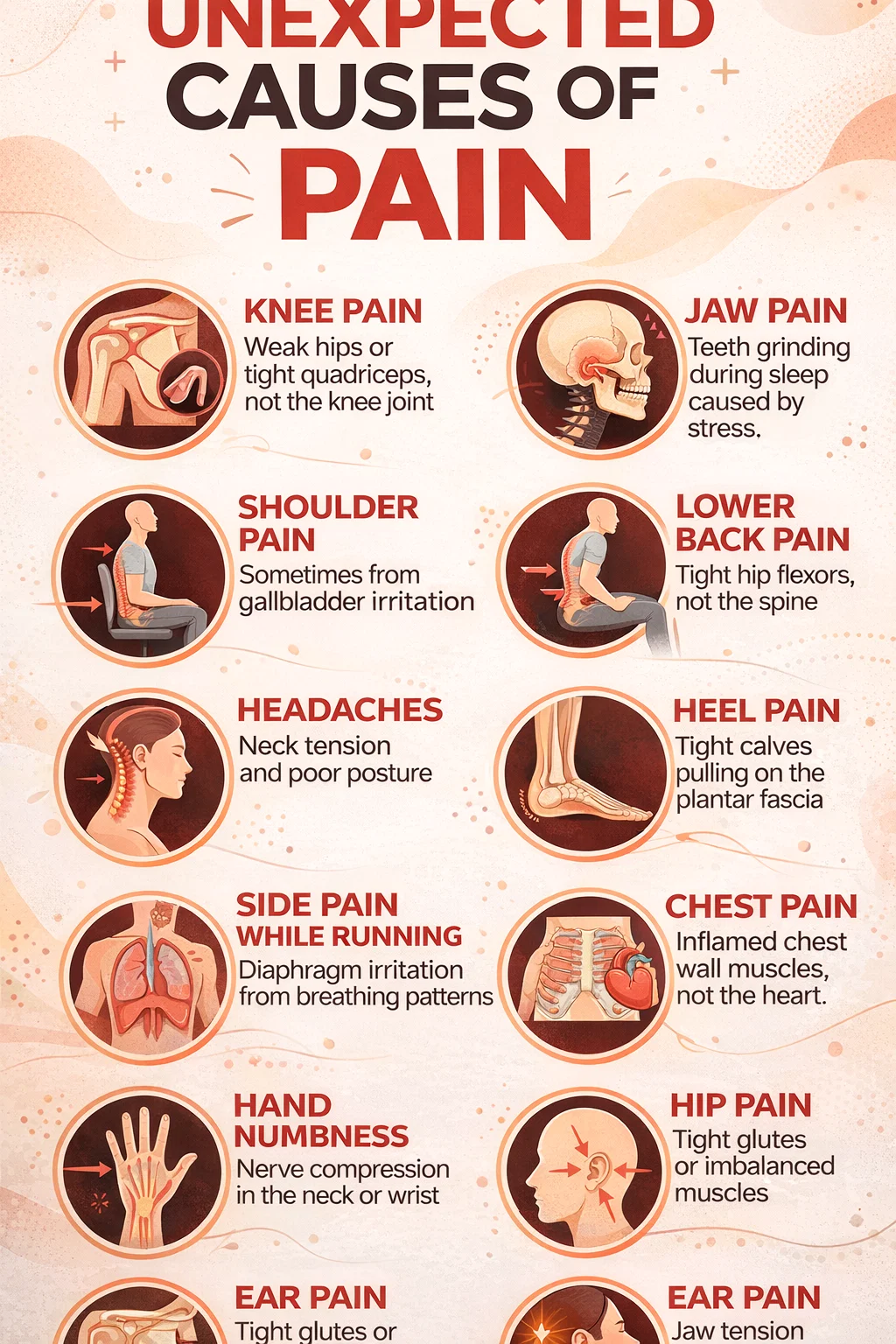
One of the most startling examples of how our internal systems are connected is the link between the gallbladder and the right shoulder. It sounds almost impossible that a small organ tucked under your liver could cause a sharp or dull ache in your shoulder blade. However, this is a classic case of nerve mapping. When the gallbladder is irritated or inflamed, perhaps due to gallstones or a high-fat meal that it is struggling to process, it can stimulate the phrenic nerve. This nerve travels up through the diaphragm and shares a pathway with the nerves that supply the shoulder area.
Instead of feeling a stomach ache, your brain interprets the signal as coming from the shoulder. This is why many people spend weeks trying to massage a shoulder knot that never seems to go away, when the real solution lies in supporting their digestive health. Understanding this connection allows you to approach your health from a more informed perspective. If you notice shoulder discomfort appearing consistently after heavy meals, it might be time to look at your gallbladder rather than booking another deep tissue massage.
Beyond the Joint: How Weak Hips Create Knee Discomfort
When we feel a twinge in our knees, our first instinct is often to reach for a knee brace or blame the joint itself. While wear and tear are real factors, many cases of chronic knee pain actually originate in the hips and the quadriceps. Your knee is essentially a hinge caught between two major powerhouses: your hips and your ankles. If your hip flexors are tight from prolonged sitting or your glutes are too weak to provide stability, the knee is forced to overcompensate for the lack of balance.
The Role of the Quadriceps in Patellar Tracking
The muscles in your thighs play a massive role in how your kneecap moves. If your quadriceps are tight or imbalanced, they can pull the patella out of its proper alignment. This creates friction and inflammation that feels like a joint issue but is actually a muscular tension problem. By focusing on hip mobility and strengthening the supporting muscles of the leg, you can take the pressure off the knee joint and restore fluid, pain-free movement to your gait.
The Hidden Impact of Posture on Chronic Headaches
In our modern world of screens and smartphones, the “tech neck” phenomenon has become a leading cause of persistent headaches. Many people suffer from tension headaches that feel like a tight band around the forehead, assuming it is just stress or dehydration. While those factors play a part, the physical alignment of your neck and upper back is often the primary culprit. When you slouch or lean forward to look at a screen, the muscles at the base of your skull and along your cervical spine have to work overtime to hold your head up.
This constant state of contraction leads to trigger points that radiate pain upward into the head. Poor posture does not just affect your spine; it alters your entire nervous system’s baseline. Correcting your workstation ergonomics and practicing regular neck stretches can do more for your long-term headache relief than a lifetime supply of over-the-counter painkillers. It is about addressing the structural cause rather than just masking the sensory symptom.
Lower Back Pain and the Sitting Epidemic
If you spend the majority of your day sitting in an office chair, your lower back is likely paying the price. However, the cause might not be your back muscles at all. Prolonged sitting causes the hip flexors at the front of your body to become shortened and extremely tight. Because these muscles are attached to the lower lumbar spine, they literally pull on your back when you stand up, creating a constant state of strain.
Waking Up the Glutes for Back Support
When hip flexors are tight, the gluteal muscles often become “inhibited,” meaning they essentially turn off because they are not being used. Without the glutes to support your pelvis, your lower back is forced to take on the load of every step you take and every movement you make. Incorporating standing breaks and hip-opening stretches into your daily routine can alleviate that “mysterious” back pain by restoring the natural balance between the front and back of your body.
Unusual Triggers: Jaw Tension and Ear Discomfort
Have you ever experienced a dull ache in your ear or a feeling of fullness that a doctor says isn’t an infection? The answer often lies in the temporomandibular joint, or TMJ. Because the jaw joint sits directly in front of the ear canal, tension in the jaw muscles can easily be felt as ear pain. Many of us carry our stress in our jaws, grinding our teeth at night or clenching during the day without even realizing it.
This muscular strain creates a radiating sensation that mimics an earache. Managing stress through relaxation techniques, or even using a night guard to prevent grinding, can often clear up ear discomfort that has persisted for months. It is a powerful reminder that our facial muscles are just as prone to tension-related referred pain as our larger muscle groups.
The Connection Between Breathing and Side Stitches
For runners and athletes, a sharp pain in the side, often called a side stitch, can be incredibly frustrating. While many blame it on eating too close to a workout, it is frequently a result of diaphragm irritation. Your diaphragm is the primary muscle responsible for breathing, and it is under a lot of pressure during cardiovascular exercise. If your breathing patterns are shallow or irregular, the diaphragm can spasm.
Furthermore, the ligaments that hold your internal organs in place can pull on the diaphragm during the jarring motion of running. Learning deep, rhythmic belly breathing can help stabilize the core and provide the diaphragm with the oxygen it needs to function smoothly. By shifting your focus to your breath, you can prevent these painful interruptions and improve your overall athletic performance.
Nerve Compression: Why Your Hands Go Numb
Waking up with “pins and needles” in your hands can be alarming. While carpal tunnel syndrome in the wrist is a well-known cause, hand numbness often originates much higher up in the body. Nerve compression in the neck or the thoracic outlet (the space between your collarbone and first rib) can cut off the signals traveling down your arm to your fingertips. This is frequently caused by slouching or a forward-head posture that pinches the delicate nerves as they exit the spine.
Instead of focusing only on your wrists, it is essential to look at the alignment of your shoulders and neck. Stretching the chest muscles and strengthening the upper back can open up the pathways for these nerves, restoring full sensation and strength to your hands. It is a perfect example of how the site of the symptom is often far removed from the site of the problem.
Heel Pain and the Chain Reaction of the Calves
Plantar fasciitis is a common and painful condition affecting the heel, but the “weird” cause is often found in the back of the leg. The calves and the plantar fascia are part of a continuous line of connective tissue. When your calf muscles are chronically tight, they pull on the Achilles tendon, which in turn pulls on the bottom of your foot. This constant tension creates micro-tears in the fascia, leading to that sharp, stabbing pain when you take your first steps in the morning.
Relief for heel pain usually requires a dedicated focus on loosening the calves. By using a foam roller or performing daily wall stretches, you can reduce the upward pull on the heel and allow the foot to heal. It shows that even in our feet, we cannot ignore the influence of the muscles further up the chain.
Taking a Holistic Approach to Body Awareness
Understanding these unusual causes of pain empowers you to take control of your health. Instead of feeling frustrated by symptoms that won’t go away, you can begin to ask better questions. Am I sitting too much? How is my breathing? Where am I holding my stress? By treating the body as a whole system rather than a collection of isolated parts, you open the door to true healing.
Consistency is key when it comes to making these changes. Small, daily habits like checking your posture, stretching tight areas, and practicing mindful breathing can have a massive cumulative effect on your well-being. Your body is incredibly resilient and has an amazing capacity to heal when you provide it with the right environment and support. Listening to those “weird” signals is the first step toward a more comfortable, active, and vibrant life.
Conclusion: Listening to the Language of Your Body
Pain is rarely a simple one-to-one equation. As we have explored, the causes of our discomfort are often hidden in our habits, our posture, and the interconnected nature of our anatomy. From the gallbladder affecting the shoulder to the calves impacting the heel, the body functions as a unified whole. When we stop viewing pain as an enemy and start seeing it as a guide, we can address the root causes of our issues and find lasting solutions.
We encourage you to use this information as a starting point for your own wellness journey. Pay attention to the patterns in your body and do not be afraid to look for the “weird” causes behind your aches. Whether it is through better ergonomics, targeted stretching, or stress management, you have the power to influence how you feel every single day. Embrace the complexity of your body, stay curious about its signals, and move toward a future of holistic health and pain-free living. Save these tips and start your transformation today!