Journal Prompts to Get Unstuck Mindfulness for Wellness Emotional Growth
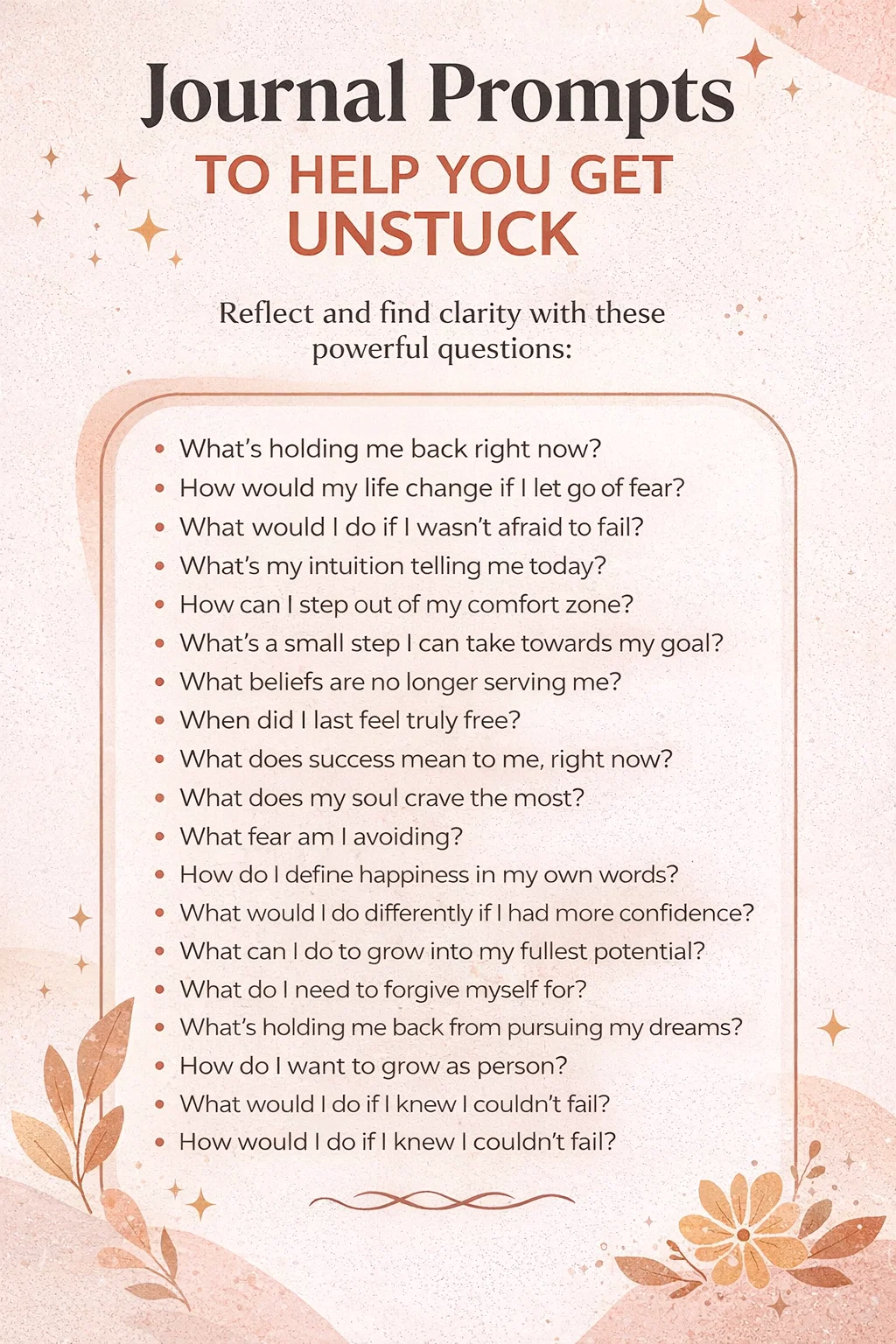
Have you ever felt completely stuck? Not physically stuck like you’re caught in a traffic jam but mentally and emotionally immobilized. It’s that frustrating sensation where you’re running on a treadmill, putting in immense effort but going absolutely nowhere. Your ideas feel stale, your motivation has evaporated, and your next big move feels like an impossible puzzle. It is an incredibly common human experience, a psychological roadblock that can leave you feeling discouraged and disconnected from your true potential. The good news is that feeling stuck isn’t a permanent state; it is often a signal from your mind and soul that it’s time for deeper introspection and a intentional pause. The attached image offers a powerful tool for this very moment: a collection of carefully crafted journal prompts designed to help you peel back the layers of frustration and find the clarity you need to move forward.
Journaling is far more than just writing down your day’s events. It’s a transformative practice, a confidential dialogue with your inner self. When you are stuck, you are often caught in an internal loop of overthinking, doubt, and fear. Journaling acts as a releases valve for this mental pressure. It forces you to externalize your vague anxieties and translate them into concrete words, making them feel smaller and more manageable. The prompts in this list are specifically designed to tackle different facets of this feeling, from identifying the invisible weights holding you back to reconnecting with your core purpose and desires. Let’s explore how you can use these prompts to unlock your potential and reclaim your sense of direction.
Understanding Why You’re Stuck
The first step toward moving forward is to get crystal clear about what is holding you in place. You can’t solve a problem you haven’t fully defined. Many times, the reasons we feel stuck are obscured by surface-level frustration or distractions. We might blame our job, our partner, or a lack of time, but the true roadblocks often lie deeper within our psychology.
The very first prompt on the list, “What’s holding me back right now?”, is a crucial starting point. It’s a direct, unvarnished invitation to sit with your current reality. Are you afraid of criticism? Is your perfectionism paralyzing you? Are you simply burnt out and in need of rest? When you take the time to answer this honestly, you might find multiple layers of answers. Don’t censor yourself. Write down every possibility, even the ones that feel silly or embarrassing.
Another powerful prompt for this stage is, “What beliefs are no longer serving me?”. This gets to the heart of your personal narratives. We all possess a collection of internal stories about who we are, what we are capable of, and what the world expects of us. These are often stories we adopted from childhood, past failures, or external pressures. “I’m not creative.” “Success is always hard.” “I can’t change my career.” These limiting beliefs are the chains of your stuckness. Identifying them is the first act of liberation. What story are you telling yourself that has become a self-fulfilling prophecy? Once you see the story written down, you can begin to question its truth.
Unmasking the Power of Overthinking
One of the most insidious forms of stuckness is analysis paralysis, or simply, overthinking. We believe that if we just think about the problem enough from every possible angle, the perfect, risk-free answer will emerge. The prompt “What would happen if I stopped overthinking and just acted?” strikes a blow at this illusion. The truth is, perfect answers are rare. Most growth and clarity come from action, from experimentation. Overthinking keeps you in a hypothetical world. Action brings you into the real world. This prompt challenges you to imagine the freedom and momentum that could come from just taking one small step, even a messy one, instead of waiting for absolute certainty.
Confronting Your Fears and Finding Courage
Fear is almost always at the root of our stuckness. It is the silent, invisible force that keeps us small and prevents us from taking the risks necessary for growth. The list in the image is full of prompts that gently, yet directly, confront this fear. Look at the prompt, “What would I do if I knew I couldn’t fail?”. This is a classic exercise for a reason: it instantly removes the mental constraint of fear. It allows you to see your deepest desires and aspirations without the shadow of doubt. When failure is off the table, what does your true self want to pursue? The answer to this prompt is not a guarantee of a seamless path, but it is a powerful indicator of your true north.
Following this, “How would my life change if I let go of fear?” asks you to paint a vivid picture of the reward. What kind of freedom, joy, confidence, or peace would you experience? Instead of focusing on the anxiety of the unknown, you are directed to focus on the expansion of your potential. This is not about magically becoming fearless; it is about recognizing how much richer your life could be if fear was no longer the sole decision-maker.
Then comes the practical challenge: “What fear am I avoiding that I need to face?”. This prompt requires brave, honest looking. We all have that one thing we are subtly dancing around, that project, conversation, or decision we keep putting off. Perhaps it’s having a difficult conversation with a partner, quitting a secure but unfulfilling job, or starting that business. Naming the specific fear takes away its mysterious, all-encompassing power. When you can say, “I am afraid of X,” you can then begin to ask, “What is the worst that could happen if X occurred, and could I handle it?” The answer is almost always yes.
Connecting to Your True Self and Desires
Sometimes we are stuck not because we are afraid but because we have lost touch with what we truly want. We are living life on autopilot, chasing goals that were never truly ours, or simply drifting. Reconnecting with your inner self is a powerful remedy for this spiritual stuckness.
The prompt “When did I last feel truly alive and free?” can be a profound key. This isn’t necessarily about a grand achievement; it might be about a simple, quiet moment: hiking on a mountain, listening to your favorite music, having a deep conversation, or losing yourself in a creative project. What were the core elements of that experience? Joy, connection, creativity, peace, adventure? Re-creating these elements in your current life can be a roadmap to feeling unstuck. They are clues about what is essential for your well-being.
Another deeply resonant question is, “What does my soul crave the most?”. This is distinct from what you think you should want. Your brain might say you want a higher-paying job, but your soul might crave more meaningful connections, more creative expression, or simply more rest. Our society is good at selling us desires that don’t match our inner truth. Honoring the quiet whisper of your soul is essential. It could point to a path that is entirely unexpected but deeply fulfilling.
“How would I describe the ideal version of myself?” This prompt allows you to create a positive vision. It’s not about being someone else; it’s about imagining yourself with more confidence, more courage, more patience, or more love. This vision can act as a guiding star. Ask yourself, “What would that ideal version of me do in my current situation?” Often, this simple question provides an entirely new perspective on a problem.
Cultivating Self-Compassion and Healing
Feeling stuck is often accompanied by harsh self-criticism. We tell ourselves we are lazy, a failure, or that we should have figured it all out by now. This internal negativity creates even more resistance and makes moving forward feel impossible. Incorporating self-compassion is a critical part of the process.
“How can I practice more self-compassion right now?” This question is a warm blanket. Instead of berating yourself for being stuck, it asks you to treat yourself with the same kindness and understanding you would offer a friend. It might mean giving yourself a break, acknowledging how hard you are trying, or validating your complex feelings. Being gentle with yourself creates a safer internal environment where new ideas and the courage to act can emerge.
The prompt “What do I need to forgive myself for?” addresses old wounds that may be silently weighing you down. Perhaps you’re holding onto a past mistake, a moment you didn’t stand up for yourself, or a relationship that didn’t work. Holding onto these regrets can feel like carrying heavy stones. Journaling offers a safe space to acknowledge these feelings and consciously decide to let them go. Forgiving yourself isn’t about condoning past mistakes; it’s about refusing to let them define your future.
Finally, “How can I show myself more love today?” is a concrete, action-oriented prompt. It translates the abstract concept of self-love into practical steps. It could be making a cup of your favorite tea, going for a walk, listening to a supportive podcast, or simply speaking kind words to yourself. These acts of self-care may seem small, but they are powerful declarations of your worth, helping you build the emotional reserves needed to move forward.
The Magic of Small Steps and Practical Action
While deep introspection is vital, it can also leave you floating in a sea of ideas without any tangible progress. The true magic happens when your inner work is translated into small, manageable outer actions. Several prompts on the list bridge this gap beautifully.
“What small step can I take towards my goal right now?”. This is the antidote to paralysis. When you look at a huge, overwhelming goal, it’s natural to feel stuck. The mountain looks too big. But if you break it down into the smallest possible actions, the fear dissipates. A “small step” could be making one phone call, spending 10 minutes researching, writing one paragraph, or opening a savings account. It doesn’t have to be perfect; it just has to be an action. Momentum builds upon itself.
“What is one thing I can do today to move closer to my goals?”. This prompt provides focus and accountability. Instead of getting distracted by endless possibilities, you commit to one specific action for the day. This simple practice helps restore your sense of agency and power, proving that you have the ability to affect change in your own life.
Finally, consider “What part of my life feels out of balance?”. This helps you identify the practical area that needs attention. You can’t fix “your life” all at once, but you can focus on improving your physical health, your relationships, your environment, or your finance. This prompt can reveal that your stuckness isn’t a total life failure; it might just be concentrated in one specific area.
Integrating a Journaling Routine for Lasting Clarity
This list of prompts isn’t a magic wand that will solve all your problems after one session. It is a powerful resource that becomes even more effective with consistent use. To harness its full potential, consider making journaling a regular part of your life. It doesn’t need to be time-consuming; even 10 minutes a day can make a significant difference.
You might choose to use these prompts in the morning to set your intention and clear your mind for the day. Or, you might prefer the evening, using the prompts to process your experiences, celebrate small wins, and reflect on challenges. There is no right or wrong way; the key is to find what works for you.
You can use this list as a direct guide. Simply choose a prompt that resonates with your current feeling, or work through them sequentially. The process is personal and flexible. You can create a cozy space with a favorite journal and pen, or use a simple digital app. The core idea is to create a moment of pause and connect with your inner wisdom.
Conclusion
Feeling stuck is not a sign of failure; it is an inevitable and often valuable part of the human journey. It is a moment of necessary introspection, a call to question your path, your beliefs, and your desires. While the feeling itself is uncomfortable, it holds the seed of profound transformation. The journal prompts in this list are like a treasure map for your inner world. They provide the questions that can lead you through the darkness of doubt and fear to a place of clarity and courageous action.
I encourage you to take that first brave step. Pull out a journal or a piece of paper, and pick just one prompt that speaks to you. “What’s holding me back right now?”. Let the words flow without judgment. Trust the process. The answers are already within you, waiting for the right question to bring them to light. Embracing this practice can be the start of a whole new chapter, one where you move from a place of being stuck to a place of feeling fully, dynamically, and vibrantly alive.