4 Natural Hair Gels for Hair Growth, Hair Fall Control, Dandruff Relief Shine
Looking for a simple way to refresh your hair care routine with natural ingredients? Natural hair gels are a popular option for people who want to nourish their scalp, manage frizz, improve softness, and enjoy shinier-looking hair. From refreshing aloe vera gel to seed-based mixtures and herbal preparations, homemade hair gels offer different textures and benefits depending on the ingredients you choose.
Whether your main concern is hair growth, hair fall, dandruff, or dry, unruly strands, choosing the right hair care ingredients can help you build a routine that suits your needs. The key is understanding what each ingredient can realistically do, how to prepare a gel safely, and how to apply it without irritating your scalp or weighing down your hair.
Key Takeaways
- Aloe vera gel can help condition hair and provide a lightweight, soothing feel for some scalps.
- Flaxseed gel offers natural slip and light styling hold, making it useful for curls and frizz-prone hair.
- Fenugreek seed gel or paste can be used as a conditioning treatment, although strong evidence for hair growth is limited.
- Onion-based hair treatments may irritate the scalp and have limited evidence, so they require caution.
- Consistent, gentle hair care and identifying the cause of hair loss are more important than relying on one homemade remedy.
- Fresh homemade gels need careful storage and should be discarded if their smell, color, or texture changes.
1. Aloe Vera Hair Gel for Moisture and Shine
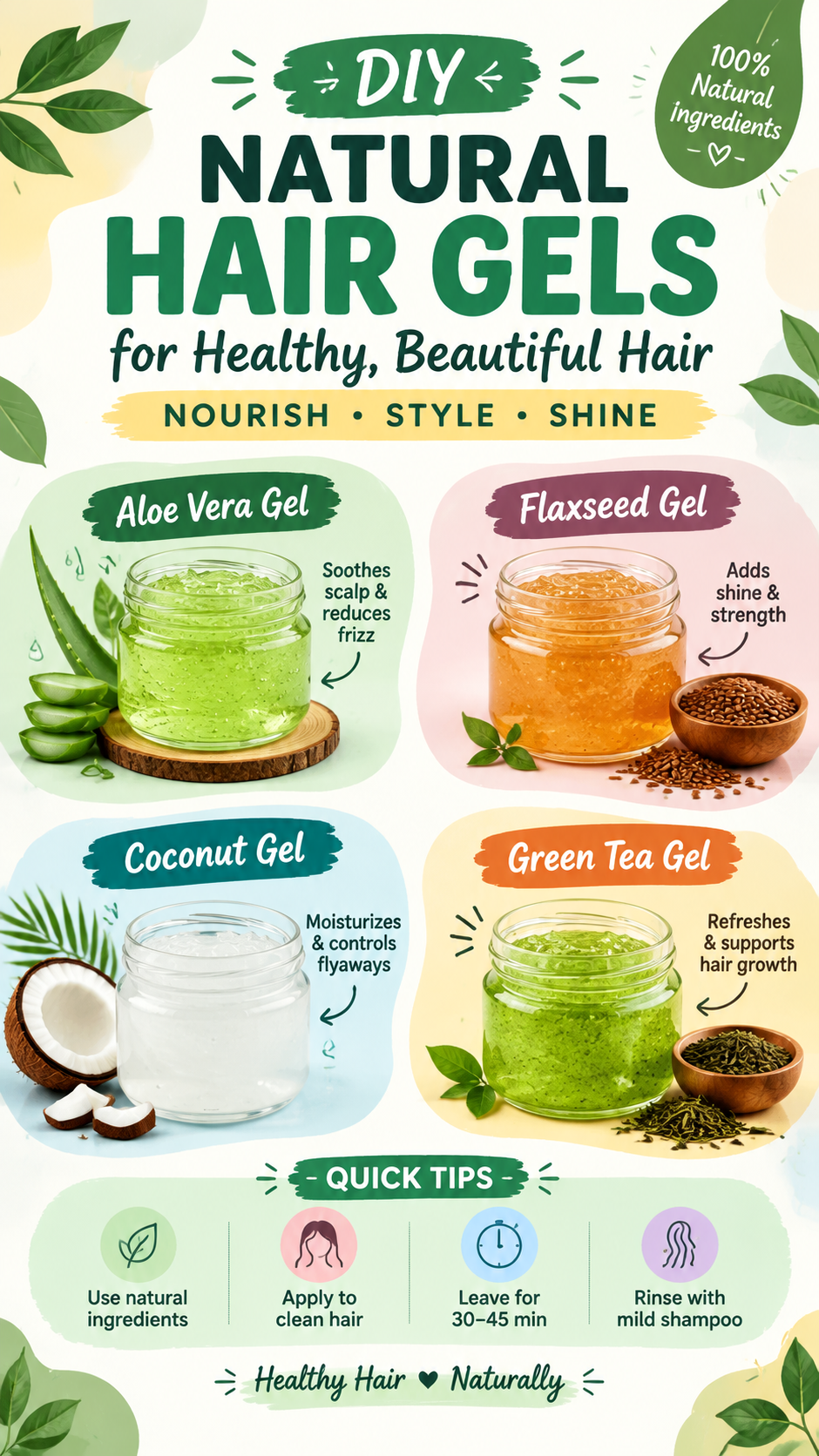
Aloe vera is a familiar ingredient in natural hair care because its gel has a lightweight texture that spreads easily through the hair. It can make strands feel softer, improve manageability, and provide a refreshing sensation when applied to the scalp. Aloe vera gel is particularly appealing to people who prefer a simple hair routine without heavy oils or thick styling products.
Potential Benefits of Aloe Vera Gel
- Lightweight conditioning: Aloe gel can help hair feel smoother and easier to comb.
- Frizz management: Its texture may help define curls and reduce the appearance of flyaways.
- Scalp comfort: Some people find aloe soothing, although it can irritate sensitive skin in certain cases.
- Easy application: A small amount can be distributed through damp hair or used as part of a rinse-out treatment.
Although aloe vera is widely used in homemade hair care, it should not be treated as a proven cure for hair loss or a guaranteed hair growth treatment. Healthier-looking hair often comes from reducing breakage, keeping the scalp comfortable, and using products that suit your hair type.
How to Use Aloe Vera Hair Gel
- Choose a commercially prepared aloe vera gel intended for cosmetic use, preferably one with a short ingredient list.
- Apply a small amount to clean, damp hair.
- Distribute it evenly with your fingers, concentrating on the lengths if your scalp is sensitive.
- Allow the gel to dry for light styling or rinse it out if you are using it as a conditioning treatment.
- Observe how your hair responds before increasing the amount or frequency.
Important: Natural ingredients can still trigger allergic reactions. Test a small amount on a limited area of skin before applying a new gel to your scalp. Stop using it if you notice burning, redness, itching, or swelling.
2. Flaxseed Hair Gel for Smoothness and Curl Definition
Flaxseed gel is one of the most popular homemade styling gels for people who want to define curls without using a heavy commercial product. When flaxseeds are simmered in water, they release a slippery, gel-like substance that can help strands group together and maintain their shape.
Unlike treatments marketed specifically for hair growth, flaxseed gel is mainly useful as a styling and conditioning aid. It can help reduce friction during styling, improve curl definition, and make hair feel more manageable. These qualities are especially useful for wavy, curly, and coily hair that tends to become tangled or frizzy.
Why Flaxseed Gel Is Worth Trying
- Natural styling hold: It can help curls keep their shape without the heavy feel of some styling creams.
- Improved slip: The gel can make it easier to distribute styling products and separate strands gently.
- Frizz control: Applying it evenly to damp hair may help create a smoother finish.
- Flexible styling: It can be used for wash-and-go styles, twists, and other curl-focused routines.
Easy Homemade Flaxseed Gel Recipe
Ingredients
- 2 tablespoons of whole flaxseeds
- 1 cup of water
Preparation Method
- Add the flaxseeds and water to a small saucepan.
- Bring the mixture to a gentle simmer, stirring occasionally.
- Continue simmering until the water develops a slippery, slightly thick consistency.
- Remove the saucepan from the heat and strain the mixture while it is still warm enough to pass through a fine strainer.
- Allow the gel to cool completely before using it.
Apply a small amount to damp hair, smoothing it over sections with your fingers. Scrunch curly hair gently to encourage definition, then let it air-dry or use a diffuser on an appropriate setting.
Homemade flaxseed gel contains water and no reliable preservation system, so contamination can develop quickly. Make small batches, use clean utensils and containers, refrigerate promptly, and discard the gel after a few days or sooner if anything changes. Do not rely on smell alone to determine whether a homemade product is safe.
3. Fenugreek Hair Gel for Conditioning and Manageability
Fenugreek, also known as methi, is commonly used in traditional hair care routines. The small golden-brown seeds shown in natural hair care inspiration are often prepared as a paste or gel-like mixture for application to the hair and scalp.
Fenugreek contains plant compounds and mucilage that can contribute to a slippery texture when the seeds are soaked or cooked. This texture makes it suitable for conditioning treatments intended to improve the feel of dry or tangled hair.
Possible Advantages of Fenugreek Treatments
- May help hair feel softer and easier to detangle.
- Can be incorporated into a pre-shampoo conditioning routine.
- Offers a traditional plant-based option for people who enjoy experimenting with homemade hair treatments.
- Can complement a routine focused on gentle handling and reducing hair breakage.
It is important to distinguish traditional use from proven results. There is not enough high-quality clinical evidence to conclude that fenugreek gel reliably stimulates new hair growth, stops hair loss, or treats scalp disorders.
How to Prepare a Simple Fenugreek Treatment
- Place a small amount of fenugreek seeds in clean water and soak them until they soften.
- Drain the seeds and blend them with a little fresh water to form a smooth paste.
- Add a little more water if necessary to create a spreadable consistency.
- Apply the mixture to a small section of hair first to check how it feels and rinses out.
- If tolerated, use it as a short pre-shampoo treatment and rinse thoroughly.
Avoid making more than you need for one application. Fresh seed mixtures can spoil, and thick pastes may be difficult to remove from dense or tightly curled hair. Do not use the mixture on irritated, broken, or inflamed skin.
4. Onion-Based Hair Treatments for Hair Fall Concerns
Onion is another ingredient associated with traditional hair care, especially in routines aimed at reducing hair fall. It contains sulfur-containing compounds, which are sometimes discussed in relation to hair structure and scalp health. However, the presence of these compounds does not establish that applying onion gel or onion juice will prevent hair loss.
Some limited research has explored onion juice for particular forms of hair loss, but the available evidence is not sufficient to support broad claims that onion-based preparations treat common hair thinning, breakage, or all types of alopecia.
What to Know Before Trying Onion Hair Gel
- Potential irritation: Onion juice can cause burning, redness, itching, or contact dermatitis.
- Strong odor: The smell may linger in hair and can be difficult to remove.
- Limited evidence: Results from small studies cannot establish that onion products work for everyone.
- Individual sensitivity: A preparation that another person tolerates may not suit your scalp.
If you decide to experiment with an onion-based cosmetic product, choose one formulated for topical use, follow its label directions, and perform a patch test. Avoid applying raw onion juice or homemade onion mixtures to an irritated scalp, and keep them away from your eyes.
Safety first: Do not assume that a natural hair fall remedy is harmless or effective. Sudden hair loss, bald patches, scalp pain, or persistent shedding deserve medical assessment. Finding the underlying cause is more useful than repeatedly switching between homemade treatments.
5. Choosing the Right Natural Hair Gel for Your Needs
Different hair concerns call for different approaches. A gel that works beautifully on loose curls may leave fine, straight hair feeling coated. Likewise, a styling gel that improves shine may not address persistent dandruff or medically significant hair loss.
Instead of choosing a product based only on its color, fragrance, or popularity, consider your scalp condition, hair texture, styling goals, and tolerance for different ingredients.
For Dry or Frizzy Hair
Look for a gel that helps hair feel smoother without leaving a stiff or sticky coating. Aloe vera gel and flaxseed gel are options worth exploring, particularly for textured hair. Apply them to damp strands and use a suitable conditioner during washing to help reduce friction.
Remember that a styling gel does not replace a conditioner. Hair that feels dry may benefit more from a complete routine that includes gentle cleansing, conditioning, and protection against excessive heat.
For Hair Breakage
Hair breakage can make it seem as though your hair is not growing, even when new strands are emerging from the scalp. Common contributors include aggressive brushing, tight hairstyles, frequent heat styling, chemical processing, and rough handling when hair is wet.
A lightweight gel may help make styling more manageable, but the bigger priority is reducing mechanical damage. Use a wide-tooth comb when appropriate, detangle gently, avoid repeatedly pulling hair into tight styles, and protect the lengths from unnecessary friction.
For an Itchy or Flaky Scalp
Flaking can result from several conditions, including dandruff, seborrheic dermatitis, irritation from hair products, and other skin disorders. A homemade gel is not a reliable treatment for every cause.
If dandruff is your main concern, an evidence-based anti-dandruff shampoo may be more appropriate than relying on herbs or seed mixtures. Depending on the formulation, useful active ingredients may include ketoconazole, selenium sulfide, or zinc pyrithione where available. Follow the product label and ask a pharmacist or clinician if symptoms persist.
For Thinning Hair
Hair thinning can be associated with genetics, hormonal changes, nutritional deficiencies, certain medications, illness, stress, and scalp conditions. The most effective approach depends on the cause.
Natural gels can be part of a cosmetic routine if they are well tolerated, but they should not replace an appropriate diagnosis or proven treatment. A healthcare professional can help determine whether further evaluation or a targeted treatment is needed.
Why This Matters
Healthy-looking hair depends on more than a single ingredient. Styling products can improve softness, manageability, and appearance, while scalp conditions and persistent hair loss may require targeted care. Choose a gel for the benefit it can realistically provide, and avoid expecting one homemade recipe to solve every hair concern.
6. How to Apply Hair Gel Without Damaging Your Hair
Even a gentle hair gel can leave buildup or cause irritation when it is used too frequently, applied in excessive amounts, or left on the scalp despite discomfort. A simple application method can help you get the most from your chosen product.
Follow These Steps
- Start with clean hair: Wash away excess oil, dirt, and old styling products when needed.
- Choose the right amount: Begin with a small quantity and add more only if necessary.
- Apply evenly: Distribute the gel through damp hair using your fingers or a suitable styling tool.
- Massage gently: If the product is designed for scalp use, use your fingertips rather than scratching with your nails.
- Follow the directions: Some gels are intended to remain in the hair, while others should be rinsed out.
- Watch for buildup: Cleanse as needed if your hair begins to feel coated, heavy, or difficult to style.
- Stop if irritation occurs: Rinse the product away and discontinue use if you develop discomfort or a rash.
There is no universal rule that every hair gel should stay on the scalp for 30 to 45 minutes. The appropriate contact time depends on the formulation and its intended use. A leave-in styling gel should be used according to its instructions, while a rinse-out treatment should not be left on indefinitely.
7. Common Mistakes to Avoid With Homemade Hair Gels
Homemade hair care can be enjoyable, but simple preparation and storage mistakes may reduce its usefulness or increase the risk of irritation. A few precautions make experimenting with natural ingredients more sensible.
Using Too Many Ingredients at Once
Combining aloe vera, onion, multiple herbs, essential oils, and seed extracts in one mixture makes it difficult to identify which ingredient is responsible for a reaction. Start with one ingredient at a time and avoid adding fragrance or essential oils simply because a recipe recommends them.
Leaving Fresh Mixtures in Storage Too Long
Water-based homemade gels can support microbial growth, particularly when they are prepared without a validated preservative system. Refrigeration slows some forms of spoilage but does not make a homemade product sterile or guarantee safety.
Prepare small batches, use clean equipment, avoid dipping dirty fingers into storage containers, and discard leftovers promptly. Never use a product that has changed unexpectedly in smell, appearance, or texture.
Expecting Instant Hair Growth
Hair grows gradually, and visible changes in length depend on many factors. A product that makes hair smoother can reduce tangling and help protect the lengths, but this is not the same as stimulating new growth from the follicles.
Take a realistic approach by focusing on manageable hair, reduced breakage, and a comfortable scalp. If shedding continues or your hair density changes noticeably, seek professional advice instead of relying exclusively on cosmetic remedies.
Ignoring Your Hair Type
Thick curls, fine strands, and straight hair do not always respond to products in the same way. Heavy or sticky mixtures may weigh down fine hair, while very lightweight gels may not provide enough hold for dense curls. Adjust the amount and method of application to suit your own hair rather than following a recipe exactly when it does not feel right.
8. Building a Simple Natural Hair Care Routine
The best hair care routine is one you can follow comfortably and consistently. You do not need a large collection of homemade treatments to improve how your hair looks and feels. A few well-chosen products and gentle habits can make a meaningful difference to manageability.
A Practical Weekly Approach
- On wash day: Use a shampoo suited to your scalp and follow with conditioner suited to your hair lengths.
- After washing: Apply a small amount of aloe vera gel or flaxseed styling gel if it suits your hair and the product is intended for that use.
- Between washes: Reduce unnecessary heat styling and handle tangles gently.
- When needed: Use an appropriate anti-dandruff product if you have persistent flakes, following its instructions.
- Regularly: Review whether your products leave your scalp comfortable and your hair easy to manage.
It can also help to keep a brief hair care journal. Record the products you use, how often you wash your hair, and whether you notice changes in dryness, irritation, breakage, or shedding. This can help you identify patterns and avoid repeatedly trying products that do not suit you.
9. Frequently Asked Questions About Natural Hair Gels
Can Natural Hair Gel Make Hair Grow Faster?
There is no strong evidence that common homemade gels, including aloe vera and flaxseed gel, reliably accelerate hair growth. They may improve the appearance and manageability of hair, and gentler styling may help reduce breakage. If growth or thinning is a concern, identifying the underlying cause is more important than choosing a particular gel.
Which Natural Gel Is Best for Frizzy Hair?
Aloe vera gel and flaxseed gel are two options to consider. Flaxseed gel is particularly popular for curl definition, while aloe vera gel may offer lightweight conditioning. Results depend on your hair texture, the formulation, and how much product you apply.
Can I Leave Homemade Hair Gel on Overnight?
That depends on the ingredients and whether the mixture is intended as a leave-in product. Do not leave an untested homemade treatment on your scalp overnight, particularly if it contains onion juice or other potentially irritating ingredients. Follow the product instructions, and rinse away any treatment that causes discomfort.
Does Natural Hair Gel Help With Dandruff?
Some gels may make the scalp feel comfortable, but they are not established treatments for dandruff. If you have recurring flakes, itching, or redness, consider an appropriate anti-dandruff shampoo or consult a healthcare professional. Avoid applying heavy mixtures that worsen buildup or irritation.
How Often Should I Use Natural Hair Gel?
There is no single schedule for every product. A styling gel can be used as needed if the formulation is suitable for your hair, while rinse-out treatments should follow their directions. Fresh homemade gels should be prepared and stored cautiously, and you should reduce use if buildup or irritation develops.
Quick Points: Natural Hair Gel at a Glance
- Choose aloe vera for lightweight conditioning and flaxseed gel for styling and curl definition.
- Try fenugreek as a traditional conditioning treatment, not a proven hair growth remedy.
- Be cautious with onion-based treatments because irritation is possible and evidence is limited.
- Use clean equipment and avoid storing fresh homemade mixtures for extended periods.
- Seek professional advice for persistent dandruff, sudden hair loss, or unexplained thinning.
Conclusion: Find the Natural Hair Gel That Works for You
Natural hair gels offer an appealing way to explore simple hair care ingredients while focusing on softness, styling, and shine. Aloe vera can provide lightweight conditioning, flaxseed gel is useful for curl definition, and fenugreek can be prepared as a traditional conditioning treatment. Onion-based products are sometimes used for hair fall concerns, but their benefits remain uncertain and irritation is a real possibility.
The most effective routine is not necessarily the one with the most ingredients. Choose products that suit your hair type, keep your scalp comfortable, and handle your hair gently. Combine styling products with regular conditioning, sensible cleansing, and habits that help reduce breakage.
Most importantly, separate cosmetic benefits from medical claims. A gel that makes your hair feel smoother or look shinier can be a valuable part of your routine, but it cannot guarantee faster growth or cure scalp conditions. If you experience ongoing shedding, bald patches, or persistent scalp irritation, seek advice from a qualified healthcare professional.
Start with one simple option, pay attention to how your hair responds, and build a routine that feels easy to maintain. With thoughtful product choices and consistent care, you can work toward softer, more manageable, healthy-looking hair without making your routine unnecessarily complicated.
Tags
Natural Hair Care
DIY Hair Gel
Aloe Vera Hair Gel
Flaxseed Hair Gel
Hair Growth Tips
Frizz Control
Healthy Hair Routine
Scalp Care