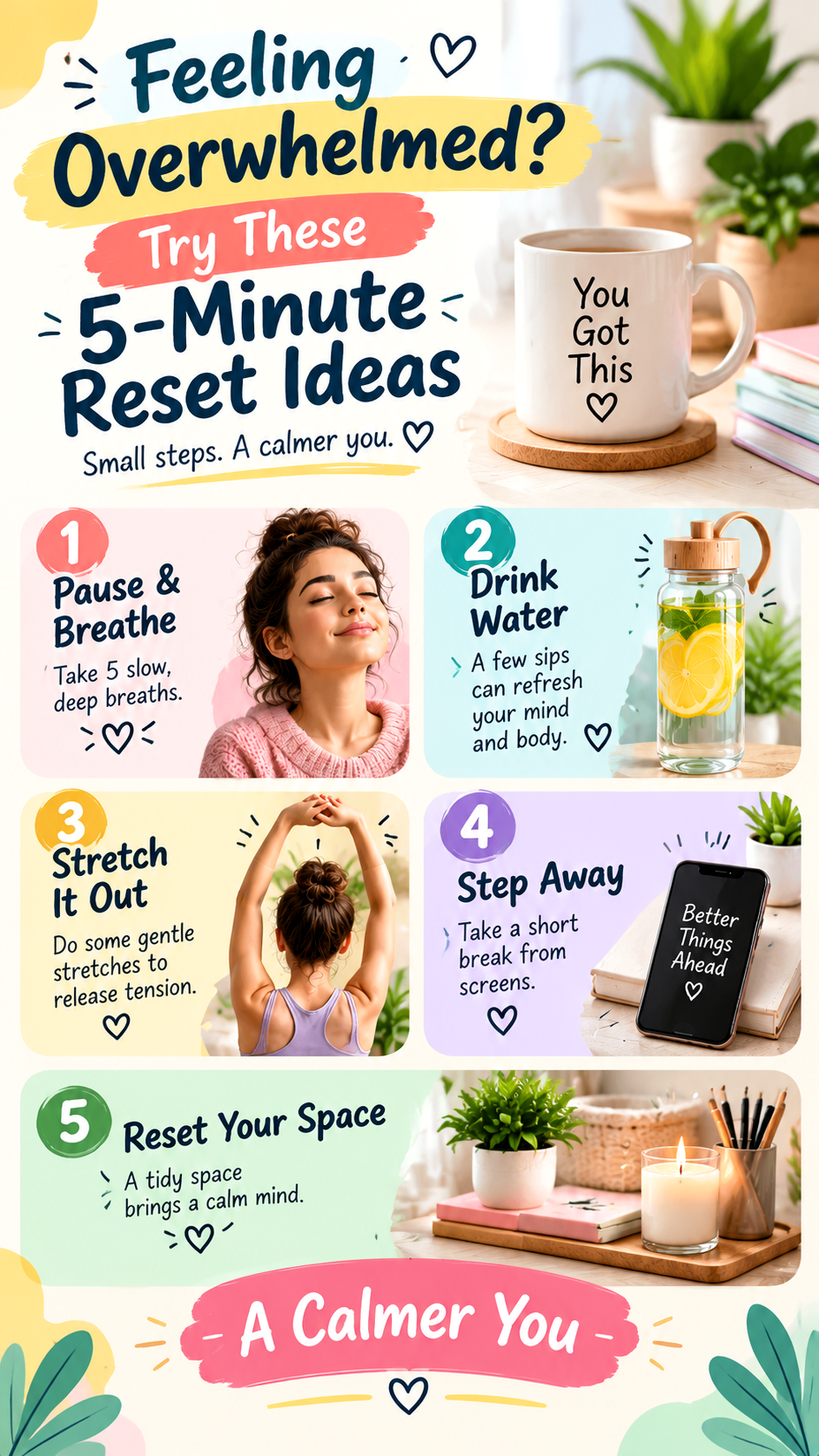
Feeling Overwhelmed Try This 5-Minute Self-Care Reset for a Calmer Mind
Feeling overwhelmed by a busy schedule, endless notifications, or a mind that refuses to slow down? Sometimes, the best way to feel better is to take a few minutes for yourself. A simple five-minute self-care reset can help you pause, breathe, and reconnect with what your mind and body need. You do not need an elaborate wellness routine, expensive products, or an entire afternoon off. A few small, intentional actions can make your day feel more manageable.
Whether you are working through a stressful morning, feeling mentally exhausted, or simply craving a little peace, these easy self-care ideas offer a gentle way to reset. From taking slow breaths and drinking water to stretching, stepping away from screens, tidying a small space, and practicing positive self-talk, each step encourages you to slow down and give yourself some kindness.
Key Takeaways
- Take five slow, comfortable breaths to create a moment of calm.
- Drink a glass of water and give your body a refreshing pause.
- Stretch gently to release everyday stiffness and tension.
- Step away from screens to reduce distractions and reconnect with the present.
- Tidy one small area to create a more peaceful environment.
- Replace harsh self-criticism with a kind, realistic reminder that you are doing your best.
Why a Five-Minute Self-Care Reset Can Make a Difference
When life feels overwhelming, it is easy to believe that you need to solve every problem before you can relax. You might keep working through your to-do list, scroll through your phone for a distraction, or push aside your own needs because something else seems more urgent.
Unfortunately, ignoring your need for a break can leave you feeling even more drained. A short self-care reset offers a different approach. Instead of trying to fix everything at once, you deliberately pause and choose one or two small actions that support your well-being.
Five minutes will not eliminate every source of stress, and it does not need to. The purpose is to interrupt the rush of the moment, notice how you feel, and give yourself a little room to respond more thoughtfully.
Remember: Self-care does not have to be complicated to be worthwhile. Small actions, repeated regularly, can help you build a more supportive relationship with yourself and make everyday stress feel easier to manage.
Think of this five-minute routine as a gentle reminder that your needs matter, even on the busiest days. You can use it at your desk, during a lunch break, before starting a difficult task, or whenever you notice that you need to slow down.
1. Pause and Breathe to Calm Your Mind
The first step is simple: stop what you are doing, if it is safe and practical, and bring your attention to your breathing. When you have a lot on your mind, you may move from one task to another without noticing how tense or hurried you feel.
A few slow, comfortable breaths can give you a moment to step out of that automatic pattern. You do not have to empty your mind or force yourself to feel relaxed. Simply pay attention to the air moving in and out.
How to Practice a Five-Breath Reset
- Find a comfortable position, either sitting or standing.
- Relax your shoulders and unclench your jaw.
- Breathe in gently through your nose if comfortable.
- Exhale slowly without forcing the air out.
- Repeat for five comfortable breaths, keeping your attention on the present moment.
As you breathe, you might silently say, “Inhale peace, exhale stress.” Treat this phrase as a gentle reminder rather than a demand to make every difficult feeling disappear.
Make Breathing a Daily Habit
Try pairing mindful breathing with an activity you already do, such as sitting down at your desk, waiting for the kettle to boil, or preparing for bed. These small pauses can make it easier to remember your self-care routine without adding another complicated task to your schedule.
If focusing on your breathing makes you uncomfortable or light-headed, return to your natural breathing pattern and try grounding yourself by noticing your surroundings instead.
2. Drink Water and Give Your Body a Refreshing Pause
When you are busy or distracted, basic needs can easily slip down your priority list. You may spend hours concentrating on work, caring for others, or managing errands without stopping to get a drink.
Taking a moment to drink water is a practical way to reconnect with your body. Keep a glass or reusable water bottle nearby and take a few comfortable sips when you begin your reset.
Staying adequately hydrated supports normal bodily functions, and drinking water can be a useful reminder to pause and check in with yourself. If you enjoy flavored water, try adding a slice of lemon or a few pieces of cucumber for a fresh taste.
Create a Simple Hydration Routine
- Place a water bottle where you can easily see it.
- Take a few sips when transitioning between tasks.
- Drink water with meals and snacks.
- Pay attention to thirst and follow any fluid guidance provided by your healthcare professional.
You do not need to turn hydration into another goal to achieve perfectly. The idea is to make caring for your body convenient and approachable.
3. Stretch Gently to Release Everyday Tension
Stress can show up physically. You might notice raised shoulders, a stiff neck, tight hands, or a back that feels uncomfortable after sitting for a long time. A short stretching break can help you change positions, move your body, and notice areas that feel tense.
You do not need a full workout or a dedicated exercise space. A few gentle movements are enough to introduce a little movement into your day.
Try These Easy Desk-Break Stretches
- Shoulder rolls: Slowly roll your shoulders backward several times, then relax them.
- Neck release: Gently tilt your head from side to side without pulling or forcing the movement.
- Overhead reach: Raise your arms comfortably above your head and lengthen your torso.
- Standing movement: Stand up, take a few steps, and let your body move naturally.
- Gentle wrist stretches: Move your wrists slowly if they feel stiff after typing.
Move at a comfortable pace and avoid bouncing or pushing into pain. If a movement causes discomfort, stop or choose a gentler alternative.
Pro Tip: You do not need to wait until you feel completely exhausted to take a movement break. A few gentle stretches between tasks can help you create a more balanced workday and remind you to pay attention to your physical comfort.
4. Step Away From Screens and Reconnect With Yourself
Phones, computers, and tablets are part of everyday life, but constant screen exposure can make it difficult to notice when you need a break. Messages, emails, social media updates, and reminders compete for your attention throughout the day.
When you feel overwhelmed, consider putting your phone aside for a few minutes. Turn the screen face down, silence nonessential notifications, or move to a quiet spot where you can take a break from digital distractions.
This is not about abandoning technology or feeling guilty about using your devices. It is about choosing when to engage with them instead of feeling that you must respond to everything immediately.
What to Do During a Screen-Free Break
- Look outside and notice the colors, shapes, and movement around you.
- Walk around your home or office for a minute or two.
- Listen to calming music without checking your phone.
- Enjoy a quiet drink without scrolling.
- Spend a few moments noticing how you feel without immediately reaching for a distraction.
If you cannot step away from a screen because of work or caregiving responsibilities, try a smaller change. Close unnecessary tabs, silence nonurgent alerts, or look away from the display for a brief visual rest.
Give Yourself Permission to Be Offline
You do not need to be available every moment of the day. Where possible, establish small boundaries around checking messages and social media. Even a short screen-free pause can create space for a more intentional choice about what deserves your attention next.
5. Reset Your Space for a Clearer Mind
Your surroundings can influence how comfortable and focused you feel. When your desk is covered with papers, your bedside table is cluttered, or your workspace feels chaotic, it may be harder to settle into a task.
You do not have to organize your entire home to create a calmer environment. Instead, choose one small area and give yourself a few minutes to make it feel more manageable.
The Five-Minute Tidy-Up
- Choose one surface, such as your desk, nightstand, or bedside table.
- Remove items that do not belong there.
- Put away a few things you use regularly.
- Wipe the surface if needed.
- Add one small item that makes the space pleasant, such as a plant, a favorite notebook, or a neatly arranged pen.
The goal is not perfection. You are simply creating a little order in one part of your environment so that your next activity feels easier to begin.
Make Your Space Work for You
Keep the items you need most within easy reach. Use a small basket for loose belongings, place frequently used supplies together, or clear your bedside table so your evening routine feels less rushed.
A tidy space will not solve every source of stress, but it can remove a few unnecessary distractions. Think of it as a practical act of kindness toward your future self.
Why This Matters
A self-care reset works best when it feels supportive rather than demanding. You are not trying to transform your mood, body, or home in five minutes. You are making a little room for yourself in the middle of ordinary life.
- Choose one small action instead of tackling everything at once.
- Adjust the routine to your energy level and circumstances.
- Celebrate showing up for yourself, even when the action feels small.
6. Say Something Kind to Yourself
One of the most valuable parts of a self-care routine is the way you speak to yourself. When you feel overwhelmed, your inner voice may become critical. You might tell yourself that you should be doing more, that you are falling behind, or that you are not handling things as well as everyone else.
These thoughts can make a difficult moment feel even heavier. Practicing kinder self-talk gives you an opportunity to respond to yourself with the same patience you might offer a friend.
You do not have to pretend that everything is perfect. Self-compassion means acknowledging that something is hard while recognizing that you deserve care and respect as you work through it.
Positive Self-Care Affirmations to Try
Choose a phrase that feels comforting and realistic. Repeat it silently, write it in a journal, or place it somewhere you will see throughout the day.
- “I am doing the best I can with what I have today.”
- “I am allowed to take a break.”
- “I do not have to solve everything right now.”
- “Small steps still count.”
- “I deserve kindness, including from myself.”
- “Rest is part of caring for myself.”
Create a Personal Reminder
Write your favorite affirmation on a sticky note, in your planner, or on a card beside your desk. You might choose a phrase such as “You are enough” or “One thing at a time.” The best reminder is one that feels meaningful to you rather than one that creates pressure to be positive all the time.
If you are having a difficult day, you can acknowledge that reality while still offering yourself encouragement. For example, “Today is challenging, and I can take it one step at a time” may feel more believable than insisting that everything is wonderful.
How to Combine All Six Steps Into a Five-Minute Routine
Now that you have six simple self-care ideas, you can turn them into a short routine that fits your day. The following schedule offers a starting point. Feel free to adjust the timing or skip a step when another action better meets your needs.
Your Five-Minute Self-Care Reset
Minute 1: Pause and breathe
Take five slow, comfortable breaths and relax your shoulders.
Minute 2: Hydrate
Drink some water and give yourself a moment to check in with your body.
Minute 3: Move gently
Stretch your arms, roll your shoulders, or take a few comfortable steps.
Minute 4: Reset your surroundings
Put away a few items or take a short break from your screen.
Minute 5: Offer yourself kindness
Choose one encouraging affirmation and decide on your next small step.
This schedule is flexible. If you have only two minutes, focus on breathing and hydration. If you need more movement, spend longer stretching. You can also save the space-clearing step for later and use the time to sit quietly instead.
The most important part is choosing a reset that feels doable. A routine that fits your real life is more useful than an ideal routine you feel unable to maintain.
When to Use Your Quick Self-Care Reset
You can practice this five-minute self-care routine whenever you notice that you need a pause. Connecting it to familiar moments can make it easier to remember.
During a Busy Workday
Use the reset between meetings, after completing a demanding task, or before beginning something that requires concentration. A short break can help you transition from one responsibility to another with greater intention.
When Your To-Do List Feels Too Long
Instead of trying to tackle every task at once, pause and identify the next manageable action. You might answer one important email, prepare the materials for a task, or write down three priorities. Breaking work into smaller steps can make it feel less intimidating.
After Too Much Screen Time
Step away from your device, stretch, drink water, and look at something in the distance. This can be a useful transition before returning to your work or moving into an offline activity.
At the End of the Day
Use the routine to shift from work mode to personal time. Tidy your bedside table, write down any tasks you want to remember for tomorrow, and choose a kind reminder to carry into the evening.
If feelings of stress or overwhelm are persistent, interfere with daily life, or become difficult to manage, a short self-care routine may not be enough on its own. Consider reaching out to a qualified healthcare or mental health professional for additional support.
How to Make Self-Care a Sustainable Daily Habit
Starting a self-care routine is often easier than maintaining one. The trick is to make it simple enough that you can return to it without feeling guilty when life gets busy.
Start Small and Stay Flexible
Do not worry about completing every step perfectly. Choose one action that feels helpful and begin there. On some days, that might mean taking a few deep breaths. On other days, it might mean stepping outside or putting your phone away for a moment.
Connect Self-Care to Existing Habits
Attach your reset to something already included in your daily routine. Take a few breaths before opening your laptop, stretch after finishing lunch, or tidy your bedside table before going to sleep. Habit pairing makes self-care easier to remember because you do not have to create a completely new schedule.
Prepare a Small Self-Care Space
Keep a few useful items together, such as a water bottle, notebook, pen, or encouraging affirmation card. You could also create a comfortable corner with a cushion and a book. Your setup does not need to be elaborate. It simply needs to make pausing and taking care of yourself a little easier.
Notice What Actually Helps
After your reset, ask yourself one simple question: “What would help me most right now?” Perhaps you need to continue with a task, take a longer break, ask someone for help, or postpone something that can wait.
Over time, paying attention to your needs can help you build a more personal self-care routine. The aim is not to follow a perfect checklist but to become more responsive to what supports your well-being.
Quick Points: Your Self-Care Reset at a Glance
- Breathe: Pause and take five comfortable, slow breaths.
- Hydrate: Drink water and check in with your body’s needs.
- Move: Stretch gently or walk around for a moment.
- Reconnect: Take a screen break or tidy one small space.
- Be kind: Remind yourself that you deserve patience, rest, and support.
Conclusion: Small Steps Can Help You Find a Little More Calm
When you feel overwhelmed, you do not have to wait for a quiet weekend or a completely empty schedule to practice self-care. You can begin with five minutes and a few simple choices that support your mind, body, and surroundings.
Pause and breathe. Drink some water. Stretch your body. Step away from your screen. Reset a small space. Say something kind to yourself. Each action offers a practical reminder that you are allowed to slow down and pay attention to your needs.
Some days, you may notice an immediate sense of relief. On other days, the reset may simply help you recognize what you need next. Both outcomes are worthwhile. Self-care is not about forcing yourself to feel happy or productive all the time. It is about treating yourself with patience while navigating the realities of everyday life.
Keep this five-minute self-care reset somewhere easy to find, such as your Pinterest self-care board, journal, or daily planner. Return to it whenever you need a gentle reminder to pause. You do not have to do everything at once, and you do not have to earn the right to rest.
Start with one small step today. A calmer moment, a kinder thought, and a little time for yourself can be a meaningful place to begin.
Tags
Five-Minute Self-Care
Stress Relief
Mindfulness
Daily Self-Care
Mental Wellness
Self-Care Routine
Positive Affirmations
Calm Mind