How to Stop Being Lazy Brain Science Tips to Take Action Get Motivated
Have you ever stared at a task you know you need to complete but still feel unable to begin? That frustrating feeling is often called laziness, but the reality is much more complex. What appears to be a lack of effort is frequently connected to how your brain processes motivation, energy, uncertainty, and rewards.
Understanding the brain science behind laziness can completely change the way you approach productivity. Instead of blaming yourself for not taking action, you can learn how your mind works and use practical strategies to create momentum, improve focus, and build better habits.
Key Takeaways
- Laziness is often a temporary mental state, not a permanent personality trait.
- Your brain evaluates effort, reward, uncertainty, and available energy before taking action.
- Small steps can reduce resistance and make difficult tasks feel easier.
- Clarity and consistent routines are more powerful than waiting for motivation.
- Understanding procrastination helps you replace guilt with effective strategies.
The Real Reason You Feel Lazy
Many people describe themselves as lazy when they are actually experiencing mental resistance. The brain is designed to conserve energy and avoid unnecessary discomfort. When a task feels overwhelming, unclear, boring, or emotionally difficult, your brain may naturally create hesitation.
This does not mean you lack ambition or discipline. It means your brain is responding to the way it interprets the situation. A large project with no clear starting point can feel much harder than a small, specific action.
Important: Feeling lazy is often a signal that something needs attention. The problem may be unclear goals, low energy, fear of failure, or too much mental pressure rather than a lack of character.
How Your Brain Decides Whether to Take Action
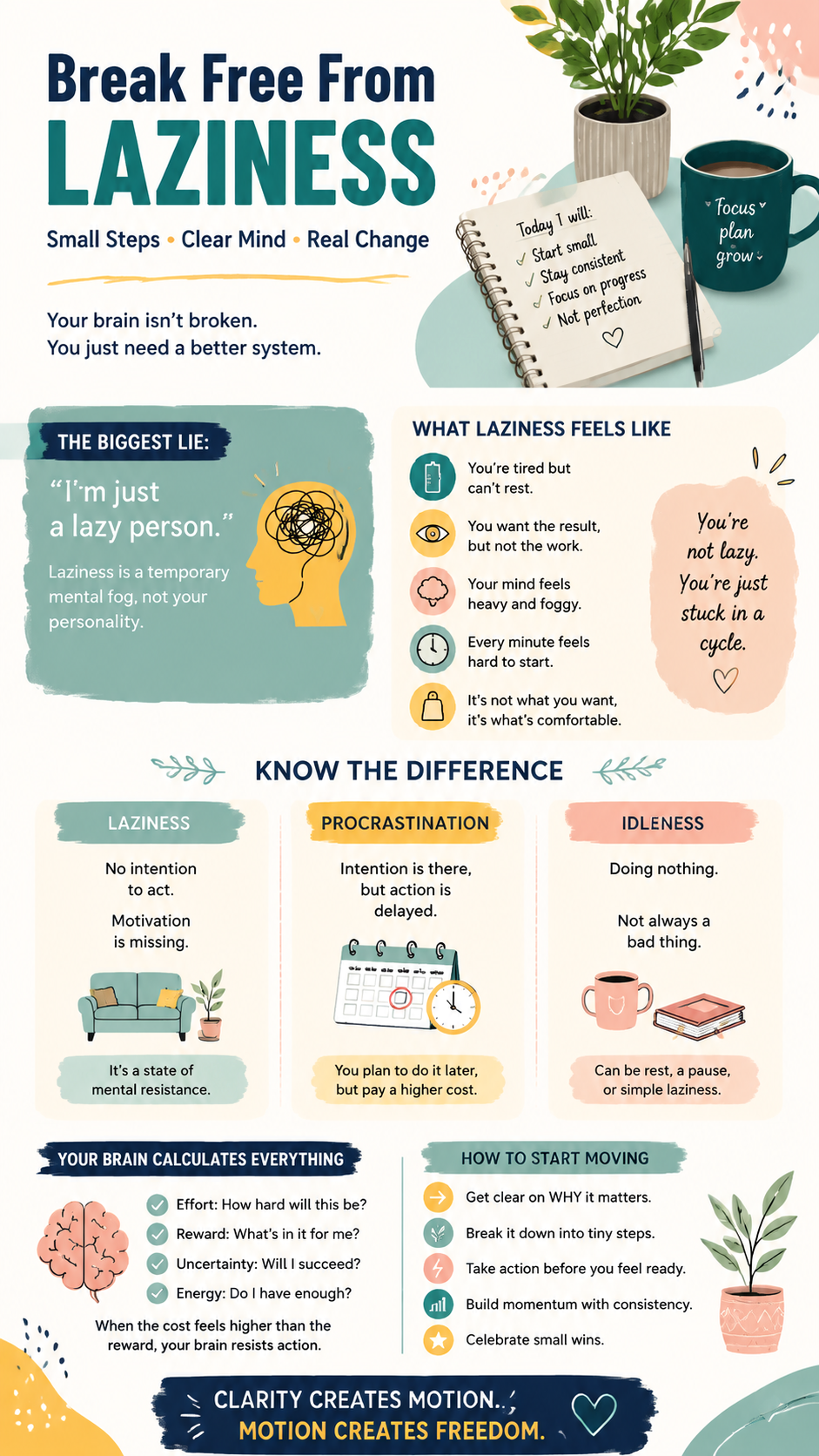
Before you begin any task, your brain performs a quick internal calculation. It considers how much effort is required, what reward you will receive, whether the outcome is predictable, and whether you have enough energy available.
The Effort and Reward Connection
Your brain naturally prefers actions that provide a meaningful reward with reasonable effort. If a task feels difficult but the benefit seems far away, your motivation system may struggle to activate.
For example, exercising for five minutes today may not seem important when the goal is better health months from now. However, creating a visible connection between today’s action and your future result helps your brain recognize the value.
The Role of Dopamine in Motivation
Dopamine is often described as a motivation chemical because it plays an important role in anticipation, learning, and goal-directed behavior. It helps your brain notice opportunities and move toward rewards.
When tasks feel rewarding, interesting, or achievable, your brain is more likely to encourage action. When tasks feel confusing or unpleasant, your motivation may decrease.
Laziness vs Procrastination vs Rest: Understanding the Difference
Not every moment of inactivity means you are being lazy. Learning the difference between laziness, procrastination, and healthy rest can help you respond in a more productive way.
Laziness
Laziness is often described as having little desire to put effort into a task. However, it is usually connected to a temporary state rather than who you are as a person.
- You feel resistance toward starting.
- The task does not feel meaningful or urgent.
- Your energy or focus may be low.
Procrastination
Procrastination happens when you intend to complete something but delay taking action. Often, procrastination is connected to emotions such as fear, perfectionism, boredom, or uncertainty.
- You know what needs to be done.
- You keep choosing easier activities.
- You experience stress because the task remains unfinished.
Healthy Rest
Rest is not laziness. Your brain and body require recovery time to maintain energy and creativity. The goal is not constant productivity, but a healthy balance between action and recovery.
Simple Ways to Overcome Laziness and Start Moving
Overcoming laziness is not about forcing yourself through exhaustion. It is about creating conditions where action becomes easier. Small changes can help your brain shift from avoidance to movement.
1. Make Tasks Smaller
A large goal can create mental resistance. Breaking it into smaller steps lowers the perceived effort and gives your brain an easier entry point.
Instead of saying “I need to finish this entire project,” try saying “I will work on this for ten minutes.” Starting is often the hardest part, and small beginnings create momentum.
2. Create More Clarity
Unclear goals create hesitation. Your brain works better when it knows exactly what action comes next.
- Write down the first step.
- Remove unnecessary decisions.
- Prepare your environment before starting.
3. Take Action Before You Feel Ready
Many people wait for motivation before beginning. However, motivation often appears after action starts. Completing a small step can create the confidence needed for the next one.
4. Build Consistent Habits
Relying only on motivation can make productivity unpredictable. Habits reduce the amount of mental energy required to make decisions.
A simple routine, such as planning your day each morning or spending a few minutes organizing tasks, can make taking action feel more automatic over time.
Expert Insight
Your environment influences your behavior more than you may realize.
- A clean workspace can reduce distractions.
- A written plan can reduce uncertainty.
- Small wins can strengthen your motivation.
How to Train Your Brain for More Action
Building an action-oriented mindset takes practice. Every time you complete a small task, you teach your brain that starting is possible.
Focus on progress instead of perfection. A person who takes small consistent actions will usually move further than someone waiting for the perfect moment.
Celebrate completed steps, even small ones. Positive reinforcement helps your brain connect effort with satisfaction.
At a Glance: Building Momentum Every Day
- Start with the smallest possible action.
- Focus on clarity instead of pressure.
- Create routines that support your goals.
- Understand resistance instead of judging yourself.
Final Thoughts: You Are Not Defined by Laziness
Laziness is not a fixed identity. It is often a temporary state influenced by your thoughts, emotions, environment, and energy levels. Once you understand how your brain responds to effort and reward, you can begin making changes that feel realistic and sustainable.
The goal is not to become productive every second of the day. The goal is to understand yourself better, remove unnecessary barriers, and create a system that helps you move forward.
Small actions create confidence. Confidence creates momentum. Momentum creates lasting change.
Tags
Brain Science
Productivity Tips
Beat Procrastination
Motivation
Self Improvement
Healthy Habits